Why Do Driveways Crack, Sink or Develop Ruts?
Cracked, sunken or rutted driveway? Learn what causes common driveway problems and when repairs, reconstruction or replacement may be needed.
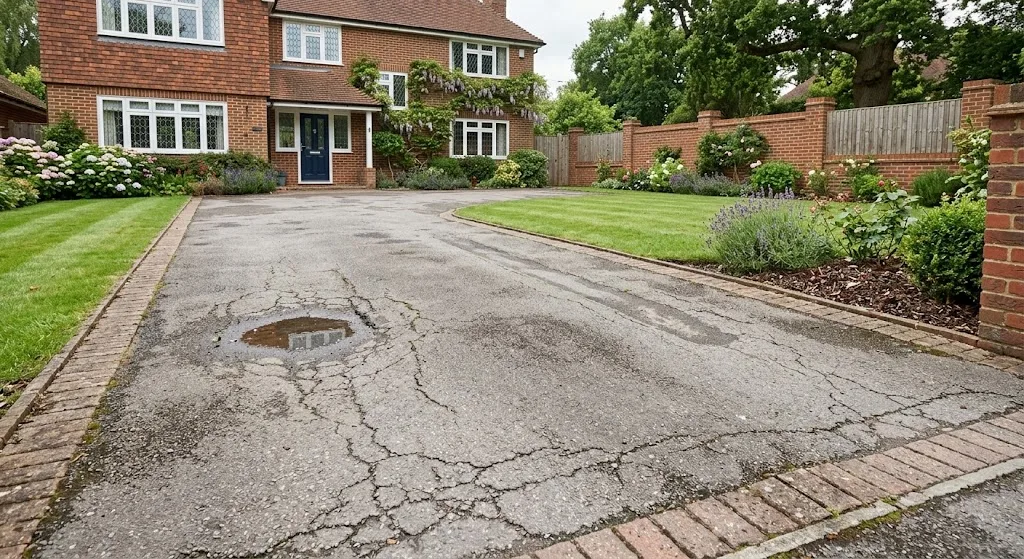
A driveway should provide a stable, durable surface for everyday parking and access. When problems start to appear, however, they can quickly become more than a cosmetic issue.
Cracks may spread across the surface, sections can begin to sink, or repeated vehicle tracks may form visible ruts. Sometimes the problem is limited to the surface, but in many cases the visible damage is a sign that something underneath has moved, weakened or been affected by water.
The cause can also depend on the type of driveway you have. Block paving, tarmac, concrete and resin-bound surfaces all behave differently when exposed to traffic, weather and ground movement.
Understanding what is causing the problem is the first step towards deciding whether the driveway needs a small repair, partial reconstruction or complete replacement.
Why Do Driveways Crack?
Cracking can happen for several reasons, and the appearance of the crack can provide clues about what is happening underneath.
Ground Movement
The ground beneath a driveway is not completely static.
Soil can expand and contract as moisture levels change, while areas of filled or disturbed ground may settle over time. Clay-rich soils can be particularly prone to movement because they can swell when wet and shrink during dry conditions.
When the ground moves unevenly, rigid surfaces are placed under stress.
This can result in cracks forming in concrete, tarmac and other driveway surfaces.
Poor Ground Preparation
A driveway relies on a properly prepared foundation to spread vehicle loads across the ground.
If the underlying construction is insufficient, poorly compacted or unsuitable for the conditions of the site, movement can eventually transfer to the surface.
This can appear as:
Cracks
Depressions
Uneven areas
Open joints
Loose paving
The visible surface may therefore not be the original cause of the problem.
Water and Drainage
Water is one of the biggest contributors to driveway deterioration.
If water collects on or beneath the driveway, it can affect the supporting ground and contribute to settlement. Persistent moisture can also make existing weaknesses more noticeable.
Poor drainage may show itself through recurring puddles, soft areas or deterioration concentrated around particular sections of the driveway.
For conventional driveway construction, managing surface water is particularly important because water that cannot drain away can remain within the construction layers.
Heavy Vehicle Loads
A driveway designed around normal domestic cars may experience problems if it regularly carries heavier vehicles.
Repeated loading from vans, larger SUVs, motorhomes or delivery vehicles can place greater stress on the surface and supporting layers.
This does not mean heavier vehicles automatically damage a driveway. The important factor is whether the driveway was designed and constructed to accommodate the loads it receives.
Age and General Wear
Driveways do not last forever.
Over time, repeated traffic, weather exposure and normal deterioration can gradually weaken the surface. Older tarmac may become brittle, concrete may develop cracking and block paving can lose its original appearance.
Small signs of ageing do not necessarily mean replacement is required, but widespread deterioration can indicate that the driveway is approaching the end of its useful life.
Why Do Driveways Sink?
A sunken driveway is usually easier to notice than minor cracking because the surface level visibly changes.
You may notice a low area where rainwater collects, a section that dips beneath the car or paving that appears lower than the surrounding driveway.
Settlement Beneath the Surface
One of the most common causes of sinking is settlement within the ground or driveway construction.
If material beneath the finished surface has not been adequately compacted, it can continue to settle after installation.
This is particularly important where the driveway has been constructed over:
Recently filled ground
Former garden beds
Excavated areas
Trenches
Previously disturbed soil
As the supporting material settles, the surface above follows it.
Leaking Pipes or Drainage
A hidden drainage or water leak can sometimes cause localised sinking.
Persistent water movement beneath a driveway can wash fine material away or weaken the surrounding ground, potentially creating a void beneath the surface.
This can produce a very specific pattern: one area sinks while the surrounding driveway remains relatively level.
If a depression appears close to an inspection chamber, drainage route or service line, the underlying infrastructure may need to be investigated before simply rebuilding the surface.
Tree Root Activity
Trees can influence the ground around a driveway, particularly where mature trees are growing close to paved areas.
Roots can alter the surrounding soil and, in some situations, cause localised lifting or movement. As soil conditions change, the affected area can become uneven.
This does not mean a tree should automatically be removed because a driveway has moved near it. The tree, roots, ground conditions and driveway should all be considered together.
Poor Edge Support
Block paving depends partly on effective edge restraint.
If the edges of the driveway begin to move outward, individual blocks can shift and the surface may gradually lose its original shape.
This can create gaps between blocks, movement around the perimeter and local depressions.
In some cases, the problem appears to be a few loose blocks when the real issue is movement at the edge of the driveway.
Why Do Driveways Develop Ruts?
Rutting is slightly different from general sinking.
Instead of one isolated depression, you usually see long, repeated channels following the path of vehicle wheels.
This is often caused by repeated loading along the same tracks.
Repeated Vehicle Traffic
Most cars enter and leave a driveway through the same route every day.
Over thousands of journeys, this concentrates the load into the same areas. If the underlying construction is strong and well-supported, the driveway can cope with this use. If the supporting layers are weak or have settled, the repeated wheel paths can gradually deform.
The result is two visible tracks where vehicles regularly travel.
Insufficient Support
Rutting can occur when the driveway does not have enough structural support for the loads placed upon it.
A surface can look perfectly good immediately after installation but begin deforming later if the layers underneath have not been properly prepared or compacted.
Ruts can therefore be a useful warning sign that the issue is not simply the visible finish.
Heavy or Repeated Use
Driveways used frequently by heavier vehicles can be more vulnerable to rutting.
A domestic driveway that normally accommodates one family car may experience much greater stress if it becomes a regular route for commercial vans or other heavy vehicles.
When planning a new driveway, future use should therefore be considered rather than designing only around what is parked there today.
How Different Driveway Surfaces Can Fail
The type of driveway material affects the way problems appear.
Driveway type | Common problems |
|---|---|
Block paving | Sinking, movement, spreading, uneven blocks |
Tarmac | Cracking, edge failure, rutting and surface deterioration |
Concrete | Cracking, settlement and surface damage |
Resin bound | Cracking or unevenness where the supporting surface moves, plus local surface damage |
Block Paving
Block paving is made from individual units, so movement often appears as loose, uneven or sunken blocks rather than one large crack.
Localised repairs can sometimes be possible when the surrounding construction remains sound.
Tarmac
Tarmac can develop fine surface cracking as it ages, while deeper cracks, depressions and wheel-path deformation can indicate more substantial problems below the surface.
Concrete
Concrete is relatively rigid, so ground movement or stresses within the slab can result in visible cracking.
The pattern and extent of the cracks matter. A few isolated hairline cracks are different from large cracks accompanied by movement or settlement.
Resin Bound
Resin-bound surfacing depends heavily on the stability of the surface beneath it.
The aggregate and resin may remain intact, but movement in the supporting construction can eventually become visible at the finished surface.
This is one reason the preparation beneath the finish is so important.
How Can You Tell How Serious the Problem Is?
Not every crack or uneven section means the driveway needs to be completely replaced.
Some useful warning signs include:
Small surface cracks
Fine cracks on an otherwise stable, level driveway may be relatively minor, particularly on an older surface.
Cracks with movement
Cracks accompanied by sinking, lifting or widening deserve more attention because the issue may extend below the surface.
Recurring puddles
Water repeatedly collecting in exactly the same location can indicate a low spot or drainage problem.
Loose or rocking paving
A few loose blocks may be repairable, but widespread movement can indicate a larger issue.
Long wheel-path depressions
Visible ruts following the normal route of vehicles may indicate repeated loading and deformation beneath the surface.
Edge movement
A driveway that is beginning to spread at its edges may have a problem with restraint or supporting construction.
Can a Cracked or Sunken Driveway Be Repaired?
Sometimes.
The right repair depends on why the damage occurred.
Localised damage
If one small section has settled because of a specific problem, it may be possible to remove the affected section, address the cause and rebuild that area.
Surface-level damage
Some deterioration can be treated at the surface where the supporting construction remains sound.
Structural failure
If large areas have sunk, cracked or deformed because of problems beneath the surface, simply repairing the visible finish may only provide a temporary solution.
In those situations, the affected area may need to be taken apart and reconstructed.
The important principle is simple:
Repair the cause, not just the symptom.
When Does a Driveway Need Replacing?
Replacement may be considered when the damage is widespread or the driveway has reached the end of its useful life.
Signs that replacement may be more appropriate include:
Cracking across large areas
Widespread settlement
Extensive rutting
Repeated repairs
Serious drainage problems
Significant edge failure
A deteriorated surface throughout the driveway
A driveway that requires constant patching can eventually become more expensive and frustrating to maintain than addressing the underlying problems properly.
Can Drainage Prevent Driveway Problems?
Good drainage can help protect a driveway from water-related deterioration.
The design should consider where rainfall will travel, where it can collect and whether the surface and underlying construction can deal with that water appropriately.
Depending on the site, solutions can include:
Suitable falls
Drainage channels
Permeable surfacing
Soakaway systems
Other site-specific drainage arrangements
There is no universal drainage solution because soil, levels and the design of the driveway all differ.
The important part is to think about water before the driveway is built rather than waiting for puddles to appear afterwards.
What About Driveways on Clay Soil?
Clay presents some additional challenges because its volume can change with moisture.
During wetter periods, clay can swell. During prolonged dry weather, it can shrink.
Where a driveway is constructed over soils that are susceptible to movement, the design and ground preparation need to take those conditions into account.
This is particularly relevant where there are mature trees nearby, as both roots and changing soil moisture can influence ground movement.
A driveway on clay is not necessarily a problem. It simply needs to be designed with the site conditions in mind.
How Can Driveway Problems Be Prevented?
Prevention starts before the finished surface is installed.
Proper site assessment
Understanding the existing ground, levels, access and drainage helps identify potential problems before construction.
Appropriate ground preparation
The supporting construction needs to be suitable for the soil and expected vehicle loading.
Effective compaction
Materials used beneath the surface need to be installed and compacted correctly rather than simply spread and left to settle naturally.
Suitable drainage
Water should have an appropriate route away from the driveway and surrounding structures.
Correct surface specification
The chosen material should be suitable for the intended use and site.
Good edge restraint
For block paving in particular, secure edges help prevent the paving from spreading under traffic.
Does the Driveway Material Make a Difference?
Yes, but material is only one part of the equation.
It is easy to assume that choosing a particular surface will automatically prevent problems. In reality, even high-quality paving or surfacing can fail if the site has not been prepared properly.
A durable driveway depends on the relationship between:
Ground conditions → Preparation → Drainage → Supporting layers → Surface → Maintenance
A strong surface installed over an unsuitable foundation can still develop problems.
Conversely, a well-designed construction using a suitable material can provide many years of reliable service.
What Should You Do If Your Driveway Has Started Moving?
If you have noticed cracking, sinking or rutting, avoid simply covering the affected area without understanding what caused it.
Start by looking at the pattern.
Does the problem occur along wheel paths? Is one corner sinking? Are cracks appearing around the edge? Does water collect in the same place?
These details can help identify whether the issue is likely to be surface deterioration, settlement, drainage, ground movement or a combination of problems.
For a significant or recurring problem, having the driveway assessed before deciding on a repair is often the most sensible approach.
Cracks, Sinking and Ruts Are Usually Signs of a Wider Problem
A driveway does not normally become uneven for no reason.
Cracking, sinking and rutting can all be linked to factors such as ground movement, water, repeated loading, ageing and problems within the supporting construction.
The visible damage is therefore only part of the story.
A small repair may be enough where the problem is localised and the surrounding driveway remains sound. Where movement is widespread or keeps returning, rebuilding or replacing the affected areas may be more appropriate.
The key is to identify why the driveway has failed before deciding how to fix it.
Need Driveway Help in Surrey?
If your driveway has started cracking, sinking or developing ruts, understanding the cause is the first step towards finding the right solution.
Surrey Oak Landscapes can help with driveway design, groundworks, drainage and installation, from assessing an existing problem to creating a completely new driveway.
Concerned about your driveway in Surrey? Get in touch with Surrey Oak Landscapes for a free, no-obligation quote.
About the author