What Is Stump Grinding and What Happens Afterwards?
What happens after a tree stump is ground? Learn how stump grinding works, what happens to the remaining roots and how the area can be prepared for lawn, planting or paving.
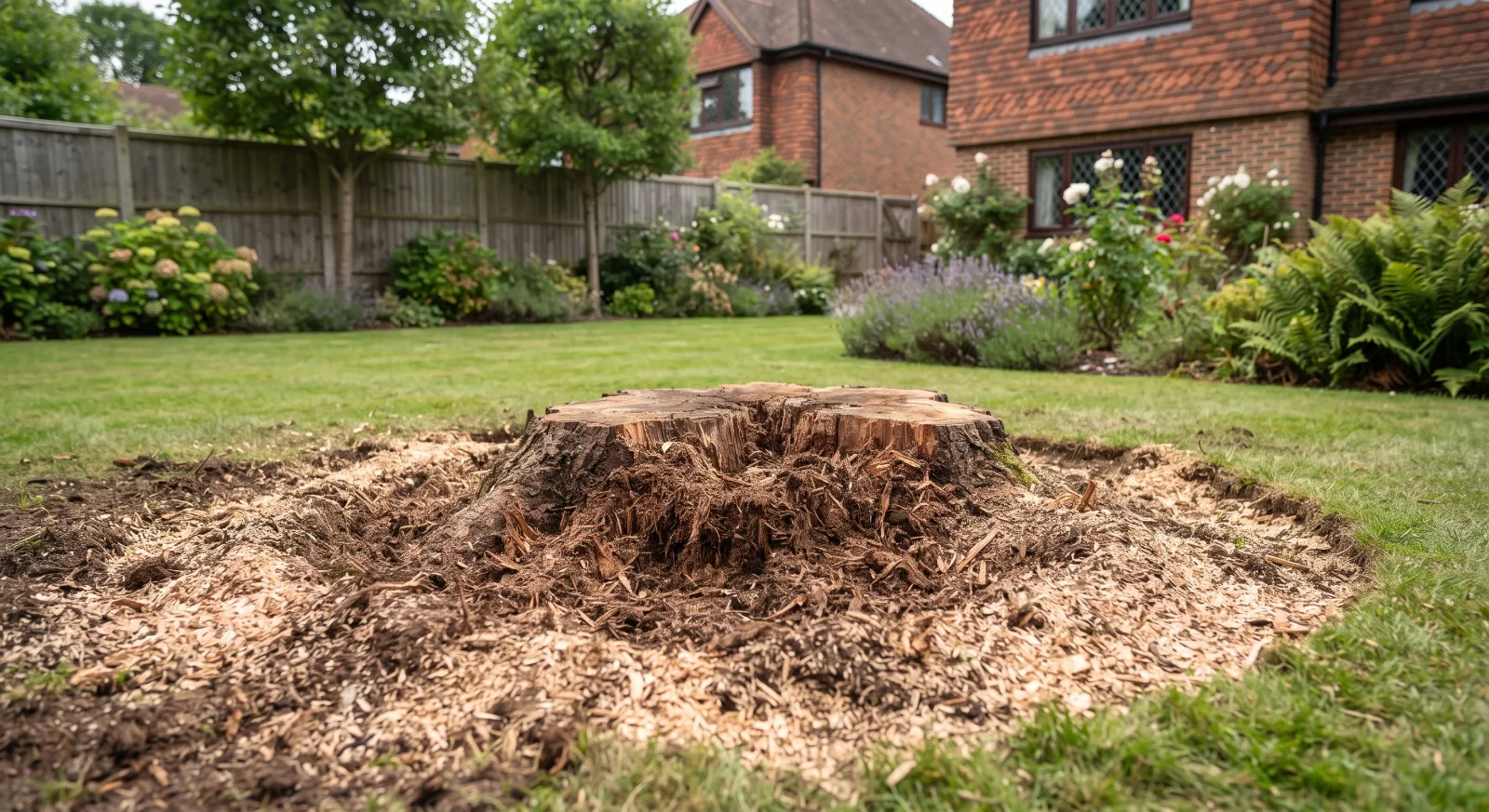
Removing a tree from a garden does not always mean the job is finished once the trunk and branches have been taken away.
In many cases, a remaining tree stump is left behind. It can take up valuable space, make mowing difficult, become an obstacle in a planting bed and prevent the area from being properly landscaped.
Stump grinding is one of the most common ways of dealing with a remaining stump. Instead of digging the entire stump and root system out of the ground, a specialist machine grinds the stump and part of the surrounding root plate into small wood chips.
The process is generally much less disruptive than excavating a large stump, but what happens afterwards is just as important.
So, how does stump grinding work, and what can you do with the area once the stump is gone?
What Is Stump Grinding?
Stump grinding involves using a specialist machine fitted with a rotating cutting wheel to gradually grind a tree stump below the surrounding ground level.
The machine removes the timber in layers, producing a mixture of wood chips and sawdust.
Unlike full stump removal, the main aim is not to extract every root from the ground. Instead, the visible stump and a portion of the root plate are reduced far enough below the surface that the area can be made usable again.
The depth required depends on what you plan to do with the space.
For example, a relatively shallow grind may be sufficient where the area will simply be turfed over, while deeper grinding may be more appropriate where a new planting bed, structure or other landscaping is planned. The RHS notes that around 20–25cm below ground level is normally sufficient for laying turf, while deeper grinding of at least around 30cm may be needed for replanting or landscaping.
How Does Stump Grinding Work?
Although the exact process varies depending on the stump and site, it generally follows a straightforward sequence.
1. Assessing the Site
Before grinding begins, the stump and surrounding area need to be assessed.
This includes looking at:
Stump size
Root spread
Access for machinery
Nearby paving or structures
Sloping ground
Fences and boundaries
Underground services where relevant
The condition and location of the stump can affect which machine is suitable and how the work is carried out.
2. Preparing the Area
The area around the stump is cleared of loose objects and anything that could interfere with the machine.
Where access is restricted, the equipment used may need to be selected carefully to avoid unnecessary damage to the surrounding garden.
3. Grinding the Stump
The cutting wheel is gradually moved across the stump, reducing it into wood chips.
The machine works from the top of the stump downwards and can also be used to reduce part of the larger root plate close to the surface.
4. Clearing the Waste
Grinding creates a significant amount of wood chip and sawdust.
Depending on the agreed work, this material may be removed from the site or left for appropriate reuse.
5. Preparing the Ground
Once the stump has been ground down, the remaining material and loose debris are cleared so the area can be prepared for its next use.
Stump Grinding vs Stump Removal
Stump grinding and stump removal are not the same thing.
Stump grinding | Full stump removal |
|---|---|
Grinds the stump below ground level | Extracts the stump and major roots |
Usually less ground disturbance | Requires more excavation |
Faster for many situations | Can be more labour-intensive |
Leaves roots in the ground | Removes much more of the root system |
Good for turfing and many landscaping projects | Useful where deeper excavation is needed |
For many garden projects, grinding is the more practical option because you do not necessarily need to excavate the entire root system.
However, there are situations where full removal makes more sense.
When Is Stump Grinding a Good Option?
Stump grinding can be particularly useful when the tree has already been removed and you want to reclaim the area.
It can be suitable where you want to:
Lay a New Lawn
A stump can make mowing awkward and prevent the area from being levelled properly.
Grinding it below the surface allows the ground to be repaired and prepared for new turf or seed.
Create a New Planting Bed
Grinding can clear the main stump without the extensive excavation involved in digging out a larger root system.
Install New Landscaping
If you are redesigning the garden, the stump may be directly in the way of a new patio, path, lawn or planting area.
Improve the Appearance of the Garden
Even where the stump is not causing a practical problem, removing it can make the garden feel cleaner and more finished.
When Might Full Stump Removal Be Better?
Grinding is not always the best solution.
Full removal may be preferable when the entire stump and a substantial amount of its root system need to be cleared from the ground.
This can be particularly relevant where:
A large structure is planned over the area
Deep excavation is required
A new tree needs to be planted in the same position
The remaining roots are likely to interfere with planned works
The stump is very large or unusually positioned
The correct choice depends on what you intend to do with the area afterwards.
What Happens to the Roots?
One of the most common misunderstandings about stump grinding is that all of the roots disappear immediately.
They do not.
The major stump and part of the root plate are ground down, but roots extending further into the surrounding soil can remain underground.
Over time, these remaining roots will naturally break down.
How quickly this happens depends on the size and condition of the roots, the soil and the surrounding conditions.
This is one reason why the area should be considered differently depending on whether you simply want a lawn or are planning something that requires deeper ground preparation.
What Happens to the Wood Chips?
After grinding, you will normally be left with a mixture of wood chips and sawdust.
This material can be handled in several ways.
Removal
The chips can be cleared and taken away as part of the tree surgery work.
Reuse
Some clean wood chip from healthy trees can potentially be used elsewhere in the garden as a surface mulch or incorporated into suitable garden-waste processes.
However, large quantities of fresh woody material should not simply be dug into a planting area. Woody material can temporarily affect the availability of nitrogen as it decomposes, which can create problems for new planting.
Leave Some Material on Site
Where appropriate, some wood chip can be left for later garden use, but this should be decided based on the wider project.
If the area is going to become a lawn or patio, clearing and preparing the ground properly is usually more useful than leaving a pile of chips behind.
What Happens to the Hole?
After grinding, the area may appear as a shallow depression filled with wood chips and fine material.
It needs to be properly prepared before you can reuse the space.
The exact process depends on what you plan to do next.
For a New Lawn
The remaining chips and loose material can be cleared, after which the area can be levelled using suitable topsoil before turf or seed is installed.
The RHS recommends filling the hole left by tree and stump removal with good-quality topsoil, compacting and levelling it, then allowing the area to settle before topping it up as necessary.
For Planting
Where the area is going to become a planting bed, the soil should be assessed and prepared properly rather than simply filling the depression with fresh wood chip.
This is particularly important where the previous tree had health problems or where the area has become compacted.
For Paving
If the area is going to become a patio, path or other hard surface, the stump and root area may require deeper preparation.
The required excavation will depend on the planned construction and the size and location of the former stump.
This is where it becomes particularly useful to know what the area will eventually be used for before deciding how deeply to grind the stump.
Can You Plant a New Tree in the Same Spot?
Sometimes, but it is not always the best approach.
The remaining roots from the original tree may continue to occupy space in the soil, and certain tree or plant problems can create additional concerns about replanting the same type of plant in the same location.
Where the previous tree died from a soil-borne disease, replanting decisions should be made carefully because some diseases can remain problematic in the soil.
For a simple ornamental replacement, it may be more practical to choose a new location or use a different planting approach.
If you do want another tree in roughly the same area, the condition of the soil, remaining roots and previous tree should be taken into account first.
Can the Stump Grow Back?
Some trees and woody plants can produce new shoots from remaining roots or the stump after cutting.
Grinding reduces the stump substantially, which can make regrowth less likely to be a practical problem, but it does not guarantee that every remaining root is incapable of producing growth.
Certain species are more prone to suckering than others.
Where regrowth does appear, it can usually be dealt with as part of ongoing maintenance. The important thing is to monitor the area rather than assuming that grinding means no further growth is possible.
How Long Does It Take for the Remaining Roots to Decay?
There is no universal timeframe.
A small network of roots can break down considerably faster than a large mature tree's root system.
The surrounding soil, moisture levels, temperature and size of the remaining wood all influence decomposition.
The important thing for homeowners is that you do not normally need to wait for every root to disappear before making the area useful again.
The visible stump can be ground below the required level, and the surface can then be rebuilt for its intended use.
Can You Lay Turf Straight After Stump Grinding?
The area should normally be prepared before turf is laid.
Simply spreading grass seed or turf over the fresh grinding material is unlikely to provide a suitable long-term growing medium.
The wood chips need to be cleared from the area that will become the lawn, followed by suitable soil preparation and levelling.
The finished ground level also needs to account for the material that will settle as the remaining woody matter decomposes.
This is why it is worth considering the full sequence:
Stump grinding → Clear chips → Prepare soil → Allow for settlement → Level → Lay turf
Can You Build a Patio Where a Tree Stump Was?
Potentially, yes, but the stump needs to be ground sufficiently and the ground then prepared for the proposed patio construction.
A patio needs a stable supporting structure, so simply hiding a stump beneath paving is not a solution.
Remaining roots and organic material can also become relevant if they are left within the area being built.
For a patio, the required preparation should therefore be determined by the construction specification rather than the stump alone.
If extensive excavation is already required for the project, full stump removal may sometimes be considered instead.
What If the Stump Is Close to a Fence or Wall?
Restricted locations can make stump grinding more complicated.
A stump close to a fence, wall, shed or other structure may provide less room for the grinding machine to operate.
The operator needs to work carefully around the surrounding property while still reaching enough of the stump to achieve the required depth.
Access is therefore one of the factors that should be considered when assessing the job.
What Happens If Access Is Difficult?
Garden access can have a significant effect on stump grinding.
A large rear garden with wide side access is very different from one where the only route is through a narrow passage.
The size of the stump grinder, protective measures for lawns and paving, and the amount of material that needs to be moved all need to be considered.
In difficult locations, a smaller machine may be more appropriate, although the exact equipment depends on the size of the stump and the work required.
Does Stump Grinding Damage the Garden?
Any machinery used in a garden has the potential to affect the surrounding area, particularly if the ground is wet or access is restricted.
The aim of a professional approach is to keep disruption as controlled as practical.
Protection may be needed over lawns, paths or other surfaces depending on the equipment and site.
The condition of the garden before work begins also matters.
A soft lawn during wet conditions may be more vulnerable to tracking or compaction than a firm, dry surface.
How Much Does Stump Grinding Cost?
There is no single price for stump grinding.
The cost can be affected by:
Stump diameter
Number of stumps
Required grinding depth
Root spread
Access
Ground conditions
Proximity to buildings or boundaries
Waste removal
Follow-on landscaping
A small, easily accessible stump can be a relatively straightforward job, while a large stump in a confined rear garden may require significantly more time and equipment.
For this reason, an assessment is normally more useful than estimating cost from stump size alone.
What Should Be Included in a Stump Grinding Quote?
Before agreeing to the work, check what the price actually covers.
A quote may include:
Item | What to check |
|---|---|
Stump grinding | How far below ground level |
Root plate | Whether visible major roots are included |
Waste | Removed or left on site |
Ground preparation | Included or separate |
Access | Any additional difficulty |
Site tidy-up | Whether chips and debris are cleared |
Follow-on landscaping | Turf, planting or paving priced separately |
This is particularly important if you intend to use the space immediately afterwards.
A quote for grinding alone can be very different from a complete service that includes clearing, topsoil and preparing the area for new landscaping.
What Should You Do After Stump Grinding?
The best next step depends on what you want to achieve with the space.
For a lawn
Clear the wood chips, add suitable topsoil, level the area and allow it to settle before completing the lawn.
For planting
Prepare the soil, check the condition of the area and choose plants appropriate to the conditions.
For paving
Make sure the area can be excavated and prepared to the required depth and specification for the new surface.
For a new feature
If you are installing a path, seating area, pergola or another garden feature, the remaining ground should be prepared as part of the wider construction.
This is why stump grinding often works particularly well as part of a larger garden project.
Should You Grind Every Stump?
Not necessarily.
Some stumps can be left in place when they do not interfere with the garden and there is a reason to retain them.
A natural stump can provide habitat for fungi, mosses and invertebrates, and can sometimes be incorporated into a wildlife-friendly garden.
However, where the stump is obstructing a lawn, planting area, path or landscaping project, grinding may be the most practical option.
The decision should be based on how the garden will be used.
Is Stump Grinding Better Than Digging Out?
For many residential gardens, stump grinding offers a useful balance between removing the visible obstruction and avoiding the extensive excavation involved in digging out a large stump.
It is particularly useful when:
The stump is in an established garden
Access is limited
You want to preserve surrounding landscaping
The area needs to be reused
The entire root system does not need to be extracted
Full removal can still be the better option where deeper excavation is required or where the remaining roots would interfere with the next stage of construction.
Plan What Comes Next Before Grinding
One of the easiest ways to approach stump grinding incorrectly is to decide how deep to grind before deciding what you want to do with the space.
The required depth should be influenced by the next use of the area.
For example:
Lawn: relatively shallow grinding may be sufficient.
Planting: deeper preparation may be preferable.
Paving: the construction depth and ground preparation requirements may determine whether grinding is enough.
New structures: deeper excavation may make complete removal more appropriate.
Thinking about the next stage first can help avoid paying for unnecessary work or discovering that the remaining stump is still in the way.
What Happens to the Garden After Stump Grinding?
Stump grinding is usually only the middle of the process.
The visible stump disappears, but the area still needs to be cleared, levelled and prepared for whatever comes next.
That might mean:
Grinding → Clearance → Topsoil → Settlement → Turf
or:
Grinding → Clearance → Soil preparation → Planting
or:
Grinding → Excavation → Ground preparation → Paving
The right sequence depends on the garden and the final result you are aiming for.
Need Stump Grinding in Surrey?
A tree stump can be more than an eyesore. It can get in the way of lawn care, planting, paths and wider garden improvements.
Surrey Oak Landscapes can help with stump grinding alongside tree surgery, garden clearance, planting and landscaping, making it easier to turn the space left behind into something useful again.
Need a tree stump removed from your Surrey garden? Get in touch with Surrey Oak Landscapes for a free, no-obligation quote.
About the author