Pollarding vs Crown Reduction: What's the Difference?
Not sure whether your tree needs pollarding or crown reduction? Learn how the two pruning methods differ and when each may be appropriate.
When a tree becomes too large for its surroundings, pruning can sometimes help manage its size. However, not all pruning methods achieve the same result.
Two terms that often cause confusion are pollarding and crown reduction. Both involve significantly changing the canopy of a tree, but they are carried out in very different ways and are suitable for different situations.
Choosing the wrong approach can leave a tree looking unnatural, encourage vigorous regrowth or create a recurring maintenance problem.
So, what is the difference between pollarding and crown reduction, and which option is more appropriate for your tree?
What Is Crown Reduction?
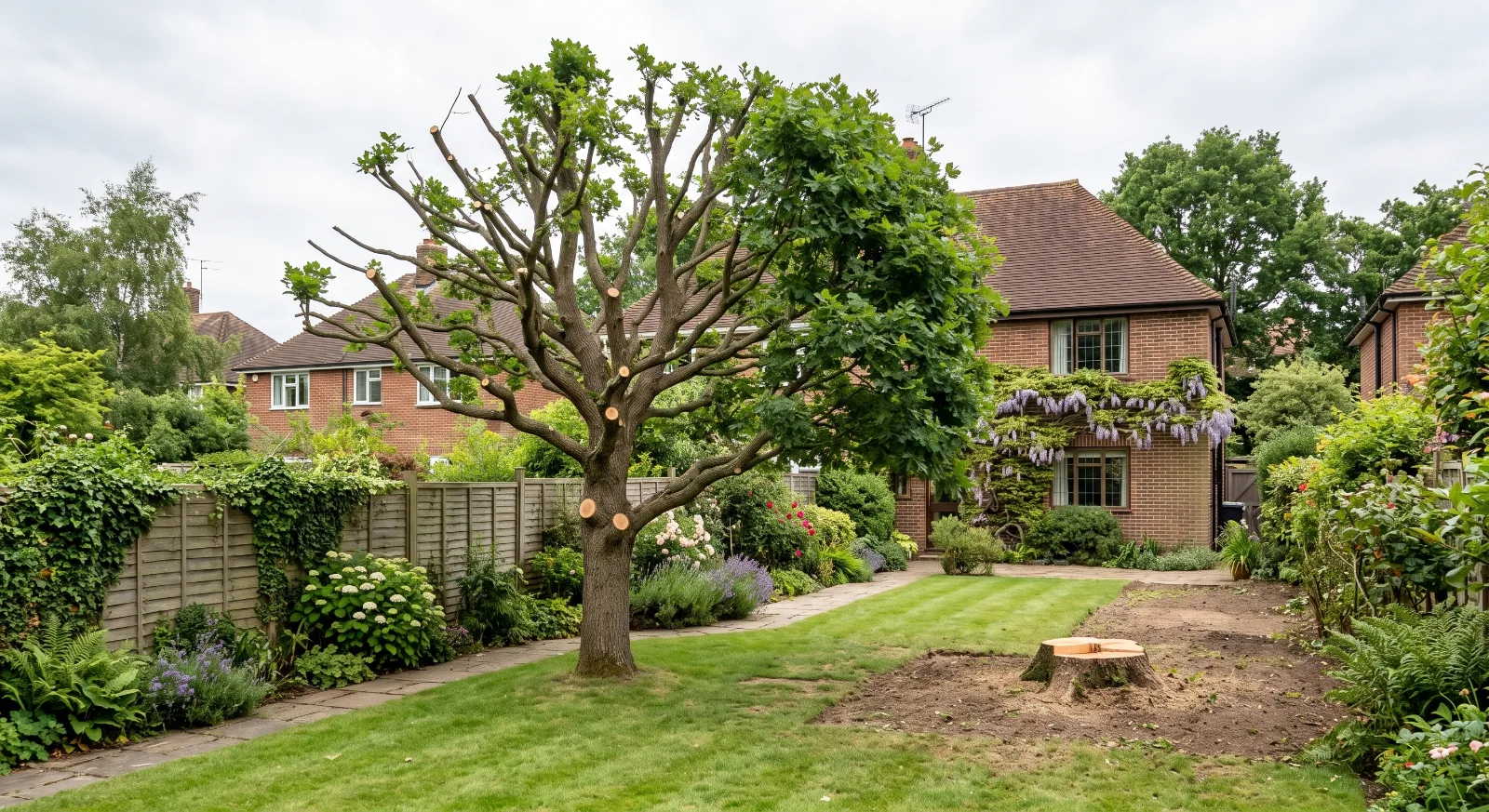
Crown reduction is a pruning technique used to reduce the overall height and spread of a tree while attempting to retain its natural shape.
Rather than cutting the tree back to a few major stubs, selected branches throughout the outer crown are shortened back to suitable growth points.
The aim is to make the tree smaller while keeping it looking like a tree.
Crown reduction may be considered when a tree has outgrown its available space, is becoming too large for nearby structures or needs its overall dimensions managed.
The amount removed should be carefully considered because excessive reduction can place unnecessary stress on the tree and encourage vigorous regrowth.
What Is Pollarding?
Pollarding is a much more severe and specific form of pruning.
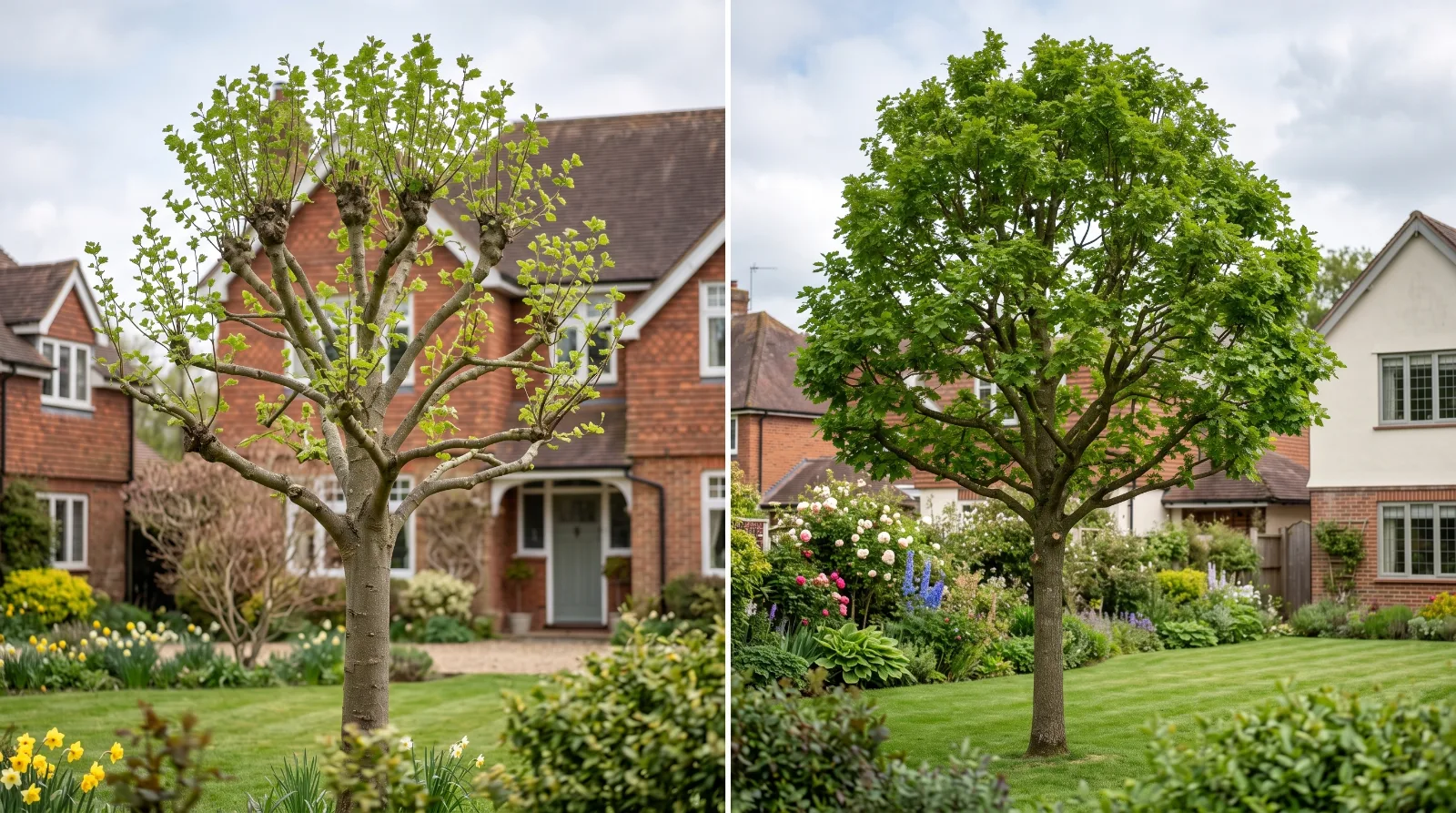
Instead of gradually shortening branches throughout the existing crown, the main branches are cut back to a framework at a predetermined height. New shoots then develop from these points, creating a distinctive structure often known as a pollard head.
Once a tree has been pollarded, it normally needs to be maintained through a repeated pruning cycle.
Pollarding is therefore not simply “a more aggressive crown reduction”.
It is a management system that changes the tree's future growth pattern.
Crown Reduction vs Pollarding
The basic difference can be summarised like this:
Crown reduction | Pollarding |
|---|---|
Reduces the existing crown | Creates a reduced framework |
Attempts to retain natural shape | Creates a distinctive pollarded form |
Branches are shortened to suitable points | Main branches are cut back to established points |
Can be used as occasional size management | Usually requires repeated maintenance |
Suitable for many trees where reduction is appropriate | Only suitable for species and situations that tolerate it |
Does not create pollard heads | Produces pollard heads and repeated new shoots |
This distinction is important because pollarding is a long-term commitment rather than simply a one-off way of making a tree smaller.
Why Would You Choose Crown Reduction?
Crown reduction can be useful when the tree itself is worth retaining but has become too large for its surroundings.
For example, you might have a mature tree growing close to:
A house
Garden buildings
A driveway
A patio
Overhead structures
Other trees
A boundary
Reducing the crown can sometimes help create additional clearance while retaining much of the tree's structure and character.
It can also be considered where the overall size of a tree needs to be managed without dramatically changing its natural appearance.
The exact suitability depends on the species, condition, structure and extent of the proposed reduction.
Why Would You Choose Pollarding?
Pollarding is generally used where a particular tree can tolerate this form of management and there is a reason to maintain it at a restricted height or size.
It has a long history in places where trees have needed to be kept within a defined space.
Pollarding can be useful for certain tree species that respond well to repeated hard pruning, particularly where a regular maintenance cycle has already been established.
Once started, however, pollarding usually needs to be continued.
That is an important difference from ordinary crown reduction.
If an existing tree has never been pollarded, suddenly cutting it back severely simply because it has become too large is not necessarily a sensible solution.
What Does a Crown Reduction Look Like?
A properly carried out reduction should retain the overall character of the tree.
The outer branches are shortened selectively and the remaining branch structure should form a balanced canopy.
The result should look like a smaller version of the original tree rather than a tree that has simply been chopped down.
A good reduction also considers where cuts are made. Branches are generally reduced back to suitable lateral branches rather than being shortened randomly.
This helps preserve a more natural structure and reduces the likelihood of excessive clusters of weak regrowth.
What Does a Pollarded Tree Look Like?
Pollarded trees have a distinctive appearance.
A framework of larger branches remains, with repeated new shoots developing from the same areas.
Over time, these cut points can become enlarged and form characteristic pollard heads.
This can create a very different visual effect from a naturally shaped tree.
Some established pollarded trees can become attractive landscape features in their own right, particularly where the form is expected and regularly maintained.
The key is that the appearance is intentional and ongoing.
Which Trees Can Be Pollarded?
Not every tree is suitable for pollarding.
Some species tolerate repeated hard pruning much better than others. Common examples include certain lime, London plane, willow, poplar and some eucalyptus and maple species.
Even within a suitable species, the individual tree's age, condition and previous pruning history matter.
A tree that responds well to pollarding when young may not respond as well if an old mature tree is suddenly subjected to severe cuts.
Pollarding should therefore be considered as a specific management method rather than a universal way of controlling tree size.
Is Crown Reduction Suitable for Every Tree?
No.
Crown reduction also needs to be considered carefully.
Different species respond differently to pruning, and the condition of the tree matters.
A tree that is already stressed, diseased or structurally compromised may not be a good candidate for major reduction.
The objective should also be realistic.
If a tree has become dramatically larger than the space available, repeatedly reducing it may not be a sustainable long-term solution.
In some situations, replacement with a more appropriately sized tree may be worth considering.
Pollarding Is Not the Same as “Topping”
These terms are sometimes confused.
Topping generally involves indiscriminately cutting major branches or the main stem to reduce a tree's height, often leaving large stubs.
Pollarding is a deliberate management system that establishes a framework and then maintains new growth on that framework.
A properly managed pollard should therefore not be confused with an arbitrary or uncontrolled heavy reduction.
Likewise, crown reduction should not involve simply cutting the ends off every major branch at the same height.
The structure and natural form of the tree should be considered throughout the work.
Which Method Is Better for Tree Health?
Neither technique is automatically “healthier”.
The better question is whether the specific method is appropriate for the tree.
A properly planned crown reduction may allow a suitable tree to remain in a confined space while retaining much of its natural structure.
Pollarding can also be a successful long-term management method for appropriate species when it is started and maintained correctly.
Problems arise when either technique is used without considering the tree's biology.
Removing too much live canopy can stimulate vigorous regrowth and leave a tree with an unnatural shape.
This is one reason significant crown work is best planned around the individual tree rather than using a fixed percentage or height for every situation.
How Often Does Crown Reduction Need to Be Repeated?
There is no universal schedule.
The frequency depends on the species, the amount removed, growth rate, location and the objective of the work.
A reduction may be carried out periodically when the tree begins to outgrow its available space again.
The more heavily a tree is reduced, the more important it becomes to consider how it will respond afterwards.
Repeated heavy reductions are not necessarily a better alternative to one carefully planned intervention.
In many cases, starting size management earlier can produce a more manageable tree over time.
How Often Does a Pollard Need to Be Cut?
Pollarding normally involves a recurring maintenance cycle.
New shoots develop from the pollard heads and are subsequently removed at intervals appropriate to the particular tree.
The exact timing can vary, but the central principle remains the same:
Once a tree has been deliberately pollarded, it normally needs continued management.
Allowing a pollarded tree to go unmanaged for many years can result in larger, heavier shoots developing from old pollard points.
These can become more difficult to manage and may create structural concerns.
This is one of the main reasons pollarding should be considered as a long-term commitment rather than a quick fix.
Can Crown Reduction Make a Tree Smaller Without Ruining Its Shape?
Yes, when it is appropriate and carefully carried out.
A crown reduction should aim to reduce the tree's height and spread while maintaining a balanced appearance.
The amount removed matters.
Trying to make a mature tree dramatically smaller in one operation can result in an unnatural canopy and encourage vigorous regrowth.
In many cases, managing a tree before it becomes significantly oversized is easier and produces a better result.
Regular, proportionate management can be preferable to allowing a tree to become very large and then attempting a major reduction.
What Happens If a Pollarded Tree Is Left Too Long?
A neglected pollard can become considerably more difficult to manage.
The new shoots that develop from the pollard heads continue to grow and increase in size and weight.
After many years without maintenance, returning the tree to its previous pollarded cycle may involve larger cuts and more complicated work.
This can be particularly relevant with mature trees where the pollard heads themselves have become large and structurally important.
An overgrown pollard should therefore be assessed before deciding how much material can safely be removed.
Does Pollarding Reduce a Tree's Height Permanently?
Not by itself.
Pollarding restricts a tree to a managed framework, but new shoots will continue to develop.
The height and spread can therefore be controlled through repeated pruning, rather than the tree simply remaining permanently at the height it was cut to.
This is why pollarding works best when there is a clear reason for maintaining that particular form and a willingness to continue the cycle.
Can Crown Reduction Solve a Privacy Problem?
It depends on the objective.
If the tree has become too dense and is creating unwanted shade, selective pruning may sometimes help alter the canopy.
However, reducing a tree can also remove foliage that was providing screening.
For privacy, the desired outcome should therefore be considered before any significant work is carried out.
If screening is important, reducing the crown too heavily may have the opposite effect from what the homeowner intended.
What About Shade?
Shade is another reason homeowners sometimes consider tree pruning.
A dense canopy can reduce light reaching lawns, patios and windows.
Crown thinning may sometimes be more appropriate than crown reduction when the objective is specifically to reduce canopy density rather than substantially reduce the tree's overall dimensions.
These are different pruning objectives.
If the tree's height and spread are acceptable but the canopy is simply too dense, taking substantial height off the tree may be unnecessary.
What About Trees Close to Buildings?
Trees growing close to houses, extensions, walls and other structures need careful assessment.
A homeowner may assume that reducing the whole crown is the best way to create clearance, but the appropriate solution depends on the branches involved and the tree itself.
Sometimes targeted pruning can address individual areas of conflict without significantly changing the whole canopy.
In more serious cases, a professional tree assessment can determine whether pruning provides a sensible solution or whether the tree's position and condition need to be considered more broadly.
What Should You Consider Before Pollarding a Tree?
Before choosing pollarding, consider:
The species
Does the tree tolerate repeated hard pruning?
The tree's age and condition
Is it healthy enough to cope with the proposed work?
Its previous history
Has it been pollarded before, or would this be a completely new management regime?
Future maintenance
Are you prepared to maintain the tree on a recurring cycle?
The reason for the work
Are you trying to control height, reduce shade, maintain clearance or solve another problem?
The alternative
Could a more moderate reduction or another pruning method achieve the same objective?
These questions can prevent a short-term decision from creating a long-term maintenance problem.
What Should You Consider Before Crown Reduction?
The same principle applies to crown reduction.
Think about:
The tree's natural size
Available space
Species
Current condition
Amount of reduction required
Desired final height and spread
Nearby structures
Future maintenance
If a tree needs to be reduced dramatically every few years simply to keep it within its space, it may be worth reassessing whether it is the right tree for that location.
What About Wildlife?
Trees provide habitat throughout the garden, and major pruning can affect nesting birds, insects and other wildlife.
Before significant tree work, the tree and surrounding area should be checked for active nests and signs of wildlife that may be affected.
Trees with cavities, deadwood and older structures can also provide valuable habitat, so removal of every damaged-looking branch is not always necessary.
The condition and location of the branch should be considered alongside the wider ecological value of the tree.
Do You Need Permission to Pollard or Reduce a Tree?
Possibly.
Some trees in England are protected by Tree Preservation Orders, while trees within Conservation Areas can also have specific legal protections.
These protections can apply to pruning as well as removal.
Before carrying out significant work, the protection status of the tree should therefore be established.
The fact that the tree is in your own garden does not automatically mean every type of pruning can be carried out without checking first.
How Much Does Crown Reduction or Pollarding Cost?
Tree surgery costs vary from one property to another.
The price can depend on:
Tree height
Species
Canopy size
Type of pruning
Access
Proximity to buildings
Equipment required
Number of trees
Waste removal
Complexity of the work
Pollarding can also become an ongoing maintenance cost because the tree needs to be revisited as new growth develops.
Crown reduction may be an occasional intervention rather than part of a fixed recurring cycle, although this depends on the tree and the reason for the reduction.
Which One Should You Choose?
A simple way to approach the decision is:
Choose crown reduction when:
The goal is to reduce the overall size of a suitable tree while retaining a natural appearance.
Consider pollarding when:
The species and circumstances are suitable for a deliberate long-term pollarding regime and there is a clear reason to maintain the tree at a restricted size.
Consider another solution when:
The tree is unsuitable for severe pruning, the reduction required is excessive or the problem can be solved more appropriately through another form of management.
The right choice is therefore not simply about which method removes more branches.
It is about choosing the pruning method that makes sense for the tree, its location and the long-term management plan.
Pollarding vs Crown Reduction: The Key Difference
The easiest way to remember the difference is:
Crown reduction makes an existing tree smaller while attempting to preserve its natural form.
Pollarding creates and maintains a deliberately restricted framework through repeated hard pruning.
Both can have a place in professional tree management, but they should not be treated as interchangeable.
A tree that has simply become too large is not automatically a candidate for pollarding. In many situations, a carefully considered reduction, thinning or other targeted pruning method may be more appropriate.
Get the Right Tree Work for Your Garden
Tree pruning is not simply about removing branches.
The species, age, condition, structure, location and intended outcome all influence the appropriate approach. Choosing the wrong method can leave more work to deal with later and may compromise the appearance of the tree.
Whether the answer is crown reduction, pollarding, another form of pruning or no major intervention at all, the best decision starts with understanding what the tree actually needs.
Need Tree Surgery in Surrey?
Surrey Oak Landscapes can help with tree pruning, crown work and wider tree surgery as part of ongoing garden care and landscaping.
Whether you need to manage an overgrown canopy, improve clearance or maintain trees as part of a wider garden project, the work can be considered alongside the rest of your outdoor space.
Need advice about tree pruning or pollarding in Surrey? Get in touch with Surrey Oak Landscapes for a free, no-obligation quote.
About the author