What Is Patio Jointing and Which Type Is Best?
Choosing the right patio jointing can affect both the appearance and durability of your paving. Compare the main jointing options and find out which suits your patio.
Patio paving is often the feature that gets the most attention when planning a new garden, but the material between the slabs is just as important to the finished result.
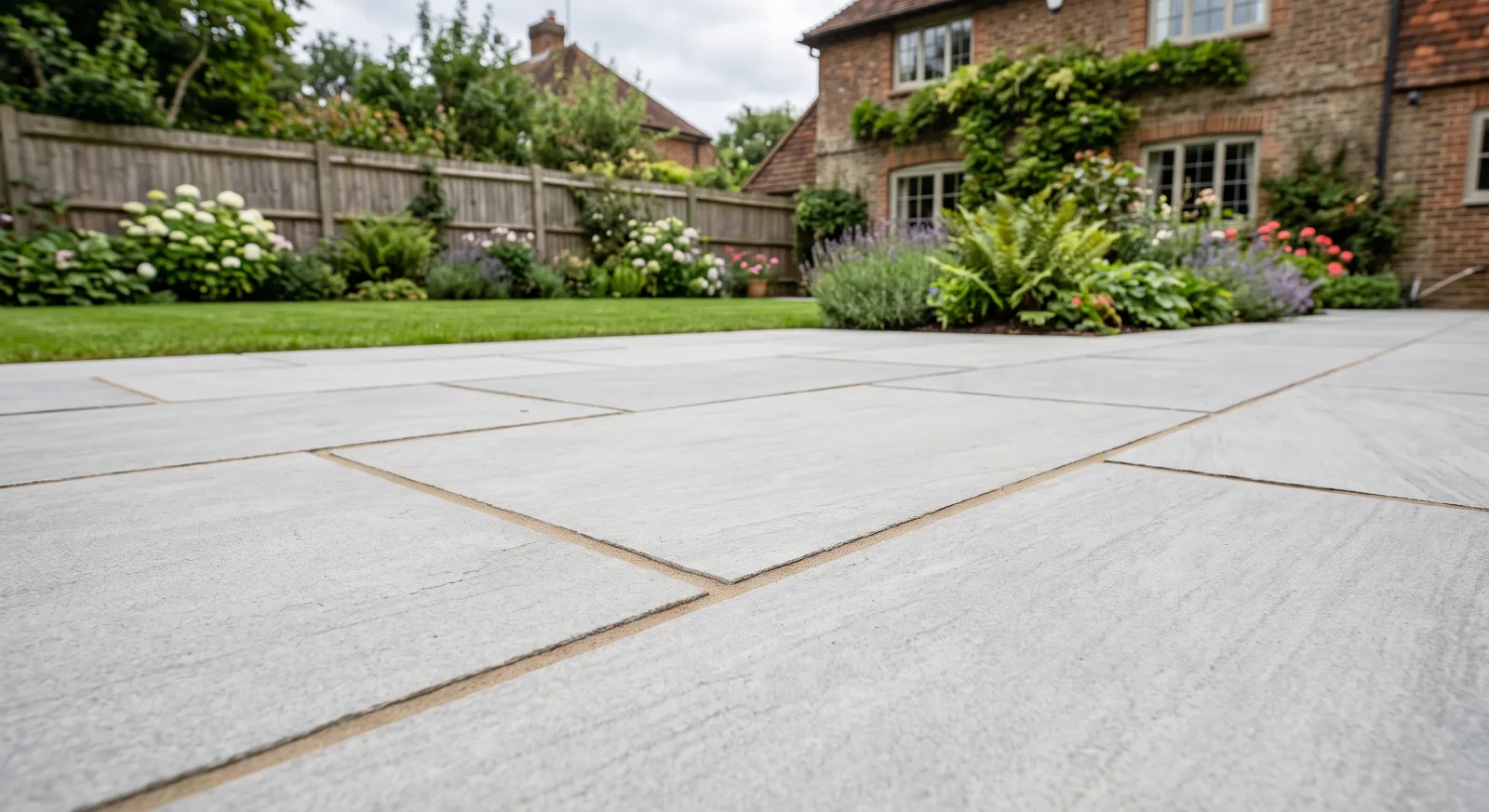
These gaps are known as joints, and the material used to fill them is called jointing or a jointing compound. It helps keep the paving secure, gives the patio a finished appearance and can reduce the amount of dirt, weeds and debris collecting between the slabs.
There are several ways to joint a patio, from traditional sand and cement mortar to modern brush-in and resin-based compounds. However, they are not interchangeable, and using the wrong product can result in poor joints, staining, cracking or premature deterioration.
So, what exactly is patio jointing, what options are available and which type is best for your garden?
What Is Patio Jointing?
Patio jointing is the process of filling the gaps between individual paving slabs.
A typical paved patio does not consist of slabs placed tightly against one another. A small gap is intentionally left between them, creating a joint that can then be filled with a suitable material.
The jointing helps:
Finish the appearance of the paving
Reduce movement between individual slabs
Prevent debris accumulating in the gaps
Reduce opportunities for weeds to establish
Protect the edges of the paving
Create a more consistent surface
The joint is therefore part of the overall paving system, rather than simply something added for appearance.
Why Does the Type of Jointing Matter?
Not all paving materials behave in the same way.
Porcelain paving, natural stone and concrete paving have different characteristics, while the same material can also be installed using different construction methods.
For example, a porcelain patio is commonly laid on a full mortar bed and requires a suitable rigid jointing material, while different jointing options may be appropriate for other paving systems.
The joint width and depth also matter. A product designed for narrow joints may not be suitable for a much wider gap, and vice versa.
This is why the jointing compound should be selected after considering the paving and how it has been installed, rather than simply choosing the cheapest or most convenient product.
The Main Types of Patio Jointing
There are several common approaches to filling patio joints.
Traditional Sand and Cement Mortar
Traditional mortar consists of cement and suitable sand mixed with water to produce a workable material.
It has been used for paving for many years and can provide a strong, rigid joint when the paving has been installed on an appropriate rigid base.
The appearance can be tailored through the colour of the sand and cement, and the joints can be finished in different ways.
However, mortar jointing requires careful mixing and application. It can also be less forgiving to work with than ready-to-use jointing compounds.
It is particularly important to avoid leaving mortar residue on porous paving, as cleaning it from textured or absorbent surfaces can be difficult.
Brush-In Jointing Compounds
Brush-in compounds have become popular because they are relatively straightforward to apply.
The compound is swept into the joints and then activated or cured according to the particular product's instructions. Some products are supplied ready to use, while others have specific preparation requirements.
They are available in different colours and formulations and can provide a neat, consistent finish.
Different compounds are designed for different paving types, so it is important to check compatibility before using one.
Resin-Based or Epoxy Jointing Compounds
Resin-based jointing compounds are another option for patios, paths and, with the correct product, some driveway applications.
Two-part epoxy systems combine resin and aggregate or coated sand before application and can create a particularly tough joint.
These products can be useful where greater resistance to water and wear is required, although application is generally more demanding and product-specific requirements need to be followed carefully.
Patio Jointing Comparison
Type | Main advantage | Main consideration |
|---|---|---|
Sand and cement mortar | Traditional, strong rigid finish | More labour-intensive |
Brush-in compound | Convenient and clean application | Product must suit paving and joint dimensions |
Resin/epoxy compound | Strong, durable finish | More specialist application |
Kiln-dried sand | Simple and inexpensive | More suited to certain paving systems than rigid patios |
The important thing is that the cheapest option is not necessarily the most suitable.
What Jointing Is Best for Porcelain Paving?
Porcelain paving needs particular care because it has very low water absorption and is normally installed differently from traditional natural stone paving.
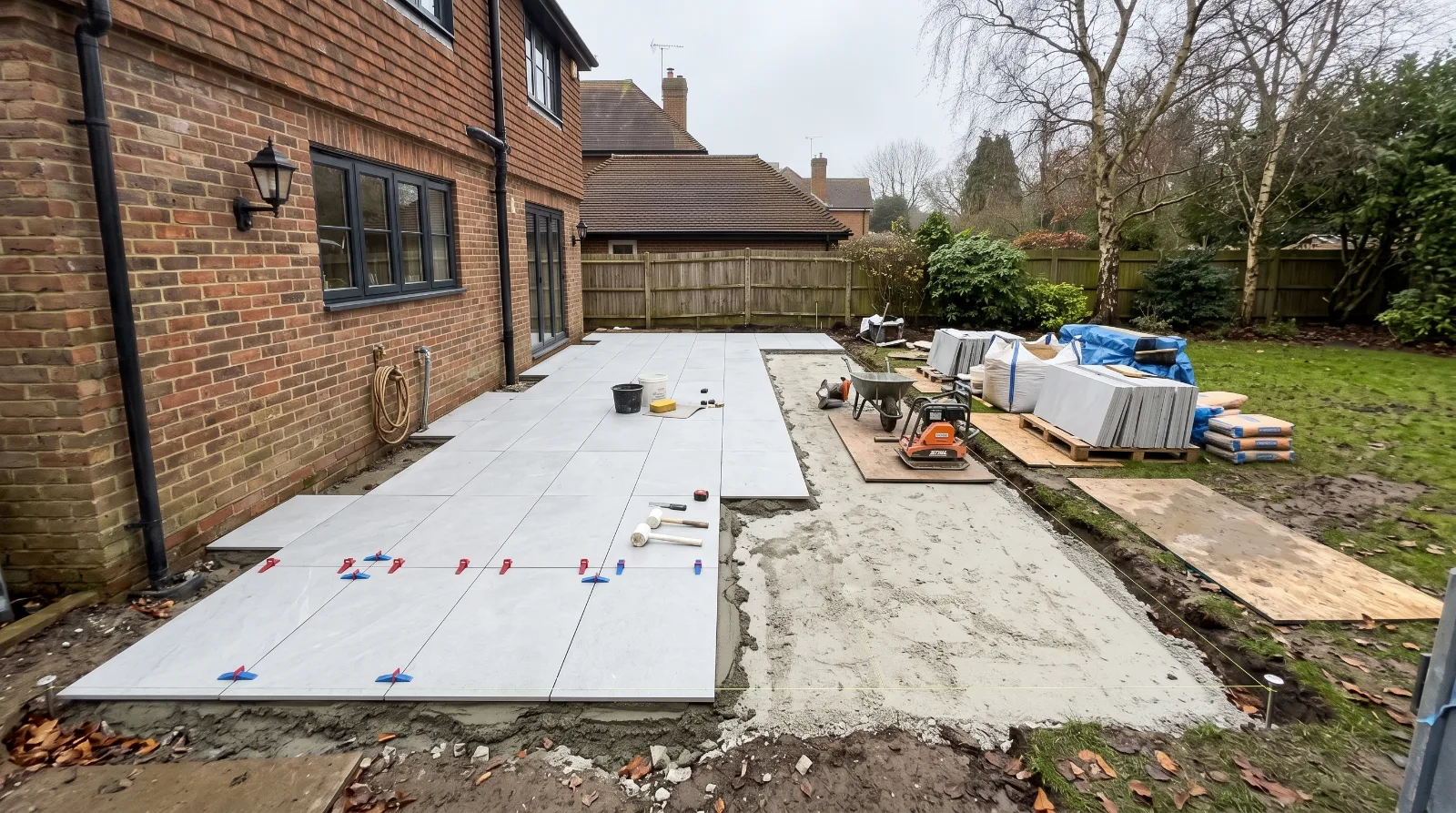
A typical porcelain patio is installed on a full mortar bed, with a flexible bonding primer used to improve adhesion between the paving and mortar bed.
The joints are then filled with a jointing product specifically suitable for porcelain.
Joint widths are commonly around 3–5mm, depending on the paving system and manufacturer's recommendations.
Dry or semi-dry sand and cement brushed across the surface is generally not recommended for porcelain because it may not create an appropriate rigid joint and can leave staining on the paving. Current UK porcelain installation guidance specifically recommends purpose-made jointing materials rather than brushed-in dry sand/cement mixes.
For porcelain, a purpose-made exterior grout or porcelain jointing compound is therefore usually the sensible approach.
What Jointing Is Best for Natural Stone?
Natural stone gives you more options, but the correct choice still depends on the stone, joint size and installation method.
A traditional mortar joint can provide a solid, rigid finish where the paving has been installed on a suitable rigid foundation.
Ready-to-use sweep-in compounds are another option and are available in formulations designed for natural stone as well as porcelain.
The appearance of the joint can also make a difference.
A pale joint can create a softer, more traditional look, while a darker joint can emphasise the individual paving slabs and create stronger definition.
What About Concrete Paving?
Concrete paving can be jointed using several methods, depending on how the patio has been constructed and the joint dimensions.
Traditional mortar is a common approach for rigidly laid paving, while suitable proprietary compounds can also be used where their specifications match the paving and installation method.
The main thing is to avoid assuming that a compound suitable for porcelain will automatically be appropriate for every concrete paving product.
Always check the intended application of the jointing material.
What Is Kiln-Dried Sand?
Kiln-dried sand is very fine, dry sand commonly used to fill narrow joints between certain types of block paving.
It is brushed across the surface and worked into the gaps.
However, kiln-dried sand is not simply a universal patio jointing solution.
Its suitability depends on the paving system and whether the paving is installed as a flexible or rigid construction.
For example, manufacturer guidance distinguishes between jointing products intended for driveways, porcelain paving and other paving installations.
This distinction matters because a traditional slabbed patio and a block-paved driveway are constructed differently.
What Is a Brush-In Jointing Compound?
A brush-in jointing compound is designed to be swept into the gaps between paving.
Depending on the product, the paving may need to be wet first, after which the compound is brushed into the joints and compacted or finished according to the manufacturer's instructions.
Some modern compounds are supplied ready to use and can be significantly quicker to apply than traditional mortar.
They can also be available in several colours, making it easier to coordinate the joint with the paving.
Are Resin Jointing Compounds Worth It?
For the right project, they can be.
Resin-based products can provide a strong, hard-wearing joint and are available for patios and other paved areas.
Some two-part epoxy products are designed specifically for areas where higher strength and greater water tolerance are required.
However, they are not automatically the best choice for every patio.
The paving material, joint width, drainage, weather conditions during installation and manufacturer's requirements all need to be taken into account.
How Wide Should Patio Joints Be?
There is no single joint width that applies to every paving product.
The correct width depends on the type and size of the paving, the installation method and the jointing material.
Porcelain paving, for example, is commonly installed with relatively narrow, consistent joints, often around 3–5mm depending on the product and installation system.
Other paving may require wider joints.
The important thing is to follow the specification of the paving and jointing system rather than choosing a width purely for appearance.
Why Do Patio Joints Crack?
Cracked joints can happen for several reasons.
Movement in the paving
If the slabs or the supporting ground move, the joint can crack as the paving shifts.
Unsuitable jointing material
Using a product that is not designed for the paving or joint dimensions can result in poor performance.
Insufficient joint depth
A jointing compound needs sufficient depth and coverage to form an effective joint. Some proprietary products specify minimum joint depths, so the joint should be prepared accordingly.
Poor installation
Incorrect mixing, inadequate compaction or poor preparation can affect the finished joint.
Weather during installation
Some jointing systems are particularly sensitive to rain, temperature or drying conditions during installation.
The specific requirements differ between products, which is why application instructions should always be followed.
Can Good Jointing Stop Weeds?
Good jointing can make it considerably harder for weeds to establish between slabs, but it cannot guarantee that weeds will never appear.
Seeds can arrive through wind, birds, soil and general garden activity, and organic material can accumulate over time.
A properly filled and maintained joint leaves fewer gaps for weeds to establish compared with an open or deteriorated joint.
This is another reason to repair damaged joints when problems first appear rather than allowing them to deteriorate.
Can You Re-Joint an Existing Patio?
In many cases, yes.
Re-jointing can improve the appearance of an older patio and replace jointing that has cracked, washed out or deteriorated.
However, the existing paving needs to be assessed first.
If slabs have become loose or are sinking, simply replacing the joint material will not solve the underlying problem.
A patio with significant movement may require the affected slabs to be lifted and the supporting construction repaired before new joints are installed.
How Do You Choose the Right Jointing Colour?
The joint colour can have a surprisingly large effect on the overall appearance of a patio.
A contrasting joint can make individual slabs stand out more clearly, while a closely matched colour creates a more seamless appearance.
For example:
Joint colour | Typical effect |
|---|---|
Light grey | Soft and traditional |
Mid grey | Versatile and understated |
Dark grey | Stronger definition |
Buff | Warmer appearance |
Black/dark | Contemporary, high contrast |
There is no universally correct colour.
Consider the paving, brickwork, fencing and surrounding planting so the joint complements the rest of the garden.
Does Jointing Need to Be Waterproof?
Not every patio requires the same type of joint, and “waterproof” should not automatically be treated as better.
Some jointing compounds are specifically designed to tolerate water and wet conditions, while other products are intended for particular paving systems and installation methods.
The important question is whether the product is appropriate for the project.
Drainage should also be considered as part of the wider patio design. Preventing water from being able to move appropriately through or away from the paved area can create problems regardless of the jointing material.
When Should Patio Jointing Be Installed?
Jointing normally forms one of the final stages of patio installation.
The paving needs to be correctly positioned, supported and sufficiently clean before the joints are filled.
For some systems, excess mortar needs to be removed from between the slabs before the jointing compound is applied so that the compound can fill the joint to the required depth.
Timing can also matter.
Some compounds should not be applied when heavy rain is expected, while others have specific temperature or moisture requirements during installation.
This is particularly important with resin-based products.
What Happens If Jointing Is Done Poorly?
Poor jointing can affect both the appearance and performance of the patio.
You may eventually notice:
Cracking
Loose or missing material
Uneven joints
Weeds
Staining
Water-related deterioration
Material washing out
A generally unfinished appearance
In some situations, poor jointing is simply a cosmetic issue. In others, it can be part of a wider problem involving movement beneath the paving.
This is why jointing should be treated as part of the overall patio construction rather than an optional finishing touch.
Patio Jointing for Different Paving Types
A simple way to approach the decision is to start with the paving material.
Paving | Jointing approach to consider |
|---|---|
Porcelain | Purpose-made porcelain grout or jointing compound |
Natural stone | Mortar or suitable proprietary jointing compound |
Concrete paving | Mortar or compatible proprietary compound |
Block paving | Jointing sand or a product specifically designed for the installation |
Specialist paving | Follow the manufacturer's specified jointing system |
This table is only a starting point because the correct solution can change depending on the installation method and joint dimensions.
What Makes a Good Patio Joint?
A good joint should look consistent and work with the paving rather than drawing attention away from it.
It should be:
Fully filled: Gaps or shallow sections can leave the joint vulnerable to deterioration.
Consistent: Similar width and depth create a more professional finish.
Compatible: The jointing material needs to suit the paving and installation method.
Neat: Excess material should be removed from the surface before it cures.
Durable: It should be capable of handling the conditions expected around the patio.
These details are what separate a finished patio from paving that simply happens to have something brushed or pressed into the gaps.
Which Patio Jointing Is Best?
There is no single jointing material that is best for every garden.
For porcelain paving, a purpose-made porcelain jointing compound or exterior grout is generally the appropriate starting point.
For natural stone, both traditional mortar and suitable proprietary compounds can work depending on the installation.
For block paving, jointing sand or a product specifically designed for that paving system is more appropriate than automatically using a patio grout.
For homeowners who want a simpler application and a consistent finish, modern sweep-in compounds can be attractive. Where a particularly robust joint is required and the paving system is suitable, resin or epoxy-based products may also be considered.
The best choice is the one that matches the paving, joint size, construction method, drainage requirements and expected use.
Good Jointing Starts With Good Patio Construction
It can be tempting to think of jointing as the final cosmetic stage of a patio.
In reality, the joints are part of the finished paving system.
A good patio needs suitable ground preparation, stable support, correctly installed paving and compatible jointing. Getting one part wrong can affect the others.
This is particularly important with modern porcelain paving, where the installation method and jointing system need to work together.
Choosing the jointing material before the patio is built can therefore help ensure the paving and joint are compatible from the beginning.
Need a New Patio or Patio Jointing in Surrey?
Whether you're planning a new patio or dealing with worn or damaged joints on an existing one, the right jointing system can make a significant difference to the finished appearance and long-term performance.
Surrey Oak Landscapes can help with patio design, paving, ground preparation and finishing, creating an outdoor space designed around your garden and how you use it.
Planning a new patio or need to refresh an existing one in Surrey? Get in touch with Surrey Oak Landscapes for a free, no-obligation quote.
About the author