What Is a French Drain and How Does It Work?
What is a French drain? Discover how this underground drainage system works, where it can be used and whether it could help solve drainage problems in your Surrey garden.
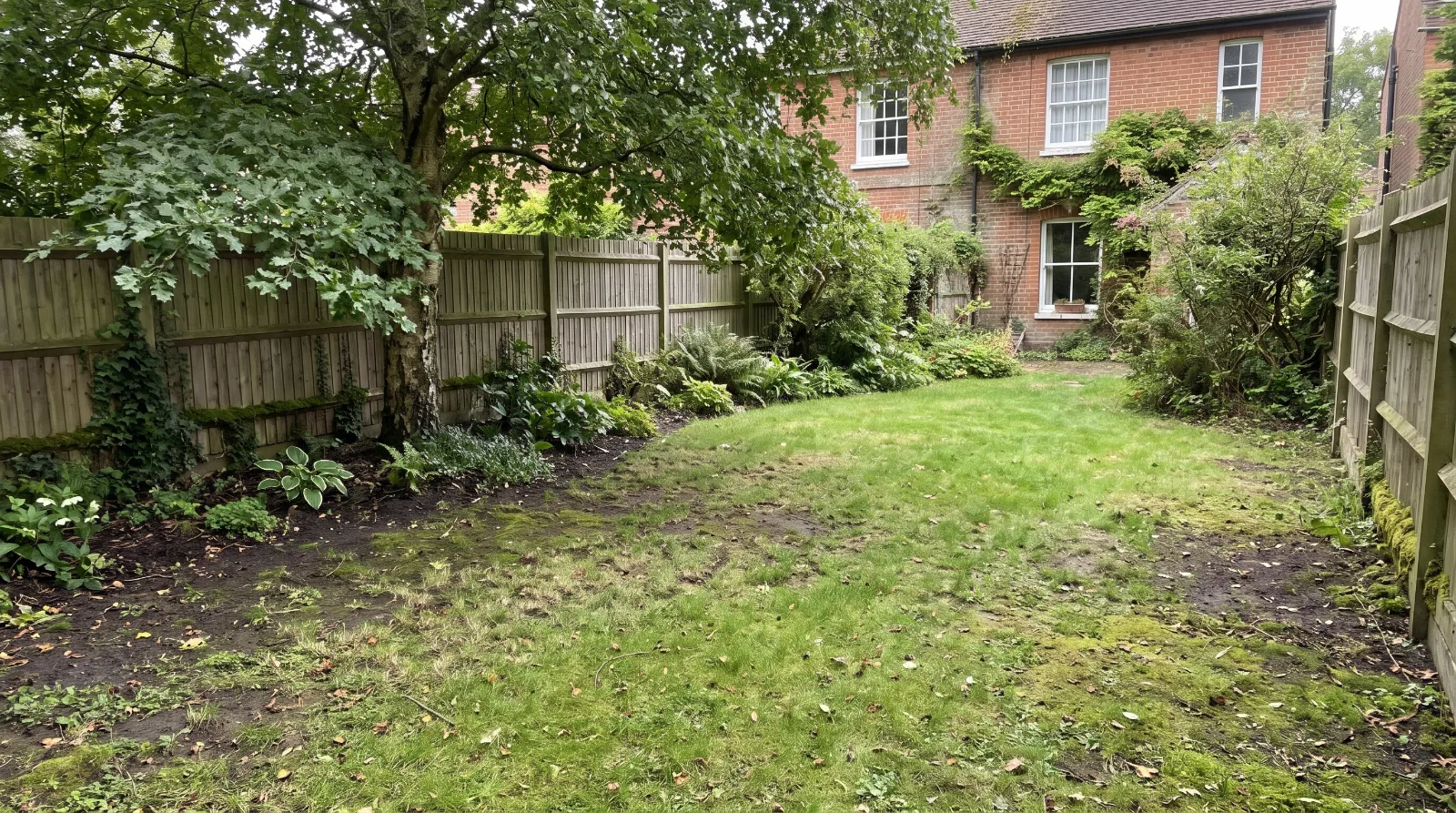
If your garden regularly develops puddles, stays soggy after rainfall or has areas where water simply refuses to drain away, the problem may be more than just a wet patch of lawn.
One possible solution is a French drain, a type of ground drainage system designed to collect excess water and move it away from a problem area. It is particularly useful where water is travelling through the soil or repeatedly collecting along a garden boundary, lawn, patio or other landscaped area.
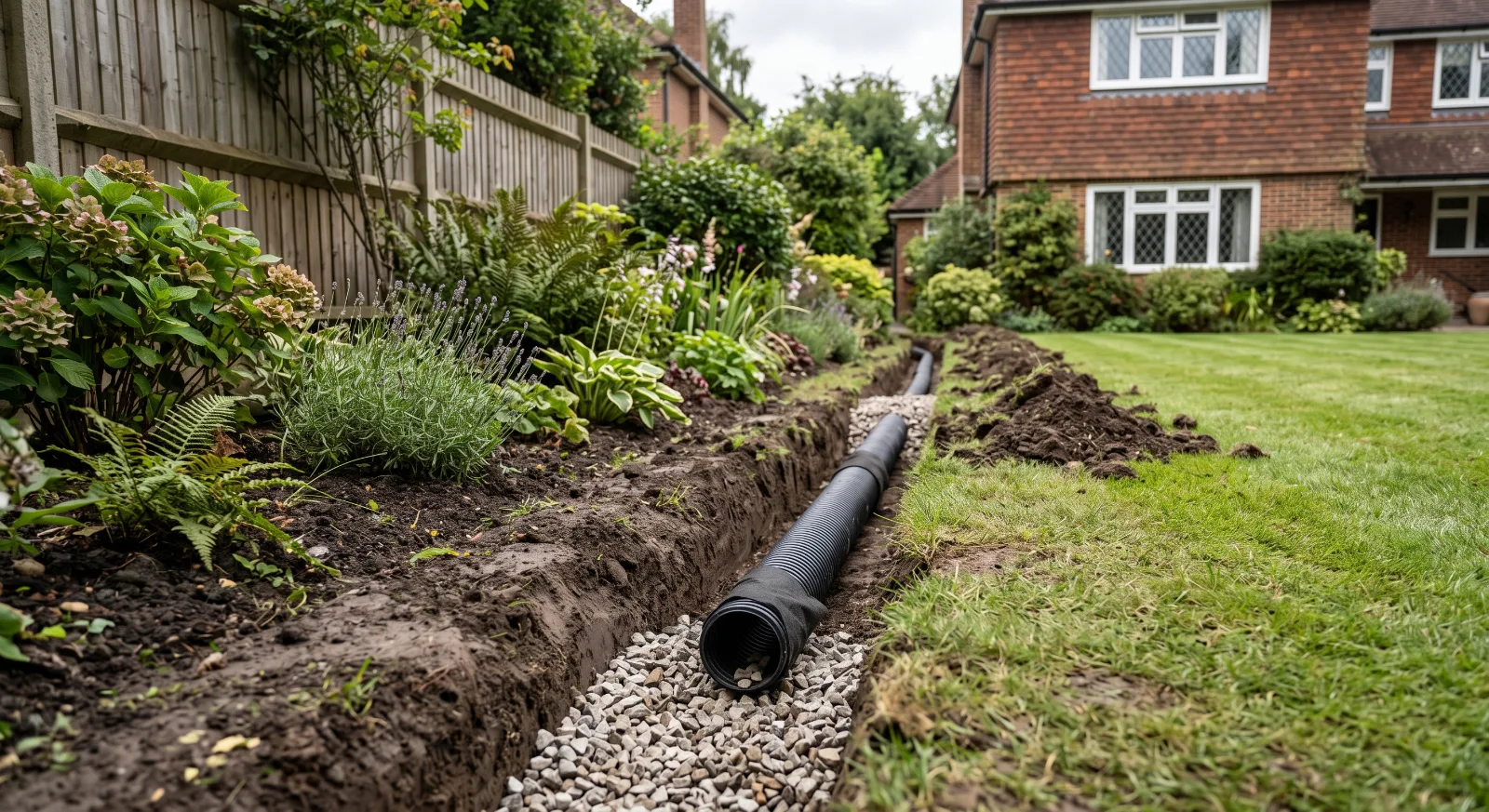
A typical French drain consists of a gravel-filled trench containing a perforated drainage pipe. Water enters the gravel and surrounding drainage layer, reaches the pipe and is then carried towards a suitable outlet, usually using a gentle fall.
What Is a French Drain?
A French drain is essentially a linear drainage system installed below ground.
Rather than collecting water at one single point, it can intercept water along the length of the trench. This makes it useful for areas where water is moving through the ground or repeatedly pooling along a particular section of the garden.
A modern French drain will typically include:
A narrow trench
Permeable geotextile membrane
Clean drainage gravel
A perforated drainage pipe
A suitable outlet for the collected water
The finished drain can be covered with soil and turf or incorporated into gravel and other landscaping, making it possible to keep the drainage system relatively discreet.
How Does a French Drain Work?
The principle is fairly simple: water follows the path of least resistance.
When rainwater reaches saturated or poorly draining ground, it can move towards the gravel-filled trench. The gravel provides a much more open route for water than compacted soil.
Water then enters the perforated pipe running through the drainage layer. Because the pipe is installed with a fall, gravity carries the collected water towards its outlet.
Think of it as an underground channel that intercepts excess water before it can continue causing problems elsewhere in the garden.
The system is particularly useful for dealing with water moving through soil rather than simply trying to remove a puddle from the surface.
What Does a French Drain Look Like?
Once installed, most of the system is hidden underground.
A typical cross-section looks roughly like this:
Layer | Purpose |
|---|---|
Soil, turf or gravel | Restores the surface |
Clean drainage gravel | Creates a free-flowing route for water |
Perforated pipe | Collects and carries water |
Geotextile membrane | Helps prevent soil particles entering the drainage layer |
Existing soil | Surrounds the drainage system |
The exact construction can vary depending on the site, soil and amount of water being dealt with.
Where Are French Drains Used?
French drains can be useful in a range of landscaping situations.
Waterlogged lawns
If a section of lawn repeatedly becomes saturated, a drainage run can intercept excess water and move it towards a suitable outlet.
Along garden boundaries
Water can sometimes collect against a fence, retaining wall or boundary because of changes in levels. A drainage channel can intercept water before it remains against the structure.
Around patios and hard landscaping
A French drain can sometimes be incorporated alongside hard landscaping where water is travelling towards a lower point or collecting at an edge.
Sloping gardens
On a sloping site, water can travel downhill and collect at the bottom of the garden. A strategically positioned drain can intercept some of this flow before it reaches the lowest point.
Areas with heavy clay soil
Clay soil can drain slowly because its fine particles restrict the movement of water. This can make drainage problems particularly noticeable after periods of heavy rainfall. Improving soil structure may help, but where excess water needs to be intercepted and redirected, a drainage system may also be appropriate.
Does a French Drain Need a Pipe?
Not every traditional French drain used a perforated pipe, but modern garden drainage systems commonly incorporate one.
The gravel provides the permeable drainage zone, while the perforated pipe provides a controlled route for collected water to travel towards an outlet. This can make the system more predictable and effective, particularly where there is a significant amount of water to manage.
The pipe size, trench dimensions and drainage arrangement should be selected according to the individual site rather than simply using the same specification for every garden.
Why Is Gravel Used?
Gravel is an important part of the system because it creates spaces through which water can move much more easily than through compacted soil.
Clean, appropriately sized drainage gravel is generally used around the pipe. The open spaces between the stones allow water to reach the perforated pipe while also providing structural support around it.
The gravel should not simply be replaced with ordinary soil or fine material, as this can reduce the free-flowing nature of the drainage layer.
What Is the Geotextile Membrane For?
The membrane acts as a filter between the surrounding soil and the drainage material.
Without suitable separation, fine particles of soil can gradually migrate into the gravel and pipework. Over time, this can reduce the amount of open space available for water and contribute to blockages.
The membrane therefore helps protect the drainage layer and maintain its effectiveness.
How Deep Should a French Drain Be?
There is no single depth that works for every French drain.
For domestic garden drainage, trenches are often installed somewhere around 400–600mm deep, although the required depth depends on what the drain is intended to achieve, the existing ground levels and where the water needs to go. The fall of the trench is equally important.
A shallow drain may be appropriate for intercepting relatively near-surface water, while a deeper system may be needed for other drainage problems.
The important thing is that the system has a properly planned route and a suitable outlet.
Where Does the Water Go?
This is one of the most important parts of planning a French drain.
A drain can collect water effectively, but that doesn't solve the problem if there is nowhere for the water to go.
Depending on the site, the water may be directed towards a suitable soakaway, drainage outfall, watercourse or other appropriate discharge point. The correct option depends on the property's layout, ground conditions and local requirements. (RHS)
A French drain should therefore never be designed in isolation. The entire route from the problem area to the final outlet needs to be considered before excavation begins.
French Drain vs Soakaway
French drains and soakaways are sometimes confused because they can be used together, but they perform different jobs.
French drain | Soakaway |
|---|---|
Collects and moves water | Stores and disperses water |
Usually contains a perforated pipe | Usually consists of an underground infiltration area |
Can intercept water along a route | Receives water at a specific location |
Moves water towards an outlet | Allows water to gradually infiltrate surrounding ground |
Useful for linear drainage problems | Useful where suitable ground can absorb collected water |
A French drain can therefore feed a soakaway where site conditions make that arrangement suitable.
When Is a French Drain Not the Right Solution?
A French drain isn't a universal answer to every drainage problem.
If water is entering a garden because of a leaking downpipe, blocked drain or poorly directed surface runoff, fixing the original source may be more appropriate.
Similarly, if the underlying ground cannot accept water and there is no suitable outlet, installing a French drain alone will not make the water disappear.
Before installing one, it is worth establishing:
Where the water is coming from
Where it is collecting
How the ground levels behave
What type of soil is present
Where the collected water can safely go
Getting the diagnosis right is often more important than simply installing a drainage system.
How Is a French Drain Installed?
Although the exact method varies between projects, a typical installation involves several stages.
1. Identify the drainage problem
The wettest areas, natural flow routes and existing levels are assessed.
2. Plan the route
The trench is positioned so that it can intercept water and maintain a suitable fall towards the outlet.
3. Excavate the trench
The required depth and width are excavated while taking care around existing utilities, trees and structures.
4. Install the membrane and drainage material
The trench is lined with suitable geotextile before the drainage gravel and perforated pipe are installed.
5. Connect the outlet
The pipe is connected to the planned discharge point.
6. Backfill and reinstate
The remaining drainage material is installed and the surface can then be reinstated with soil, turf, gravel or another suitable finish.
For larger or more complicated drainage projects, getting the levels and outlet wrong can undermine the entire system, so professional planning is often worthwhile.
How Long Does a French Drain Last?
A properly designed and installed drainage system can provide long-term service, but its performance depends on the quality of the installation and the conditions around it.
Keeping soil and fine material out of the drainage layer is important. Accessible inspection or maintenance points can also make it easier to deal with potential blockages in larger systems.
The biggest consideration is usually getting the design right from the beginning. A drain with no effective fall or no suitable outlet cannot perform properly regardless of how much gravel is installed.
Could a French Drain Help Your Garden?
If part of your garden repeatedly stays wet after rainfall, a French drain could be one option worth considering.
However, the right solution depends on why the water is accumulating in the first place. In some gardens, improving the soil or changing the levels may be enough. In others, a French drain, soakaway or wider drainage system may be required.
For Surrey gardens, where heavy clay soils and periods of wet weather can contribute to drainage problems, assessing the site properly before digging can save a lot of unnecessary work.
Need Help With Garden Drainage in Surrey?
Persistent standing water can make a garden difficult to use and can affect lawns, planting and hard landscaping. A properly planned drainage system can help manage excess water while being incorporated into the wider design of the garden.
Struggling with a wet or poorly draining garden in Surrey? Get in touch with Surrey Oak Landscapes for a free, no-obligation quote.
About the author