Timber vs Composite Fencing: Which Is Right for Your Garden?
Thinking about timber or composite fencing? Compare the cost, appearance, maintenance, durability, privacy and flexibility of both options.
Choosing a new fence is not simply a decision about height and style. The material you choose can affect the appearance of your garden, how much maintenance the fence needs, how long it lasts and how much you spend over its lifetime.
Two popular options for modern gardens are timber fencing and composite fencing.
Timber has been used for garden boundaries for generations and remains a popular choice because it is versatile, natural-looking and available in a wide range of styles. Composite fencing offers a more contemporary alternative, generally combining recycled or manufactured materials to create a low-maintenance fencing system.
Both can work extremely well, but they offer different benefits.
So, should you choose timber or composite fencing for your garden?
What Is Timber Fencing?
Timber fencing is made from natural wood and can be constructed in several different ways.
Common styles include:
Closeboard fencing
Feather edge fencing
Overlap panels
Slatted fencing
Decorative timber panels
Trellis-topped fencing
Timber can be treated to improve resistance to moisture, insects and decay, although the level of protection depends on the treatment and specification.
One of its biggest advantages is flexibility. Timber can be cut, shaped and adapted on site, making it suitable for gardens with unusual boundaries, changes in level and bespoke designs.
What Is Composite Fencing?
Composite fencing is made using a manufactured material rather than solid natural timber. Many composite products combine materials such as recycled plastic and wood fibre, although the exact composition varies between systems.
Composite fencing is available in a range of colours and styles, including designs intended to resemble timber.
The material is popular with homeowners who want a modern appearance with less routine maintenance than traditional wood.
Some systems use composite boards fitted between posts, while others use complete modular fencing systems.
Timber vs Composite Fencing at a Glance
Feature | Timber fencing | Composite fencing |
|---|---|---|
Appearance | Natural and traditional | Modern and consistent |
Maintenance | Usually higher | Generally lower |
Colour options | Can be painted or stained | Often available in several factory finishes |
Repairs | Individual components can often be replaced | Depends on the system |
Design flexibility | Very high | Depends on the product range |
Weathering | Natural ageing over time | Usually designed for greater colour and moisture stability |
Initial cost | Often lower | Usually higher |
Long-term upkeep | May require treatment | Usually less routine treatment |
These are broad comparisons. The quality of the specific product and installation can make just as much difference as the material itself.
Which Looks Better?
This comes down to the style of your home and garden.
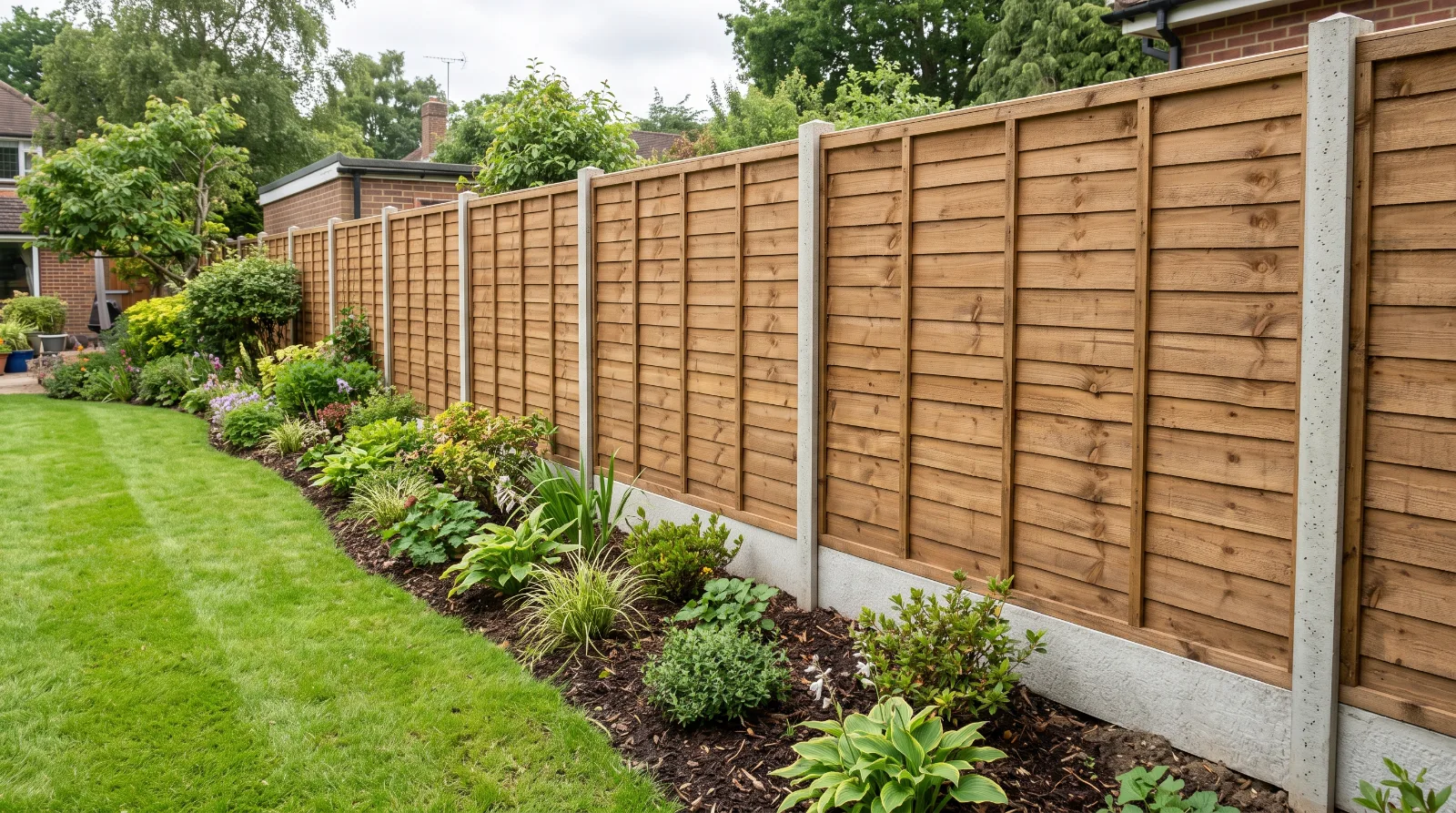
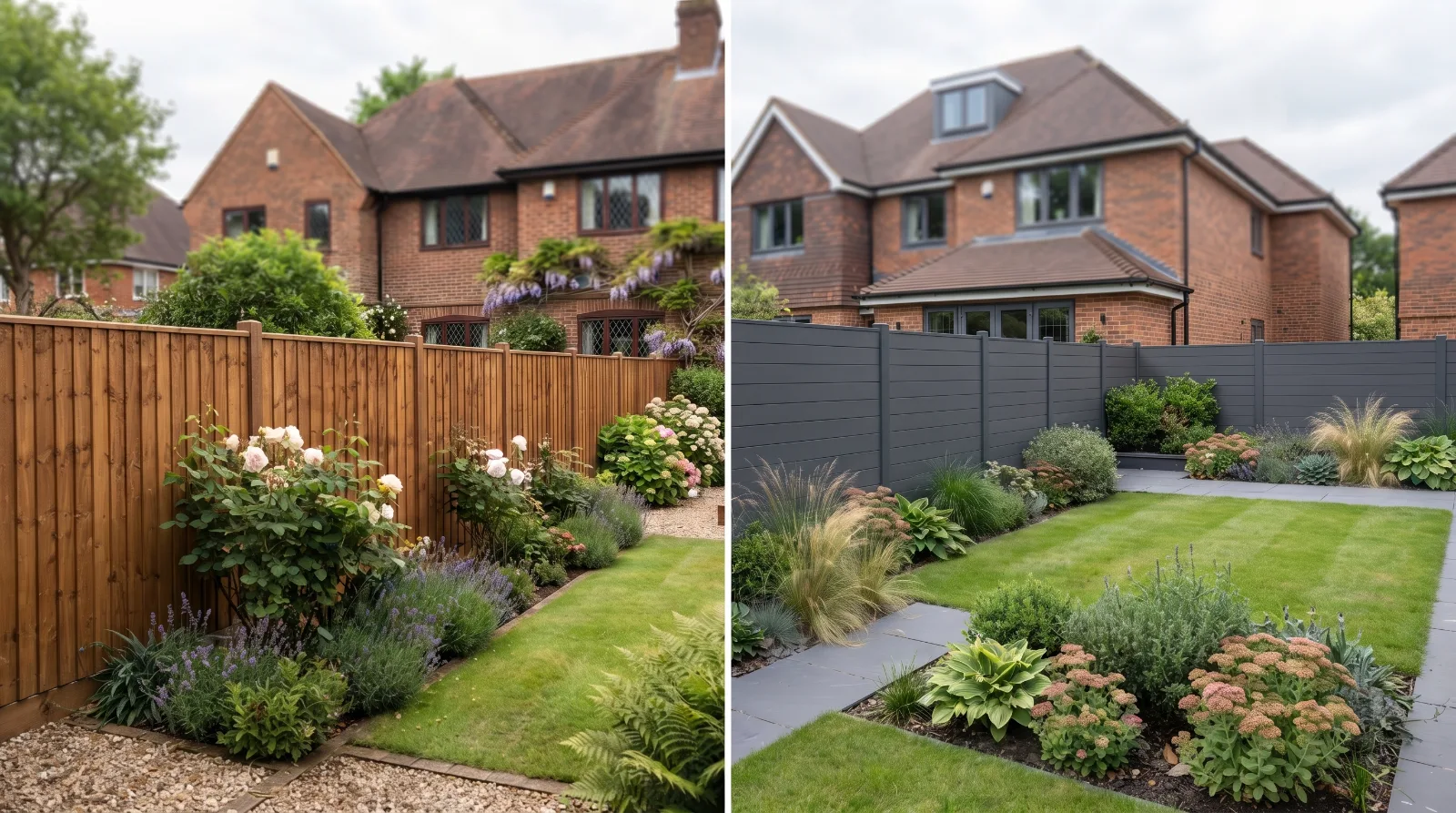
Timber has a natural appearance that works especially well in traditional British gardens. It can soften hard landscaping, complement planting and fit naturally with brick, stone and mature greenery.
Composite fencing tends to have a cleaner and more uniform appearance. This can suit contemporary gardens, newer homes and modern landscaping where strong lines and consistent colours are part of the design.
That does not mean composite fencing can only be used in modern gardens.
Many composite systems now have wood-like finishes and neutral colours that can work in a wide range of properties.
The most important question is whether the fence complements the house, paving, planting and wider garden design.
Which Provides Better Privacy?
Both can provide excellent privacy.
A solid timber closeboard fence can create a strong visual barrier, while many composite systems are designed around overlapping or tightly fitted boards that provide a similar level of screening.
Privacy depends more on the actual fence design than simply whether it is timber or composite.
Consider:
Board spacing
Fence height
Orientation of the boards
Ground levels
Nearby planting
Whether neighbouring properties overlook the garden
For a particularly overlooked garden, the fence can also be combined with planting, trellis or screening to create privacy without making the space feel completely enclosed.
Which Requires More Maintenance?
This is one of the biggest differences between the two materials.
Timber
Timber naturally changes over time.
It can weather, fade and become affected by prolonged exposure to moisture. Depending on the finish and treatment, homeowners may eventually need to clean, stain, paint or treat the fence.
The exact maintenance requirement depends on the timber and the finish used.
Routine checks can also help identify:
Rot
Cracked boards
Loose fixings
Damaged posts
Areas of water damage
Composite
Composite fencing is generally chosen because it needs less routine maintenance.
It does not require the same regular painting or staining as untreated or decorative timber, and many products are designed to resist common problems associated with moisture and decay.
That does not mean composite is completely maintenance-free.
It can still become dirty from mud, algae, dust and general garden use, so occasional cleaning may be required.
Which Lasts Longer?
There is no simple answer because lifespan depends on the quality of the material, installation, exposure and maintenance.
A well-built timber fence can last many years when it is properly specified and maintained.
Composite systems can also provide a long service life and are designed to resist several of the issues that can affect natural timber.
The supporting structure matters too.
A premium composite board does not compensate for poorly installed posts, while a good timber fence can still fail early if it is exposed to persistent moisture or has inadequate support.
When comparing lifespan, think about the complete fence system, not just the visible boards.
What About Rot?
Rot is one of the main concerns associated with timber fencing.
Wood can deteriorate when it remains wet for long periods, particularly where water is allowed to collect around vulnerable areas.
The risk depends on the timber, treatment, construction and how well the fence is protected from ground moisture.
Composite does not suffer from timber rot in the same way because it is not a solid natural wood product.
For homeowners who want to minimise the risk of wood-related decay and avoid regular treatment, this can be an important reason to consider composite.
Which Is Better in Wet Weather?
Both types can be suitable for the British climate, but they behave differently.
Timber absorbs and releases moisture naturally, so repeated wet and dry conditions can contribute to movement and weathering over time.
Composite fencing is generally less affected by moisture than natural timber, although individual products still have different performance characteristics.
Good installation remains essential for both.
A fence should have appropriate drainage around its posts, suitable foundations and enough separation from constantly wet ground where required.
Which Is Better in Strong Winds?
Wind resistance depends on several factors, not just the material.
A tall, solid fence can experience significant wind loading whether it is made from timber or composite.
The important factors include:
Fence height
Panel or board design
Post spacing
Post strength
Foundation depth
Site exposure
Ground conditions
An open or slatted fence allows some airflow, while a fully solid fence presents a larger surface to the wind.
If the property is particularly exposed, the fence specification should be selected with those conditions in mind.
Which Is Easier to Repair?
Timber has an advantage in terms of flexibility.
Individual boards, rails and other components can often be replaced without rebuilding a whole section. Timber can also be cut and adjusted relatively easily on site.
With composite fencing, repairs depend more heavily on the specific manufacturer's system.
Some modular systems allow individual boards to be replaced, while others may require a larger section to be dismantled.
This is worth checking when choosing a composite fence, especially if long-term repairability is important to you.
Which Is Easier to Customise?
Timber is generally more flexible when it comes to bespoke fencing.
Because it can be cut and constructed on site, timber can be adapted to:
Uneven ground
Slopes
Angled boundaries
Unusual garden shapes
Specific height requirements
Bespoke gate designs
Composite systems can also be adapted, but typically within the dimensions and components offered by the manufacturer.
If you have a complicated boundary or want a very particular design, timber may give you more freedom.
Can Composite Fencing Be Used on a Sloping Garden?
Yes, but the installation approach depends on the system.
Some composite fencing can be stepped along a slope, while other systems may allow more flexibility in how the boards are installed.
The important thing is to plan the fence around the actual levels of the garden rather than trying to force standard sections into an unsuitable arrangement.
Timber closeboard fencing is often particularly flexible on sloping ground because it can be constructed to follow changes in level more closely.
However, both materials can work on sloping gardens when properly designed and installed.
Which Is More Environmentally Friendly?
This question is more complicated than simply choosing wood over composite.
Timber is a natural material and can be sourced from responsibly managed forests, but its environmental impact also depends on where it comes from, how it is treated, how long it lasts and what happens to it at the end of its life.
Composite products may incorporate recycled materials and can have a long service life, but they are manufactured products with their own environmental footprint.
Rather than assuming that one material is always the greener option, consider:
Material source
Recycled content
Expected lifespan
Maintenance requirements
Product durability
Disposal or recycling options
A fence that lasts longer and needs fewer replacements can also reduce the need for repeated material use.
Which Is More Expensive?
Timber fencing generally has a lower starting cost, particularly when using standard panels or straightforward closeboard construction.
Composite fencing usually costs more initially because of the manufacturing process and the materials involved.
However, the purchase price is only one part of the calculation.
A timber fence may involve additional spending over time on staining, painting, treatment and repairs.
Composite may have a higher initial cost but lower routine maintenance requirements.
A simple way to think about it is:
Timber = lower initial cost, potentially more ongoing maintenance
Composite = higher initial cost, generally less ongoing maintenance
The best value depends on how long you intend to keep the fence and how much maintenance you are prepared to carry out.
What About Colour?
Timber gives you considerable freedom to change the appearance over time.
You can stain or paint it in different colours, depending on the finish and product.
This can be useful if you want to update the garden without replacing the fence.
Composite fencing is usually finished in a factory-produced colour.
This creates a more consistent appearance, but it gives you less flexibility to change the colour later.
For homeowners who want a fence that closely matches a modern landscaping scheme from day one, this consistency can be an advantage.
Which Looks Better as It Ages?
This comes down to personal preference.
Timber develops a natural weathered appearance as it ages. Some homeowners like the softer, more mature look, while others prefer the appearance of freshly treated timber.
Composite is designed to retain a more consistent appearance for longer, although colour and surface characteristics can still change over time depending on the product and exposure.
Think about whether you want the fence to develop character or stay visually consistent.
Timber vs Composite for Different Gardens
Traditional Surrey Garden
Timber is often a natural fit for traditional properties with brick walls, mature planting and softer landscaping.
Contemporary Garden
Composite can work particularly well with modern paving, clean lines and structured planting.
Sloping Garden
Timber may offer greater flexibility for following uneven levels, although suitable composite systems can also be installed on slopes.
Low-Maintenance Garden
Composite is attractive where reducing routine fence maintenance is a priority.
Bespoke Garden Design
Timber offers more freedom where the fence needs unusual dimensions, shapes or details.
Which Is Better for a Family Garden?
Both can work well.
If the main priority is privacy and durability, either material can provide a suitable boundary when correctly specified.
The choice may come down to maintenance.
Busy households may prefer composite because it requires less routine finishing and treatment.
Other homeowners may prefer timber because it is easier to modify, repair and repaint as the garden changes.
What About Fence Posts?
It is easy to focus on the boards and forget the posts.
However, the posts are one of the most important parts of the fence structure.
Depending on the specification, you may have options such as:
Timber posts
Concrete posts
Specialist composite-compatible systems
The right choice depends on the fence type, ground conditions, appearance and structural requirements.
A premium fence material cannot make up for weak or poorly installed posts.
Which Is Easier to Install?
Standard timber fence panels can be relatively quick to install when the boundary is straightforward.
Closeboard fencing takes more time because it is constructed from individual components on site.
Composite systems vary considerably.
Some are designed as modular systems that can be assembled quickly, while more bespoke installations can involve additional work.
Access is another important factor. A difficult-to-reach garden can increase labour requirements regardless of the material chosen.
How Does the Fence Fit Into the Wider Garden?
A fence should not be treated as a separate object.
Think about how it works with:
Patio paving
Garden planting
Lawn
Garden rooms
Outdoor seating
Lighting
Gates
Walls and other boundaries
For example, a dark composite fence can provide a strong backdrop for greenery, while natural timber can blend more softly into a planting-heavy garden.
The best choice is often the one that supports the overall garden design rather than standing out as an unrelated feature.
Can You Combine Timber and Composite?
Yes, although it needs to be done carefully.
A garden might use timber fencing along one boundary and composite screening around a seating area or garden room.
This can work when there is a clear reason for the change and the colours and proportions complement one another.
Mixing materials randomly can make the garden feel disjointed, but using them intentionally can create useful visual zones.
What Should You Consider Before Choosing?
Before deciding between timber and composite, ask:
How much maintenance am I prepared to do?
Do I prefer a natural or contemporary appearance?
Is the garden sloping or irregular?
How important is privacy?
What is my initial budget?
How long do I expect the fence to remain in place?
Will I want to change the colour later?
Does the fence need to connect with an existing garden design?
How exposed is the boundary to wind?
These questions can quickly narrow down which option makes more sense.
Timber or Composite: Which Should You Choose?
There is no universal winner.
Timber fencing is a strong choice if you want a natural appearance, flexibility, easier on-site adjustment and a generally lower initial cost. It is particularly well suited to traditional gardens and bespoke boundary designs.
Composite fencing is worth considering if your priorities are low maintenance, consistent appearance and a more contemporary finish. The higher initial cost can be attractive when you want to spend less time treating and maintaining the fence in the future.
Ultimately, the best fence is the one that fits the property, garden design, budget and maintenance expectations.
Make the Fence Part of the Garden Design
A new fence can do much more than replace an old boundary.
The right choice can improve privacy, create a stronger backdrop for planting, define outdoor spaces and change the overall character of the garden.
Timber and composite both have their advantages, so the decision should come down to how you want the finished garden to look and perform.
Rather than choosing based purely on price or appearance in isolation, consider the entire project: materials, posts, installation, maintenance, privacy, garden layout and long-term use.
Need New Fencing in Surrey?
Whether you are looking for traditional timber fencing, a modern composite boundary or a complete garden redesign, the fence should work with the rest of your outdoor space.
Surrey Oak Landscapes can help with fencing alongside garden design, planting and wider landscaping work, creating a boundary that suits your property and the way you use your garden.
Planning new fencing in Surrey?
About the author