Timber vs Composite Decking: Which Is Better?
Choosing between timber and composite decking? Compare their cost, appearance, maintenance, durability and suitability for different Surrey gardens.
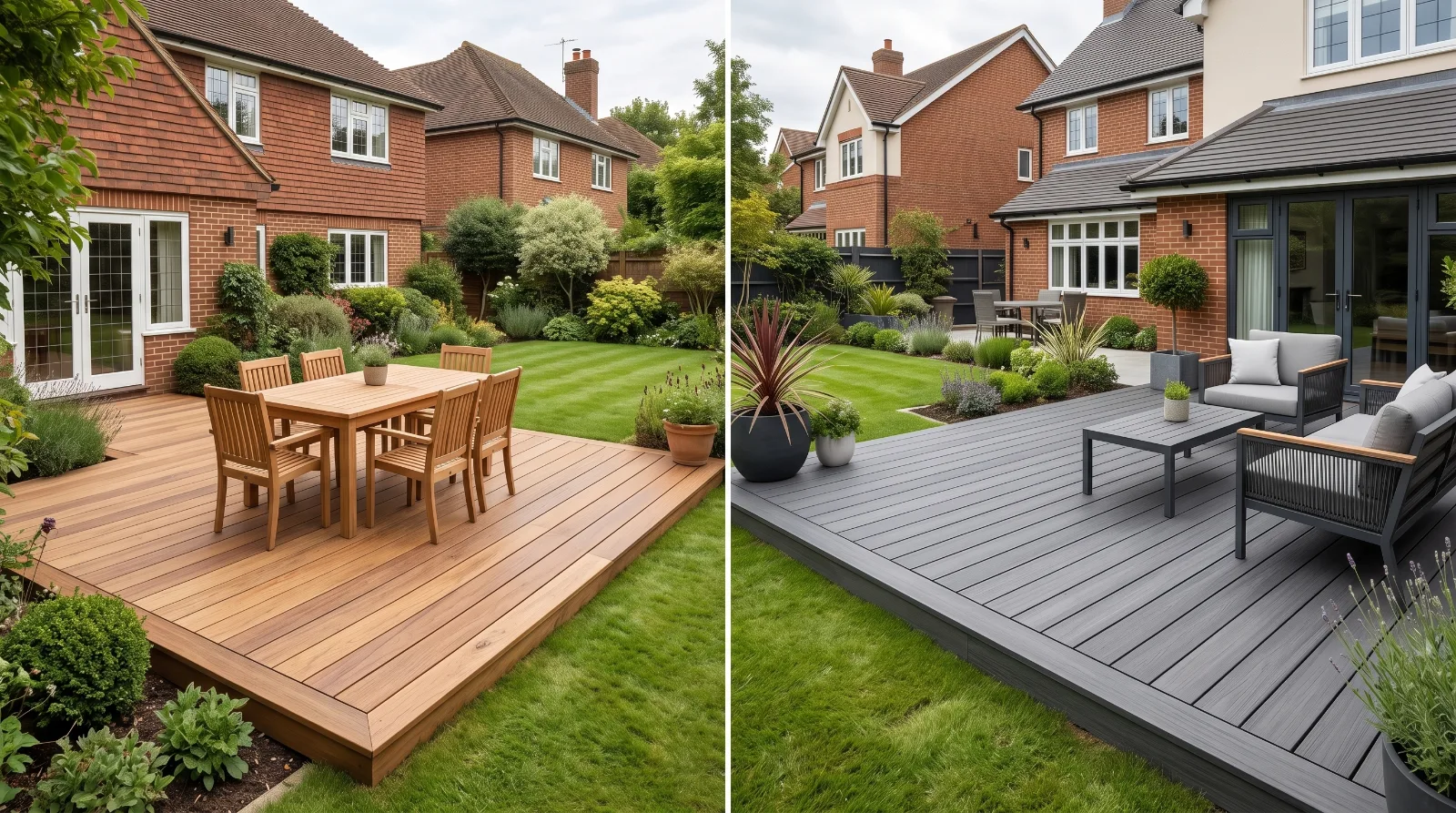
Decking can be a great way to create an outdoor living area, connect the house to the garden or make use of a space that would otherwise be difficult to landscape.
But choosing the right decking material can be surprisingly difficult.
Timber has a natural appearance and remains a popular choice for gardens across the UK. Composite decking offers a more contemporary alternative, with the main attraction being its lower routine maintenance.
Neither option is automatically better for every garden.
The right choice depends on your budget, how much maintenance you are prepared to do, the appearance you want and how the deck will be used.
What Is Timber Decking?
Timber decking is made from natural wood, with common options including treated softwood and hardwood.
Softwood decking is often the more affordable option and can provide a traditional garden appearance. Hardwood decking is generally denser and more expensive, with species and quality varying considerably.
One of timber's biggest advantages is its natural character.
The grain, colour and texture of real wood give the decking a warmth that can be difficult to reproduce with manufactured materials.
Timber can also be cut, shaped and adapted relatively easily, which makes it useful for more bespoke garden designs.
What Is Composite Decking?
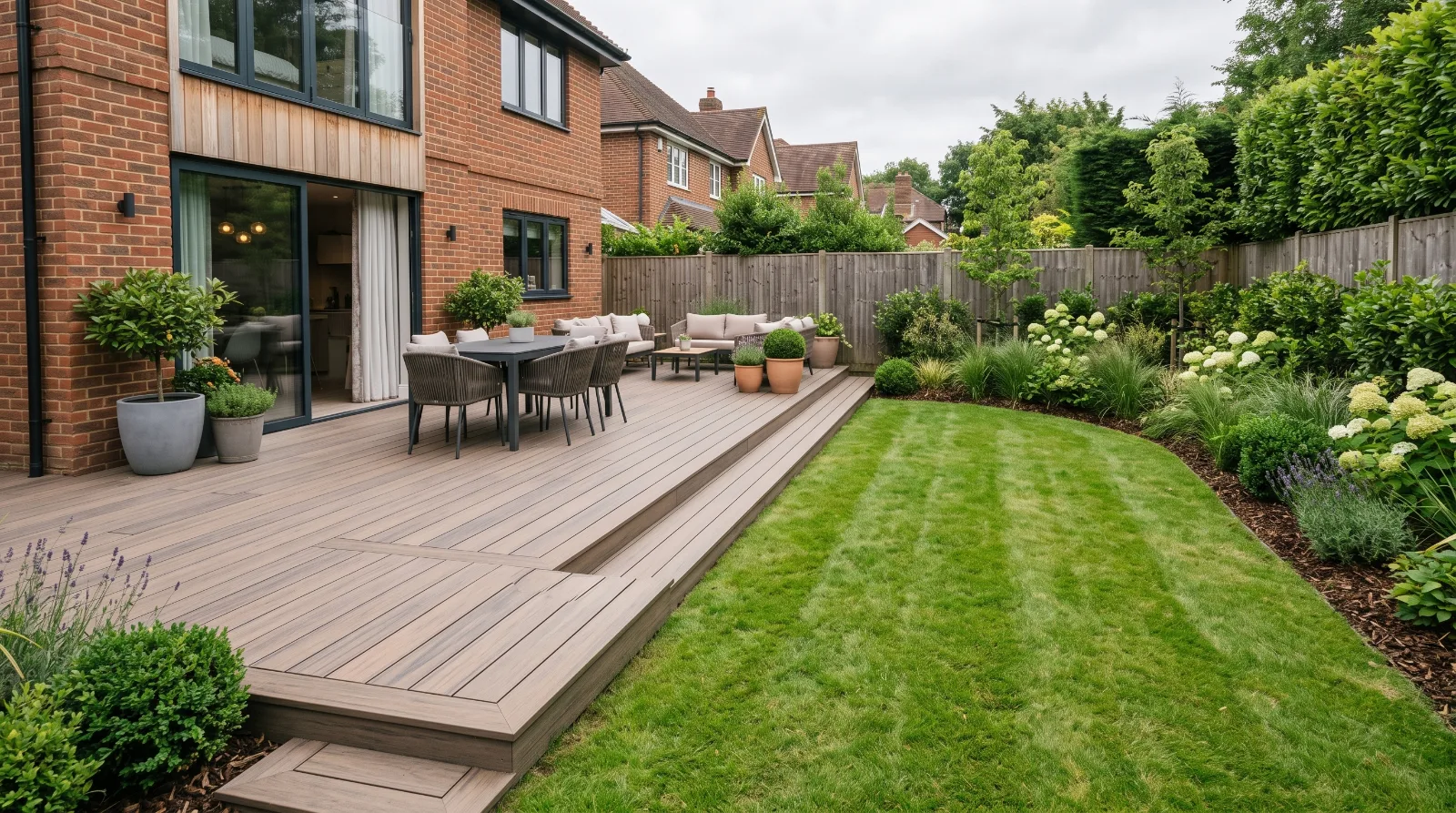
Composite decking is a manufactured decking material commonly made using a combination of wood fibres and polymers.
It is designed to provide the appearance of decking while reducing some of the maintenance associated with natural timber.
Composite boards are available in a wide range of colours, textures and finishes. Some are designed to closely imitate natural wood, while others have a more contemporary appearance.
The exact performance of composite decking varies considerably between products, so quality and specification are important when comparing different systems.
Timber vs Composite Decking at a Glance
Feature | Timber decking | Composite decking |
|---|---|---|
Appearance | Natural and varied | Consistent and modern |
Initial cost | Usually lower | Usually higher |
Maintenance | More regular upkeep | Generally lower |
Painting/staining | May be used to maintain appearance | Usually not required |
Rot resistance | Depends on species and treatment | Not susceptible to timber rot |
Colour changes | Naturally weathers over time | Generally more colour-stable, but fading can still occur |
Repairs | Relatively easy to modify and replace | Depends on the system |
Heat in direct sun | Can become hot | Can also become hot, especially darker colours |
Customisation | Very flexible | More dependent on the system |
Feel underfoot | Natural timber feel | Manufactured but increasingly realistic |
The most important difference is therefore not simply how the decking looks on day one, but how it will look and need to be maintained over the following years.
Which Looks Better?
This is largely a matter of personal taste.
Timber
Timber has a natural variation in colour and grain that gives each deck its own character.
It can work particularly well with:
Traditional homes
Cottage-style gardens
Natural planting
Stone paving
Mature gardens
Informal landscaping
As timber ages, it will naturally weather unless treated to retain its original colour.
Some homeowners like this silver-grey appearance, while others prefer to keep the original warmer tones through regular cleaning and treatment.
Composite
Composite decking offers a more consistent appearance.
It can be a particularly good fit for:
Contemporary gardens
Modern homes
Outdoor kitchens
Pergolas
Clean-lined landscaping
Minimalist garden designs
Modern composite products can reproduce wood grain and texture convincingly, but they still have a more manufactured appearance than natural timber.
The choice ultimately comes down to whether you prefer natural variation or consistent design.
Which Needs More Maintenance?
This is where composite has a major advantage.
Timber decking needs regular cleaning to remove dirt, leaves, algae and other surface deposits. Depending on the timber and the finish you choose, you may also need to apply oils, stains or protective coatings periodically.
The exact level of maintenance depends on the timber species, its location and whether you want to maintain its original appearance.
Composite decking generally requires much less maintenance.
It still needs cleaning, particularly in damp or shaded areas where dirt, algae or mould can accumulate, but it does not normally require the same sanding, staining or sealing associated with maintaining the appearance of natural timber.
That makes composite appealing for homeowners who would rather spend their time using the garden than maintaining it.
Does Timber Decking Need to Be Treated?
Not necessarily.
Some timber decking can be allowed to weather naturally.
However, if you want to retain a particular colour or give the timber additional protection, coatings such as oils, stains or water-repellent products can be used where appropriate.
These finishes need to be maintained and renewed periodically.
This means the question is not simply whether timber needs maintenance.
It is also how you want your timber decking to look as it ages.
A naturally weathered deck can require much less cosmetic maintenance than one that is expected to remain close to its original colour.
Is Composite Decking Maintenance-Free?
No.
This is an important distinction.
Composite decking is low-maintenance rather than maintenance-free.
It still needs occasional cleaning to remove dirt, leaves, food, algae and other deposits.
The deck should also be inspected from time to time, particularly around the supporting structure, fixings and areas where water or debris can collect.
Different composite products also have different maintenance requirements, so the manufacturer's recommendations should be followed.
Which Lasts Longer?
There is no single lifespan that applies to all timber or composite decking.
The expected service life depends on the quality of the material, the design, installation, exposure and maintenance.
With timber, durability varies significantly between species and treatment levels. A properly selected and installed timber deck can provide many years of use when correctly maintained.
Composite products can also have long service lives, but quality differs considerably between manufacturers and product types.
The substructure underneath the boards is also critical.
A premium composite deck still depends on a suitable supporting frame, and many composite decks use timber joists underneath the boards.
Choosing a high-quality surface material does not remove the need for good structural construction.
What About Rot?
Natural timber can deteriorate when it is repeatedly exposed to moisture and conditions that encourage decay.
The risk depends on the timber species, treatment, detailing and how the decking is installed.
Composite does not rot in the same way as natural timber, which is one reason it appeals to homeowners looking for lower maintenance.
However, composite should not be treated as completely immune to outdoor deterioration.
Poor drainage, persistent dampness, dirt accumulation and unsuitable installation can still cause problems.
Which Is Better in the UK Climate?
Both materials can work well in UK gardens.
The British climate brings a mixture of rain, damp conditions, frost, sunlight and changing temperatures, so outdoor decking needs to be designed to cope with those conditions.
Timber naturally absorbs and releases moisture, which means it can expand and contract as the seasons change.
Composite also responds to environmental conditions, and product-specific installation requirements can be particularly important because different composite materials behave differently.
In either case, good drainage and ventilation beneath the deck are essential.
Water should not be allowed to remain trapped around the boards or supporting structure.
Which Is More Slippery?
No decking material should automatically be assumed to be slip-proof.
Rain, leaves, algae and surface dirt can make outdoor decking slippery regardless of the material.
Regular cleaning is therefore an important part of keeping a deck in good condition.
For timber, board profile also matters.
Grooved boards are designed primarily to help move water across the surface rather than automatically making a deck slip-resistant.
Where additional grip is important, particularly around steps or other high-use areas, decking products specifically designed for enhanced slip resistance can be considered.
The conditions surrounding the deck are just as important as the board material.
A shaded, damp deck covered in leaves can become slippery whether it is timber or composite.
Does Composite Decking Get Hot?
Yes.
Composite decking can become hot in direct sunlight, particularly when darker colours are used.
This is not unique to composite. Timber and other outdoor surfaces can also become hot when exposed to strong sunlight.
If the deck is in a particularly sunny location, colour selection can make a difference.
Lighter colours generally absorb less heat than darker ones, and some manufacturers now offer products specifically designed to reduce surface temperatures.
This is worth considering if the deck will be used regularly in bare feet or by children.
Which Is Easier to Repair?
Timber has an advantage when it comes to flexibility.
Individual boards can often be replaced, cut or modified relatively easily.
This can be useful if a small section becomes damaged or if you want to make changes to the deck in the future.
Composite decking can also be repairable, but the process depends on the particular system.
Some products allow individual boards to be removed and replaced, while others use proprietary clips and components that make repairs more product-specific.
It is worth checking how a composite system can be repaired before committing to it.
Which Is Easier to Customise?
Timber is generally the more flexible material.
Because it can be cut and worked on site, it can be adapted around:
Curved boundaries
Existing trees
Changes in level
Unusual garden shapes
Steps
Bespoke seating
Built-in features
Composite decking can also be used for creative designs, but you will usually need to work within the dimensions and installation system provided by the manufacturer.
For a simple rectangular deck, this may make very little difference.
For a complicated garden, it can be an important consideration.
Is Composite More Expensive?
Usually, yes.
Composite decking generally has a higher upfront cost than standard treated softwood timber.
Current UK cost guides show a wide range depending on product quality, deck size, access, height and construction, but consistently place many composite systems above basic softwood decking on initial installation cost.
However, the initial price is not the whole story.
A timber deck may require additional expenditure over its life for cleaning products, protective treatments, staining, repairs and replacement boards.
Composite generally has lower routine maintenance requirements, so a higher upfront cost may be attractive to someone planning to keep the deck for many years.
Timber vs Composite: Which Is Better Value?
This depends on how you measure value.
Timber may offer better value if:
Your initial budget is limited
You like natural timber
You do not mind regular maintenance
You want greater flexibility during installation
You may want to change the finish later
Composite may offer better value if:
You want minimal ongoing maintenance
You prefer a consistent appearance
You are prepared to spend more initially
You want to avoid regular staining and sealing
You expect to keep the deck for many years
The cheapest deck to install is not necessarily the cheapest deck to own.
What About the Subframe?
This is something many homeowners overlook.
The decking boards are only the visible part of the structure.
Underneath them is the subframe, made from joists and supporting timbers that carry the load of the deck.
A poor-quality or inadequately protected subframe can become a problem regardless of whether the surface is timber or composite.
The supporting structure therefore needs to be designed and installed appropriately for the deck, its height, ground conditions and intended use.
In many cases, composite boards are still installed over timber subframes, so choosing composite does not mean every part of the deck becomes maintenance-free.
Which Works Better on a Sloping Garden?
Decking can be particularly useful on sloping sites because a raised structure can create a usable level without requiring the entire garden to be excavated and levelled.
Timber offers considerable flexibility because the structure can be built around the existing levels.
Composite can also work very well on sloping gardens, but the supporting structure and the manufacturer's installation requirements need to be considered carefully.
The slope itself should therefore not determine whether you choose timber or composite.
Instead, look at the overall design, structure and access requirements.
Which Is Better for a Family Garden?
Both can work well for families.
Think about how the deck will be used.
If it will become a high-traffic dining and entertaining area, you may value easy cleaning and low maintenance.
If children will regularly use the deck, consider the surface texture, colour, edges, stairs and how hot the material can become in direct sunlight.
For a family garden where convenience is a major priority, composite can be particularly attractive.
For someone who prefers a natural material and does not mind maintaining it, timber remains an excellent option.
Which Is Better Around a Pool or Hot Tub?
Both materials can be used around pools and hot tubs, but the surrounding conditions need to be considered carefully.
Constant exposure to water makes drainage and ventilation especially important.
The surface should also be selected with slip resistance and barefoot use in mind.
Composite can be appealing because it avoids some of the decay concerns associated with natural timber, while timber offers a natural appearance that can work beautifully with planting and water.
The specific product should always be checked for its intended application rather than assuming all decking is equally suitable.
Which Is More Environmentally Friendly?
There is no simple answer.
Timber is a natural, renewable material, and responsibly sourced timber can be a sensible choice from a sustainability perspective.
Composite can also contain recycled materials, with some products making substantial use of reclaimed wood fibre and recycled plastics.
However, the environmental impact depends on more than the material itself.
Consider:
Where the material comes from
How long it lasts
How much maintenance it requires
Whether it needs replacing
What happens at the end of its life
The recycled or responsibly sourced content
A long-lasting deck that is properly maintained can avoid repeated replacement, regardless of whether it is timber or composite.
Which Looks Better After Several Years?
This depends on what you expect from the material.
Timber will naturally develop a weathered appearance unless it is regularly treated to maintain its original colour.
This can be part of its appeal.
Composite is generally designed to maintain a more consistent appearance, although composite products are not completely immune to colour fading or surface changes over time.
Some composite products can also develop mould or mildew in damp, shaded conditions if they are not kept clean.
Neither material will look exactly as it did on installation day several years later.
The difference is that timber changes more naturally, while composite is generally designed to change less dramatically.
Which Is Better for a Modern Garden?
Composite often suits modern gardens particularly well because of its clean lines and consistent colours.
It can work alongside:
Porcelain paving
Modern pergolas
Outdoor kitchens
Architectural planting
Rendered walls
Contemporary garden rooms
Timber can also look excellent in contemporary gardens, especially where the design uses natural materials and softer planting.
A timber deck with modern furniture and structured planting can create a much warmer appearance than an entirely hard, manufactured landscape.
Which Is Better for a Traditional Garden?
Timber usually has the advantage here.
Its natural grain and weathering work well with established planting, brickwork, natural stone and more informal garden styles.
That does not rule out composite.
There are now composite boards designed to mimic natural wood, which can work in more traditional settings.
However, if authentic natural timber is central to the appearance you want, composite will not completely reproduce that character.
Timber vs Composite Decking: Which Should You Choose?
The decision becomes much easier when you focus on what matters most to you.
Choose timber if you want natural character, flexibility and a lower initial cost, and you are comfortable with ongoing maintenance.
Choose composite if you are willing to spend more initially in exchange for lower routine maintenance and a more consistent appearance.
Neither is universally better.
The quality of the product, the design of the deck and especially the supporting structure can have as much influence on the finished result as the choice between timber and composite.
What Should You Consider Before Installing Decking?
Before choosing your boards, think about:
Budget
How much are you comfortable spending initially?
Maintenance
Are you happy to clean, treat and periodically refinish natural timber?
Appearance
Do you prefer genuine wood or a consistent contemporary finish?
Location
Will the deck be exposed to full sun, shade or frequent moisture?
Use
Will it mainly be used for dining, relaxing, entertaining, children or access?
Shape
Is the deck a simple rectangle or will it require a more complicated design?
Access
Can materials and equipment reach the garden easily?
Subframe
Is the supporting structure being designed properly for the site and chosen decking?
These decisions can help narrow down the right material before installation begins.
Timber or Composite Decking: There Is No Single Winner
Timber and composite decking both have a place in modern UK gardens.
Timber offers natural character, flexibility and a more traditional feel, while composite offers a consistent appearance and significantly reduces the amount of routine maintenance required on the deck boards.
The best choice is therefore not the material that wins every comparison.
It is the material that matches your garden, your budget, your preferred appearance and how much maintenance you want to take on.
And whichever option you choose, the quality of the supporting structure and installation will have a major impact on how well the deck performs over time.
Need Decking in Surrey?
Whether you prefer the natural appearance of timber or the low-maintenance benefits of composite, the decking should form part of a wider garden design.
Surrey Oak Landscapes can help with decking, patios, planting, pergolas, outdoor living areas and complete garden transformations, creating a finished space that suits your home and the way you use your garden.
Planning new decking in Surrey? Get in touch with Surrey Oak Landscapes for a free, no-obligation quote.
About the author