Resin Bound vs Resin Bonded: What's the Difference?
Resin bound and resin bonded paving look similar but are installed differently. Learn how they compare on drainage, appearance, maintenance, cost and use.
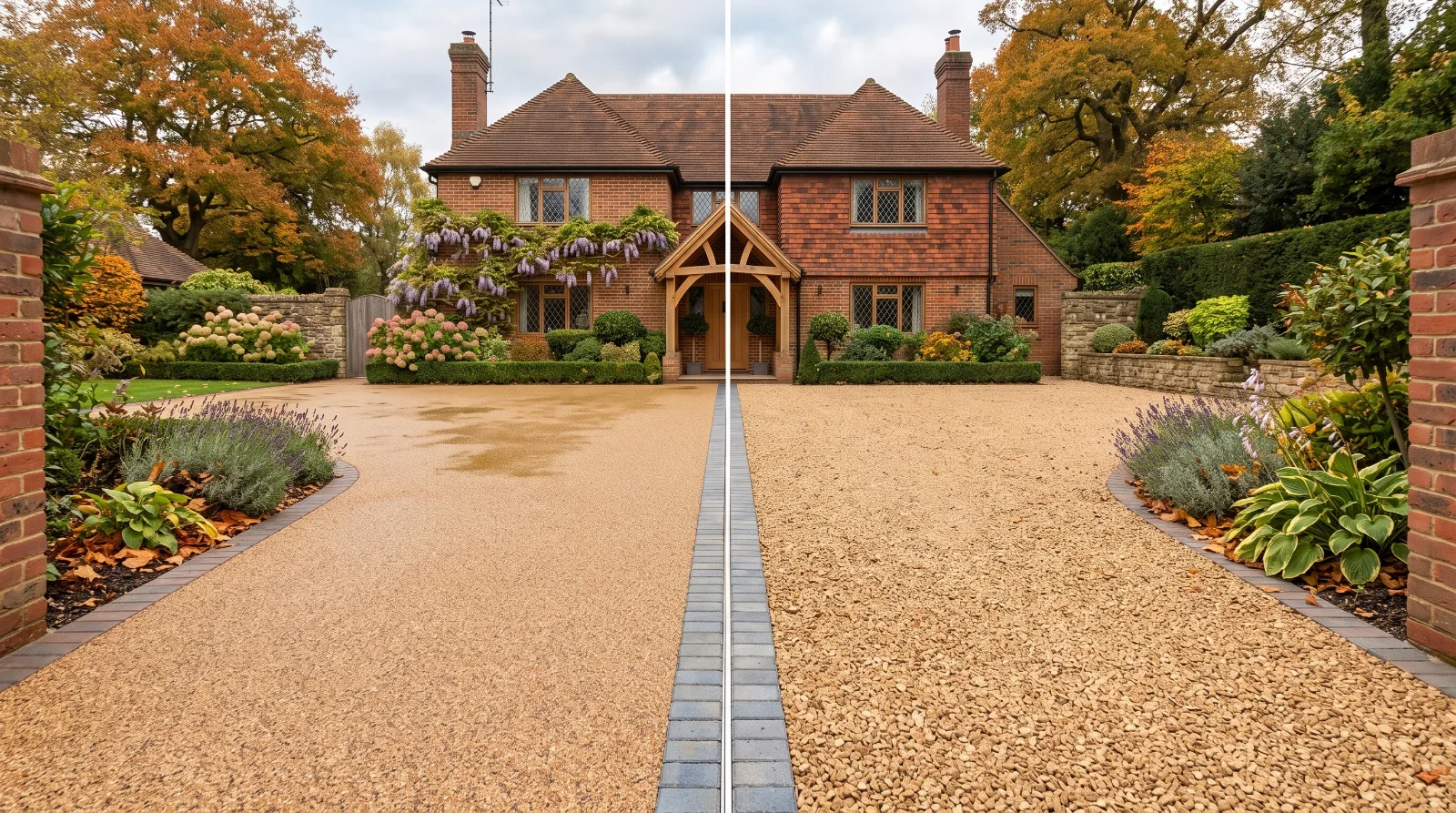
Resin bound and resin bonded paving are often described as if they are the same thing. They are not.
Although both use decorative aggregate and resin, the way they are constructed is completely different. This affects the appearance, texture, permeability, thickness, maintenance and suitability of the finished surface.
For homeowners considering a new driveway, patio or pathway in Surrey, understanding the difference can make it much easier to compare quotes and choose the right surface for the job.
What Is Resin Bound Paving?
Resin bound paving is made by mixing the chosen aggregate with resin before the mixture is laid onto a prepared base.
The aggregate and resin are thoroughly combined, then spread and trowelled to create a smooth, even surface.
Because the stones are mixed through the resin rather than simply scattered onto the surface, the finished paving has a consistent appearance with no loose layer of decorative stone on top.
Resin bound systems can also be designed to allow water to pass through the surface when the correct permeable materials and underlying construction are used.
This makes resin bound particularly useful for driveways and other areas where surface water management is an important part of the design.
What Is Resin Bonded Paving?
Resin bonded paving is installed differently.
Instead of mixing the aggregate into the resin, a layer of resin is applied to a suitable existing surface and decorative aggregate is scattered over the resin while it is still tacky.
Once the resin cures, the stones are fixed to the surface.
The finished appearance can resemble loose gravel, but the aggregate is held in place by the resin underneath.
Resin bonded surfacing is generally much thinner than resin bound paving and is normally applied over a suitable solid base. It is also generally impermeable, meaning water does not simply pass through the surface as it can with a properly designed permeable resin bound system.
Resin Bound vs Resin Bonded
The simplest way to remember the difference is:
Resin bound = aggregate mixed with resin.
Resin bonded = aggregate scattered onto resin.
That small difference in the installation process creates significant differences in the finished surface.
Feature | Resin Bound | Resin Bonded |
|---|---|---|
Installation | Aggregate mixed with resin, then trowelled | Resin applied first, aggregate scattered over it |
Appearance | Smooth and consistent | Textured, gravel-like appearance |
Surface thickness | Usually considerably thicker | Usually much thinner |
Permeability | Can be permeable with the correct system and base | Generally impermeable |
Loose stones | Very few when correctly installed | Some excess aggregate can remain or become loose |
Colour options | Wide range of aggregate blends | Wide range, but aggregate selection is more limited |
Typical cost | Higher | Lower |
Typical applications | Driveways, patios, paths | Paths, decorative areas and suitable driveways |
Base requirements | Requires a suitable structural base | Requires a sound, suitable existing surface |
The exact specification varies between products and applications, so these should be treated as general differences rather than fixed rules.
Which Looks Better?
This largely comes down to the style you want.
Resin bound produces a smooth, continuous appearance because the aggregate is contained throughout the resin matrix. This can create a clean finish that works particularly well with modern houses and contemporary landscaping.
Resin bonded has a more textured appearance. Because the aggregate sits on top of the resin, it can create a look that is visually closer to loose gravel.
Both systems are available in different aggregate colours and blends, meaning the surface can be designed to complement brickwork, render, walls, planting and other hard landscaping.
What About Drainage?
Drainage is one of the biggest differences to understand.
A correctly designed resin bound system can be permeable because the spaces between the aggregate particles allow water to move through the surface.
However, the surface alone does not determine whether a driveway is actually permeable.
The underlying construction also needs to allow water to pass through and be managed appropriately.
A resin bonded surface does not work in the same way. Because the resin forms a continuous layer underneath the surface aggregate, it is generally impermeable.
This means that drainage needs to be considered separately when designing a resin bonded installation.
Is Resin Bound Stronger Than Resin Bonded?
The two systems are constructed differently, so it is better to think in terms of application and specification rather than assuming one is universally stronger.
Resin bound is a full-thickness surface layer in which the aggregate and resin form a single matrix. It is commonly used for domestic driveways, paths and patios where a smooth, durable finished surface is required.
Resin bonded is a thinner surface dressing. The strength and stability of the finished installation therefore depend heavily on the existing base beneath it.
In both cases, the condition and preparation of the base are critical.
A high-quality resin surface cannot compensate for a weak, moving or poorly prepared foundation.
Which Requires Less Maintenance?
Both surfaces are relatively straightforward to maintain when correctly installed.
Regular sweeping helps remove leaves, soil and other debris before it builds up. Occasional cleaning can also help keep the surface looking fresh.
Resin bound surfaces have no conventional open joints between slabs, which can reduce some of the weed and dirt accumulation associated with traditional block paving.
Resin bonded surfaces can also be low maintenance, although loose surface aggregate and wear to heavily used areas should be monitored over time.
The surrounding landscape matters too. Trees, planting beds and unprotected soil can all introduce leaves, organic debris and dirt onto the surface.
Is Resin Bound More Expensive?
In most cases, resin bound costs more than resin bonded.
This is partly because resin bound uses more material and involves mixing, spreading and trowelling the aggregate-resin mixture to a consistent depth.
Resin bonded is a thinner surface dressing, which can make it a more economical option for suitable applications.
However, the cheapest option is not necessarily the most appropriate one.
The cost should be considered alongside the existing base, drainage requirements, intended use and the finish you want.
A quote that appears cheaper may also be specifying a completely different construction method.
Can Resin Bound Be Laid Over an Existing Driveway?
Sometimes.
A suitable existing tarmac or concrete base can potentially provide the foundation for a resin bound surface, provided it is structurally sound and appropriate for the proposed installation.
Cracks, movement, weak areas and drainage problems should be addressed before the resin surface is installed.
This is important because resin bound is a surface system rather than a solution for an unstable driveway.
If the base moves, the surface above it can move too.
Which One Is Right for a Surrey Home?
There is no single answer for every property.
Resin bound may suit you if you want:
A smooth and continuous finish
A wide range of aggregate blends
A permeable surface system where the whole build-up is designed accordingly
A premium finish for a driveway or patio
A surface with minimal loose aggregate
Resin bonded may suit you if you want:
A thinner decorative surface
A gravel-like appearance
A potentially lower-cost resin surfacing option
A suitable finish over an existing sound base
Surfacing for appropriate paths or lower-demand areas
The right choice depends on the site as much as personal preference.
Don't Choose Resin Based on the Name Alone
One of the most important things to check when comparing quotations is exactly which resin system is being proposed.
“Resin driveway” can be used as a general term, but resin bound and resin bonded are different installation methods.
Ask the contractor:
Which system are you installing?
What will the finished surface be laid over?
How will the base be prepared?
How will surface water be managed?
What thickness will be installed?
What aggregate and resin system will be used?
Is the existing surface suitable?
These questions can tell you much more about the proposed installation than the word “resin” on its own.
Choosing the Right Resin Surface
Resin bound and resin bonded surfaces can both have a place in landscaping, but they should not be treated as interchangeable products.
Resin bound combines aggregate and resin before installation to create a thicker, smooth surface, while resin bonded uses resin as an adhesive layer with aggregate scattered over the top.
The better choice depends on the property, existing base, intended use, drainage requirements, budget and appearance you want to achieve.
For a Surrey driveway or patio, getting the base, levels and drainage right is just as important as choosing the resin system itself.
Surrey Oak Landscapes can help assess your existing surface, discuss suitable paving and surfacing options, and plan a driveway or patio around the wider landscape design.
About the author