How to Make Your Garden More Private
Make your garden more private with practical ideas for fencing, planting, trellis, screening, trees and pergolas without making the space feel enclosed.
A garden should feel like a space where you can relax without constantly worrying about being overlooked.
For some homes, privacy is only an issue around a patio or seating area. For others, neighbouring windows, nearby gardens or roads can leave much of the outdoor space feeling exposed.
Fortunately, creating more privacy does not necessarily mean surrounding the entire garden with tall fencing.
The best results often come from combining different approaches, such as fencing, planting, screening and thoughtful garden design. The aim is to block unwanted views while keeping the garden feeling open, attractive and enjoyable.
Start by Working Out Where the Problem Is
Before adding anything, identify exactly where you are being overlooked.
You might only need screening around one part of the garden rather than along the entire boundary.
For example, a neighbouring upstairs window may look directly over your seating area, while the rest of the garden already feels private.
Look at the garden from the positions where you normally spend time:
Patio
Dining area
Seating area
Kitchen doors
Garden room
Lawn
Hot tub or pool area
Then consider where the unwanted view is coming from.
This helps you create targeted privacy rather than adding unnecessary screening everywhere.
Use Fencing for Immediate Privacy
A solid fence is one of the quickest ways to create privacy at ground level.
Closeboard fencing, solid timber panels and other screening styles can provide a strong visual barrier between neighbouring gardens.
The best fence depends on the property and the style of the garden.
For example:
Fencing option | Typical benefit |
|---|---|
Closeboard | Solid, traditional privacy |
Overlap panels | Simple and practical |
Composite | Low-maintenance modern finish |
Slatted fencing | Privacy with a lighter appearance |
Decorative panels | Privacy with more visual detail |
A fence does not have to look like a blank wall.
Choosing the right colour, materials and surrounding planting can make the boundary feel like an intentional part of the garden design.
Think About Privacy Above the Fence
One of the most common privacy problems occurs when a neighbouring property overlooks the garden from an upper floor.
Increasing the height of the existing boundary may not always be the best answer.
Instead, consider adding privacy features at the specific point where the view enters the garden.
Trellis, carefully positioned planting, screening panels and trained trees can all help interrupt views from above without completely enclosing the garden.
This can be particularly useful where you want privacy around a seating area but still want plenty of light.
Add Trellis to Existing Boundaries
Trellis can provide an effective middle ground between an open fence and a completely solid screen.
It adds height and structure while still allowing some light and airflow through.
Trellis can also provide support for climbing plants, allowing the boundary to become greener over time.
This makes it particularly useful where you want a softer appearance rather than a large expanse of solid timber.
Before adding height to an existing boundary, check that the proposed structure is suitable for the property and does not breach any local restrictions.
Use Plants as Natural Screening
Plants can create privacy while making the garden feel greener and more attractive.
Evergreen shrubs, hedges and suitable trees can provide screening throughout much of the year, while deciduous trees and shrubs can add seasonal interest.
The right plant depends on:
Available space
Desired height
Soil conditions
Sunlight
Growth rate
Maintenance requirements
How quickly you need privacy
It can be tempting to choose the fastest-growing plant available, but rapid growth also means more pruning.
A plant that eventually becomes much larger than the space available can create another problem instead of solving the first one.
Use Layered Planting
A single row of identical plants can provide privacy, but layered planting often looks more natural.
For example, you might combine:
Groundcover → shrubs → taller shrubs → small trees
This creates different heights within the garden and can soften the appearance of a boundary.
It also gives you more flexibility when one plant is not providing complete screening.
Planting can be particularly effective when combined with a fence.
The fence provides immediate privacy while shrubs and trees gradually soften the boundary as they establish.
Consider Evergreen Plants
If privacy is needed throughout the year, evergreen planting can be especially useful.
Evergreen shrubs and trees retain their foliage for much of the year, meaning they can continue to provide screening when deciduous plants have lost their leaves.
However, evergreen does not automatically mean low maintenance.
A dense hedge may require regular trimming to remain within its intended size.
The plant should therefore be chosen based not only on its ability to screen but also on how much space and maintenance it will require as it matures.
Use Trees for Higher-Level Privacy
Trees can be particularly effective where neighbouring properties overlook the garden from above.
A carefully positioned tree can interrupt a view without requiring a large solid structure.
Small and medium-sized trees may be more appropriate for many residential gardens than simply planting the largest possible specimen.
The position is important.
A tree planted too close to a boundary can eventually become difficult to manage, while one placed strategically within the garden can provide screening from a specific viewing angle.
Think about the final size of the tree, not just how it looks when it is planted.
Pleached Trees for Privacy
Pleached trees are trained onto a clear stem with foliage forming a relatively high, horizontal screen.
They can be useful where you want privacy at upper-window level but do not want a large tree canopy taking up extensive ground space.
They can create a formal architectural appearance and work particularly well alongside modern landscaping.
However, they require ongoing maintenance to keep their trained shape, so they are best considered when you are comfortable with that level of upkeep.
Use Climbers on Fences and Walls
Climbing plants can turn a bare fence or wall into a green backdrop.
They are particularly useful where ground space is limited because much of the growth can be directed vertically.
Depending on the conditions and the support provided, climbers can add:
Greenery
Flowers
Seasonal colour
Texture
Additional visual screening
The support needs to be suitable for the eventual weight and growth of the plant.
Rather than planting a climber and hoping it will cover the entire boundary, consider how it will be trained and maintained as it grows.
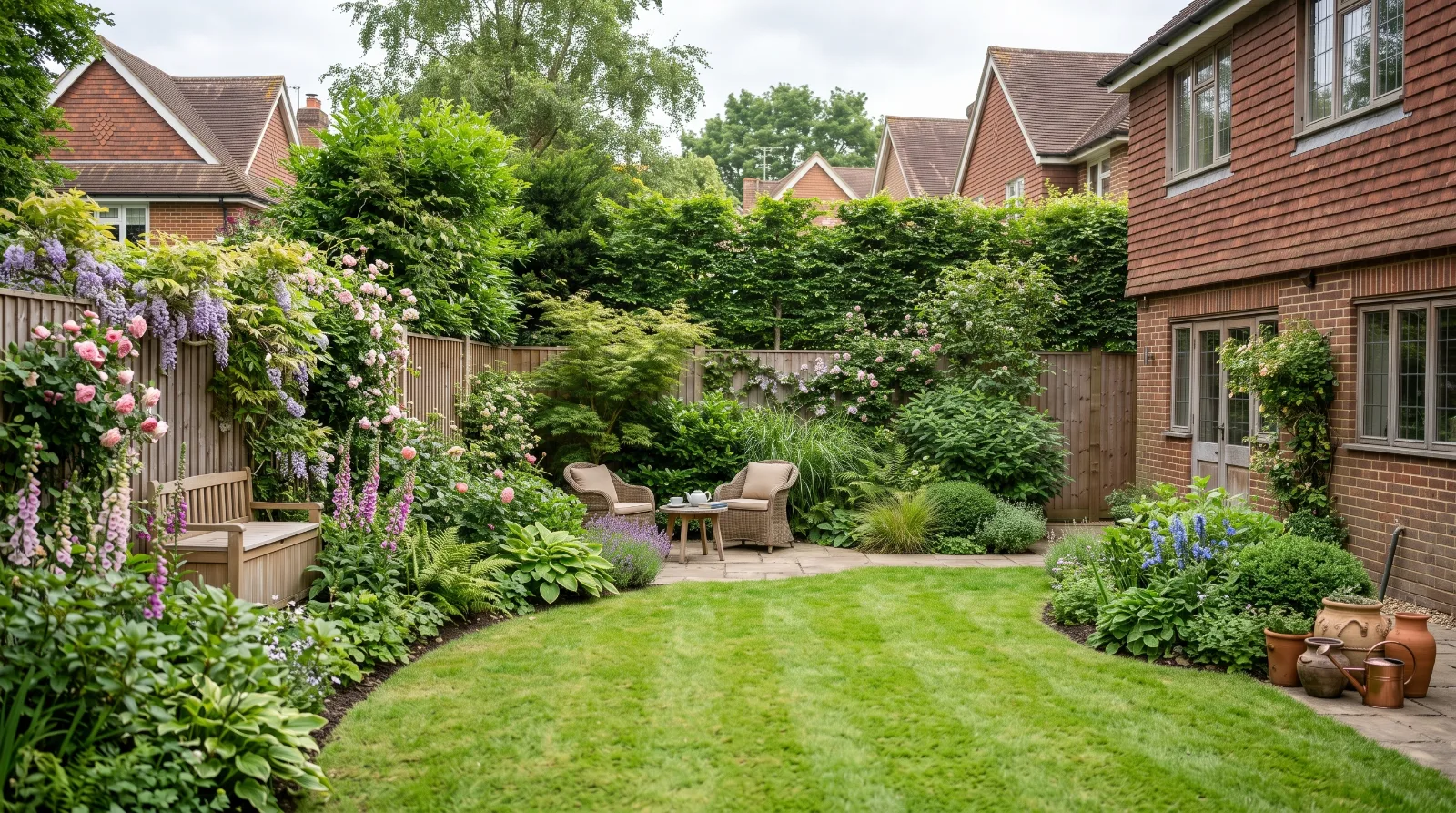
Create a Private Seating Area
You do not always need to make the entire garden private.
Creating one enclosed or semi-screened seating area can be much more effective.
For example, a patio or dining area can be surrounded by:
Tall planting
Trellis
Slatted screens
Pergola structures
Shrubs
Small trees
This creates a private outdoor room without making the whole garden feel enclosed.
It also lets you concentrate the screening where you actually spend time.
Use a Pergola for Privacy
A pergola can provide both structure and privacy.
Vertical screens can be added to one or more sides, while climbing plants can gradually soften the structure.
A pergola is particularly useful over an outdoor dining area or seating space because it creates a defined destination within the garden.
Privacy can also come from above.
Training plants across a pergola can create a sense of enclosure while still allowing light through.
Consider Slatted Screening
Slatted screens provide privacy without looking completely solid.
The gaps between the boards allow some light through and can make the structure feel lighter than a full-height wall.
Depending on the viewing angle, the screen can still block direct sightlines.
This can be useful where privacy is important but you do not want to make the garden feel boxed in.
Slatted timber can also complement modern paving, outdoor kitchens, pergolas and contemporary planting.
Use Your Garden Layout to Improve Privacy
Privacy is not only about adding barriers.
The position of different features can affect how exposed the garden feels.
For example, moving a seating area away from a boundary or placing a planting bed between the seating and neighbouring property can make a noticeable difference.
Similarly, a change in level can sometimes place a seating area below the main sightline.
This is why privacy should be considered as part of the wider garden design rather than treated as a separate problem.
Use Existing Features to Your Advantage
Before building anything new, look at what you already have.
An existing tree, shed, garden room, pergola or mature shrub may already block part of the unwanted view.
You may only need to add planting around an existing feature or adjust the position of your seating area.
This can be a more cost-effective approach than replacing the entire boundary.
Don't Forget Privacy From Above
Ground-level privacy is relatively straightforward because fences and hedges can block direct views.
Overlooking from upstairs windows is more difficult.
A combination of trees, pleached planting, pergolas and carefully positioned screens can help break up those higher sightlines.
The important thing is to consider the angle of the view.
A screen does not necessarily have to be extremely tall if it is positioned correctly between your seating area and the source of the overlooking.
How Tall Should Your Privacy Screen Be?
There is no single height that works for every garden.
The required height depends on where the view is coming from and which area you are trying to screen.
A screen around a ground-level patio may need much less height than one intended to block an upstairs window.
For fencing in England, the commonly permitted development height limit is generally 2 metres, although the rules can vary depending on circumstances and location.
Higher fencing or other structures may require additional consideration, so it is worth checking the relevant rules before making substantial changes.
Planting gives you more flexibility because the privacy is created through natural growth rather than simply increasing the height of a boundary.
Avoid Making the Garden Feel Like a Fortress
Privacy is important, but too much solid screening can make a garden feel dark and enclosed.
If every boundary is covered by tall, dense structures, you may solve the overlooking problem while creating another one.
This is where a combination of materials often works best.
For example:
Fence + planting + trellis + open lawn
can provide privacy while maintaining a sense of space.
You can also leave some views open where they are attractive and only screen the areas that need it.
Think About Light
Before installing a tall fence, hedge or screen, consider what effect it will have on sunlight.
A feature that blocks a neighbour's view can also block light into your own garden.
This is particularly important in smaller gardens where sunlight is already limited.
Slatted screens, more open planting and carefully positioned trees can provide privacy while allowing some light through.
The aim is to control the view rather than simply build the largest barrier possible.
Think About Maintenance
Privacy planting needs maintenance just like any other part of the garden.
A hedge that grows several feet beyond its intended size can become difficult to manage and may begin to dominate the garden.
Before choosing a privacy plant or screen, consider:
Solution | Maintenance |
|---|---|
Timber fence | Low to moderate |
Composite fence | Generally low |
Slatted screen | Low to moderate |
Formal hedge | Moderate to high |
Evergreen shrubs | Moderate |
Pleached trees | Moderate to high |
Climbers | Depends on species |
The cheapest privacy solution is not always the easiest one to live with long term.
What Is the Best Privacy Solution for a Small Garden?
Small gardens often benefit from lighter screening rather than large solid barriers.
A combination of a good boundary fence, narrow planting beds and carefully positioned climbers can create privacy without taking up too much ground space.
Vertical planting is particularly useful.
Instead of spreading plants across the garden, encourage growth upwards using trellis or suitable supports.
A compact seating area surrounded by planting can also feel considerably more private than the same furniture sitting in the middle of an exposed lawn.
What Is the Best Privacy Solution for a Large Garden?
Larger gardens give you more options.
You can use trees, hedges, planting groups, structures and changes in level to create privacy at different points.
Rather than enclosing the whole boundary, consider creating several private destinations.
A dining terrace might have screening around it, while a lawn remains relatively open and a quieter seating area further down the garden is surrounded by planting.
This approach creates privacy without making the entire garden feel closed.
How Much Does Garden Privacy Cost?
There is no single cost because privacy can be achieved in many different ways.
A simple replacement fence may be relatively straightforward, while a more ambitious screening scheme involving mature planting, structures and landscaping can become a much larger project.
The main factors include:
Length of the boundary
Height of the screen
Material choice
Number and size of plants
Access
Ground preparation
Existing fencing
Removal of old boundaries
Landscaping around the finished screen
A combination of solutions can sometimes provide better value than relying entirely on one expensive feature.
Which Privacy Solution Should You Choose?
The right choice depends on what you are trying to hide and how you want the finished garden to feel.
Privacy problem | Possible solution |
|---|---|
Neighbouring garden at ground level | Solid fencing |
Upper-floor overlooking | Trees, pleached trees or targeted screening |
Exposed patio | Planting, trellis or screen |
Bare boundary | Climbers, shrubs or new fencing |
Small garden | Vertical planting or lightweight screening |
Large garden | Layered planting and separate private areas |
Modern garden | Composite or slatted screening |
Traditional garden | Timber fencing and hedging |
You do not necessarily need to choose just one.
The most successful privacy schemes often combine hard landscaping and planting to create immediate screening that becomes more natural over time.
Don't Forget the Rest of the Garden
Privacy should improve the garden rather than dominate it.
Before adding a fence, screen or hedge, consider what the garden will look like once everything has matured.
Will there still be enough sunlight?
Will the seating area remain comfortable?
Will the planting have enough room?
Will the boundary complement the patio and house?
Will you be able to maintain everything without constant cutting back?
These questions help ensure that the privacy solution remains useful several years after installation.
How to Make Your Garden More Private
There is no one perfect way to create privacy.
Fencing provides an immediate solution. Trellis and screens can add targeted height. Trees and hedges bring natural screening, while pergolas and planting can create more private outdoor rooms.
The best approach is usually to identify exactly where privacy is needed and why, then choose a combination of solutions that blocks the unwanted view without making the whole garden dark or enclosed.
A well-designed private garden should still feel open, attractive and connected to the surrounding landscape.
Need Help Creating a More Private Garden in Surrey?
Whether you need a new boundary fence, additional screening or a complete redesign of an overlooked garden, privacy can be built into the wider landscape.
Surrey Oak Landscapes can help with fencing, planting, garden design, patios, pergolas and other landscaping features to create a more private and usable outdoor space.
Looking for more privacy in your Surrey garden? Get in touch with Surrey Oak Landscapes for a free, no-obligation quote.
About the author