How to Design a Long Narrow Garden
Have a long narrow garden? Discover practical ways to make the most of the space with better layouts, planting, paving, seating and garden features.
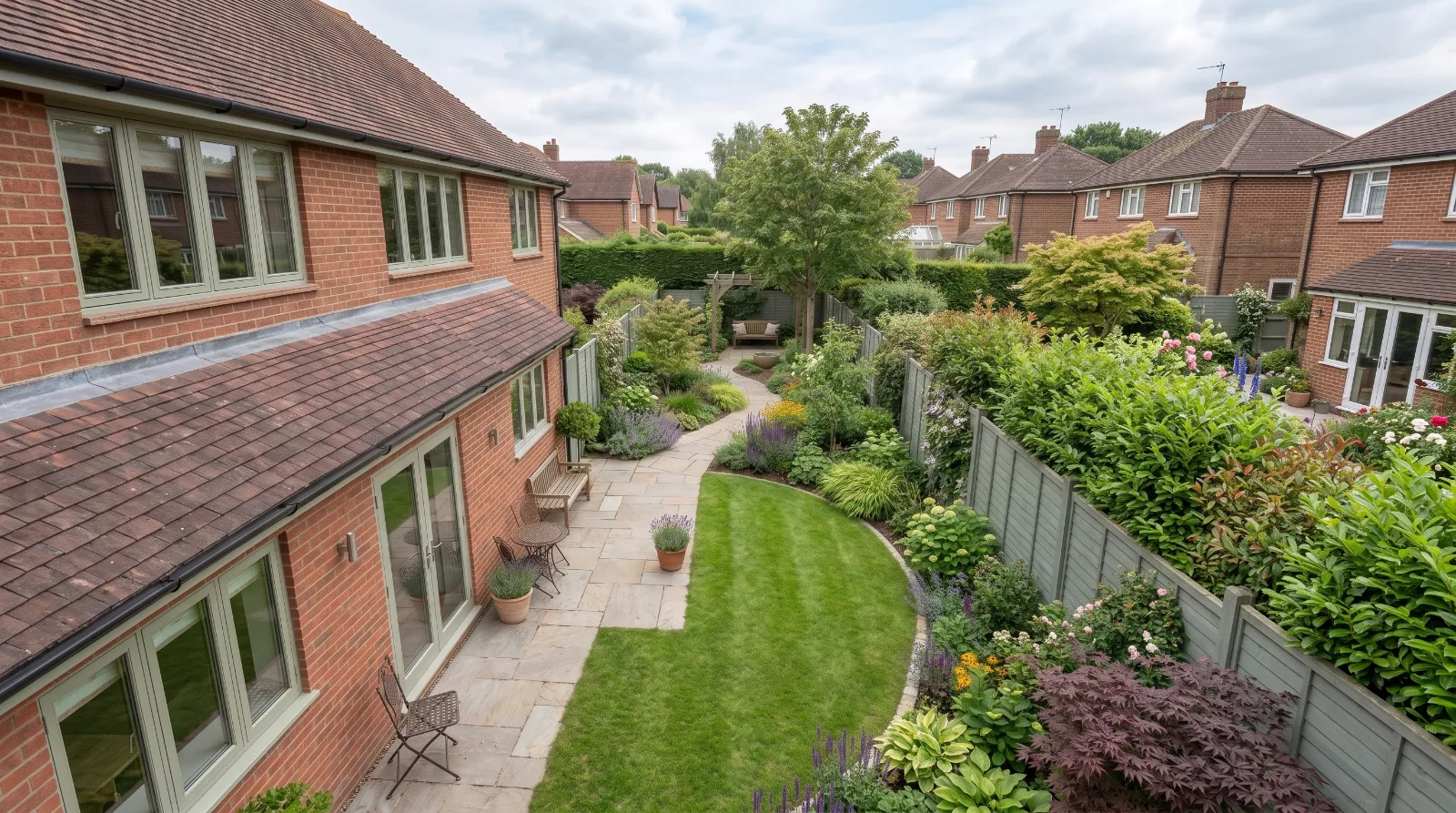
Long, narrow gardens can be challenging to design. The lack of width can make the space feel enclosed, while a straight layout can sometimes create the impression of a long corridor rather than a garden.
However, the shape does have advantages. A long garden can provide plenty of space for different uses, from dining and entertaining close to the house to planting, lawns and quieter seating areas further away.
The key is to work with the proportions of the garden rather than trying to make it look like a square plot.
A good design should create a sense of movement, give each part of the garden a purpose and make the whole space feel connected.
Start With the Shape of the Garden
Before choosing materials or plants, look carefully at the existing layout.
Measure the garden and note fixed features such as:
The house and doors
Existing fences and walls
Trees
Outbuildings
Drainage points
Changes in level
Access points
Also consider where the garden gets the most sunlight.
A long garden can have noticeably different conditions from one end to the other. The area close to the house may be more shaded, while the far end could receive much more direct sunlight.
Creating a simple plan before starting can make it much easier to understand how everything will fit together and avoid designing features that are too large for the available width.
Avoid Creating One Long Straight Line
One of the easiest mistakes is putting a straight path, straight lawn and straight borders directly down the middle of the garden.
This can emphasise the garden's length and make it feel even narrower.
Instead, introduce some variation.
You could:
Offset a path
Use curved planting borders
Change paving direction
Create separate seating areas
Introduce different materials
Use planting to interrupt long views
The aim is not to make the garden feel complicated. It is simply to prevent the eye from travelling from the back door straight to the end of the garden without anything interesting along the way.
Divide the Garden Into Useful Areas
A long garden naturally lends itself to different zones, but they should still feel like part of the same space.
For example, you could have a dining area close to the house, an open section for lawn or family use in the middle and a quieter seating or planting area further away.
You do not need a hard boundary between each section.
A change in paving, a planting border, a pergola or even a shift in furniture can suggest that one area has a different purpose.
The important part is that people can move naturally between them.
Make the Width Work Harder
In a narrow garden, every part of the width matters.
A wide patio that takes up most of the garden may leave very little room for planting or lawn. Equally, oversized furniture can make a usable area feel cramped.
Look at the width required for each feature before committing to the layout.
For example, instead of creating one huge patio, consider a more compact dining terrace close to the house and use the remaining space for planting, lawn or a path.
The goal is to create enough space to use the garden comfortably without filling the entire plot with hard landscaping.
Use the Far End of the Garden
The end of a long garden can easily become an afterthought.
That is a missed opportunity.
A destination at the far end gives people a reason to move through the garden.
This could be:
A seating area
A pergola
A specimen tree
A planted border
A water feature
A garden structure
A small paved terrace
The feature does not need to be large.
Even a simple bench surrounded by planting can create a reason to explore the full length of the garden rather than using only the area closest to the house.
Break Up Long Views
Long views can be an advantage, but an uninterrupted view from the house to the back boundary can make a narrow garden feel longer and less varied.
Introducing visual breaks can make the space feel more layered.
Consider using:
Planting groups
Low walls
Screening
Pergolas
Trees
Changes in paving
Decorative structures
These do not necessarily need to block the view completely.
A partially obscured area can encourage the eye to move from one feature to another.
This can make the garden feel more interesting without simply filling it with more plants or structures.
Be Careful With Boundaries
The side boundaries are particularly noticeable in a narrow garden.
Large, heavy-looking fences or walls can make the space feel enclosed.
That does not mean you need to remove privacy measures. Instead, think about how the boundary can become part of the design.
Planting can soften a fence line, while climbers, trellis or carefully positioned shrubs can break up a long uninterrupted boundary.
A narrow planting strip along the edge can also add depth without taking up a large amount of usable space.
Where a wall or fence receives limited sunlight, plant choice becomes particularly important because conditions near boundaries can differ from those elsewhere in the garden.
Use Planting to Add Depth
Planting is one of the most effective ways to stop a long narrow garden feeling flat.
Rather than using a single row of identical plants, consider different heights and textures.
A border could combine:
Low planting → Medium shrubs → Taller plants or small trees
This creates layers and gives the garden more visual depth.
Evergreen planting can provide structure throughout the year, while deciduous plants, grasses and flowering plants can add seasonal colour and movement.
The key is not to overfill the narrowest parts of the garden.
Planting should support the layout rather than make paths and seating feel smaller.
Choose Plants for the Actual Conditions
The shape of the garden is only one consideration.
Sunlight, soil, moisture and exposure all affect what will grow successfully.
A long boundary might contain sections that are sunny, shaded, sheltered or particularly dry.
Rather than choosing plants purely because you like their appearance, match them to the conditions in the part of the garden where they will be planted.
This is especially important in narrow border areas where walls and fences can alter both light and moisture levels.
Good planting design starts with understanding the site before deciding what to plant.
Create a Strong Focal Point
A focal point gives the eye somewhere to settle.
In a long garden, it can also help control where people look and how they move through the space.
Possible focal points include:
A specimen tree
A water feature
A sculpture
A pergola
A feature wall
A planted arch
A seating area
The focal point does not necessarily need to be at the very end of the garden.
Placing one slightly off-centre can create more interest and prevent the layout from feeling overly predictable.
Think About the Path Before Everything Else
A path is often one of the most important features in a long garden.
A completely straight central path is practical, but it can exaggerate the length of the space.
Depending on the garden, a gently offset or slightly curved route can create more visual interest.
You can also change the width or material of the path to suggest different areas.
For example, a simple route from the house could open into a wider paved area around a seating space before becoming narrower again further down the garden.
The path should still be easy to use. The goal is to improve the experience of moving through the garden, not make it unnecessarily complicated.
Do You Need a Lawn?
Not every long garden needs a traditional central lawn.
A lawn can work very well when you need flexible open space for children, pets or entertaining, but a narrow strip of grass running the entire length of the garden can sometimes reinforce the corridor effect.
Instead, consider whether the lawn needs to occupy the full length.
You could use a more compact central lawn surrounded by planting, or divide it from the patio and other areas through changes in level or materials.
If a lawn is important to you, design it around how you will actually use it rather than simply filling the largest available area with grass.
Use Paving Carefully
Paving can help define outdoor rooms, but too much hard landscaping can make a narrow garden feel even narrower.
A large terrace close to the house can be useful for dining, while smaller paved areas further down the garden can create additional destinations.
Using the same paving material in different areas can help the garden feel connected, while changes in layout or detailing can still distinguish each space.
For example, you might use the same paving around the main terrace and a smaller seating area further down the garden, creating a visual link between the two.
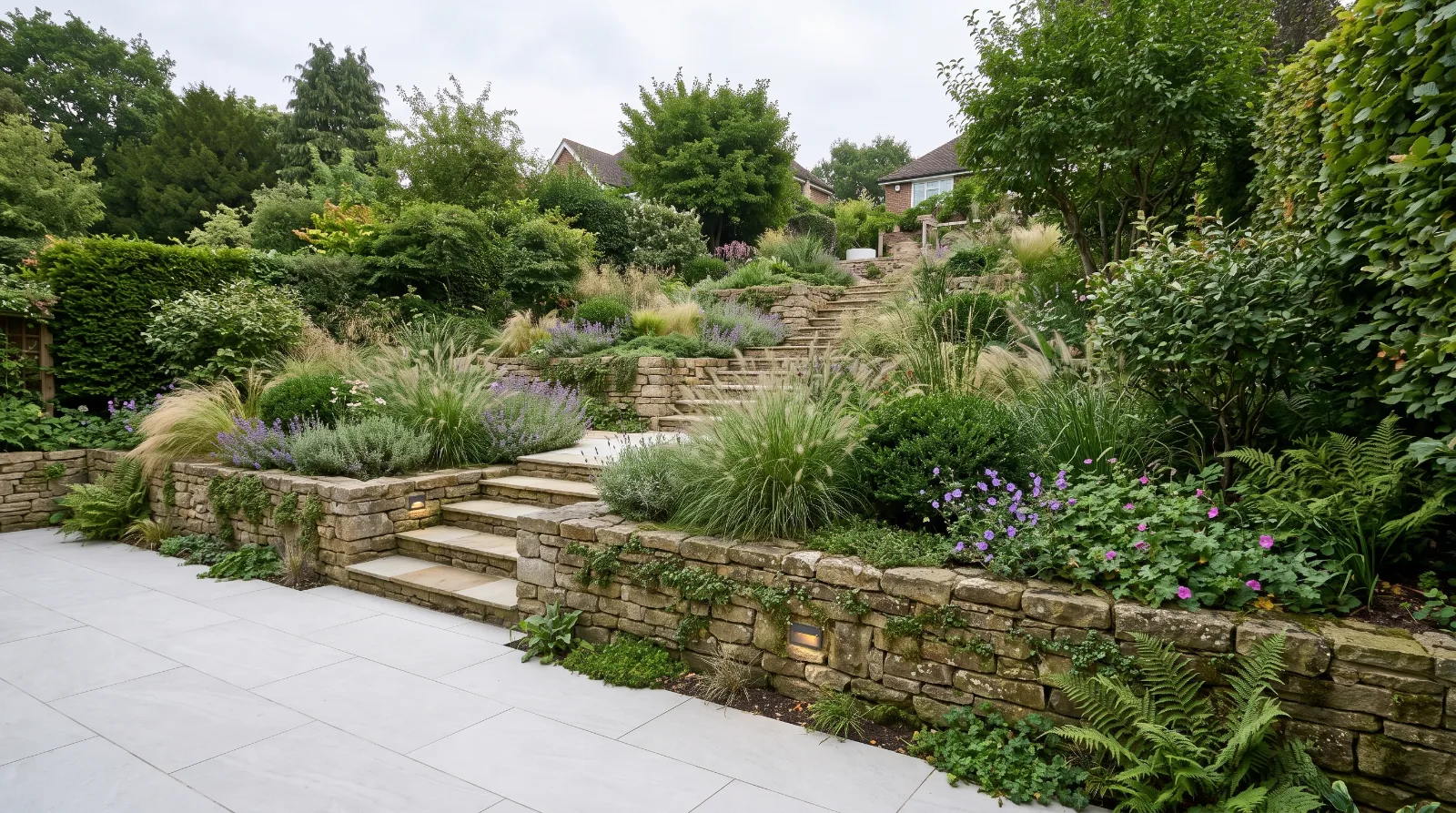
Consider Different Levels
If the garden has a natural slope, do not automatically assume that everything needs to be levelled.
Changes in level can actually help break up the length of a narrow plot.
Terraces, steps and retaining structures can create distinct spaces while adding architectural interest.
However, changes in level need to be carefully planned because they affect drainage, access and the amount of usable space.
If the garden is already relatively level, there is usually no reason to introduce multiple levels simply to make the design more complicated.
Use Screening Without Closing the Garden In
Privacy can be difficult in narrow gardens because neighbouring properties may look directly across the space.
Screening can help, but solid barriers along both sides can make the garden feel enclosed.
A better approach is to target the areas where privacy is actually needed.
For example, you might screen a seating area with planting or a slatted structure while keeping other sections more open.
This gives privacy where it matters without turning the whole garden into a narrow enclosed corridor.
Consider Outdoor Entertaining
If you regularly entertain, place the main dining area where it is easiest to access from the house.
This usually makes carrying food and drinks outside much easier.
A second seating area further down the garden can then provide a quieter space for relaxing.
A pergola can also create a strong architectural feature and help define an outdoor room without requiring a large structure.
The important part is to leave enough circulation space around furniture so the garden remains comfortable when several people are using it.
Make the End of the Garden Feel Connected
A common design mistake is making the back section look like a completely separate garden.
The end should feel like a natural continuation of the space.
Repeat materials, planting styles or colours from earlier sections to create visual links.
For example, the same paving could appear near both seating areas, while repeated plants could appear in borders at different points along the garden.
These small details can make a long plot feel like one cohesive garden rather than a collection of unrelated zones.
How to Approach the Overall Layout
Rather than trying to divide a long garden into a fixed sequence of areas, start by deciding which parts of the garden need to work hardest for you.
The space nearest the house will often be the most practical location for everyday activities such as dining, while the middle and far sections can be used for lawn, planting, play, additional seating or a quieter destination.
The arrangement should then be shaped around the garden's width, sunlight, access and existing features.
This creates a more natural layout because each section has a purpose without making the garden feel like a series of separate rooms.
The result should be a garden that encourages movement through the space while still feeling open and connected.
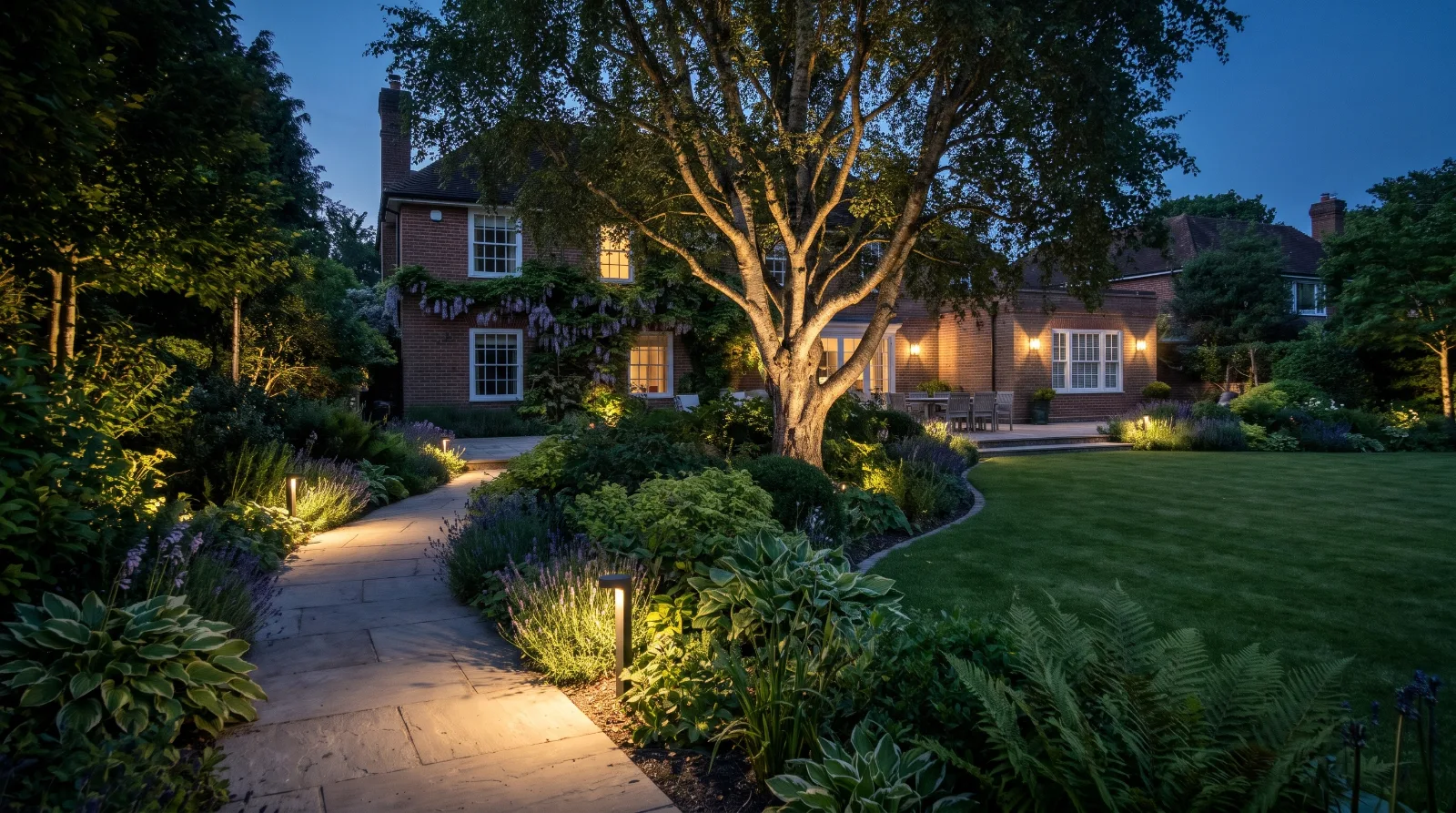
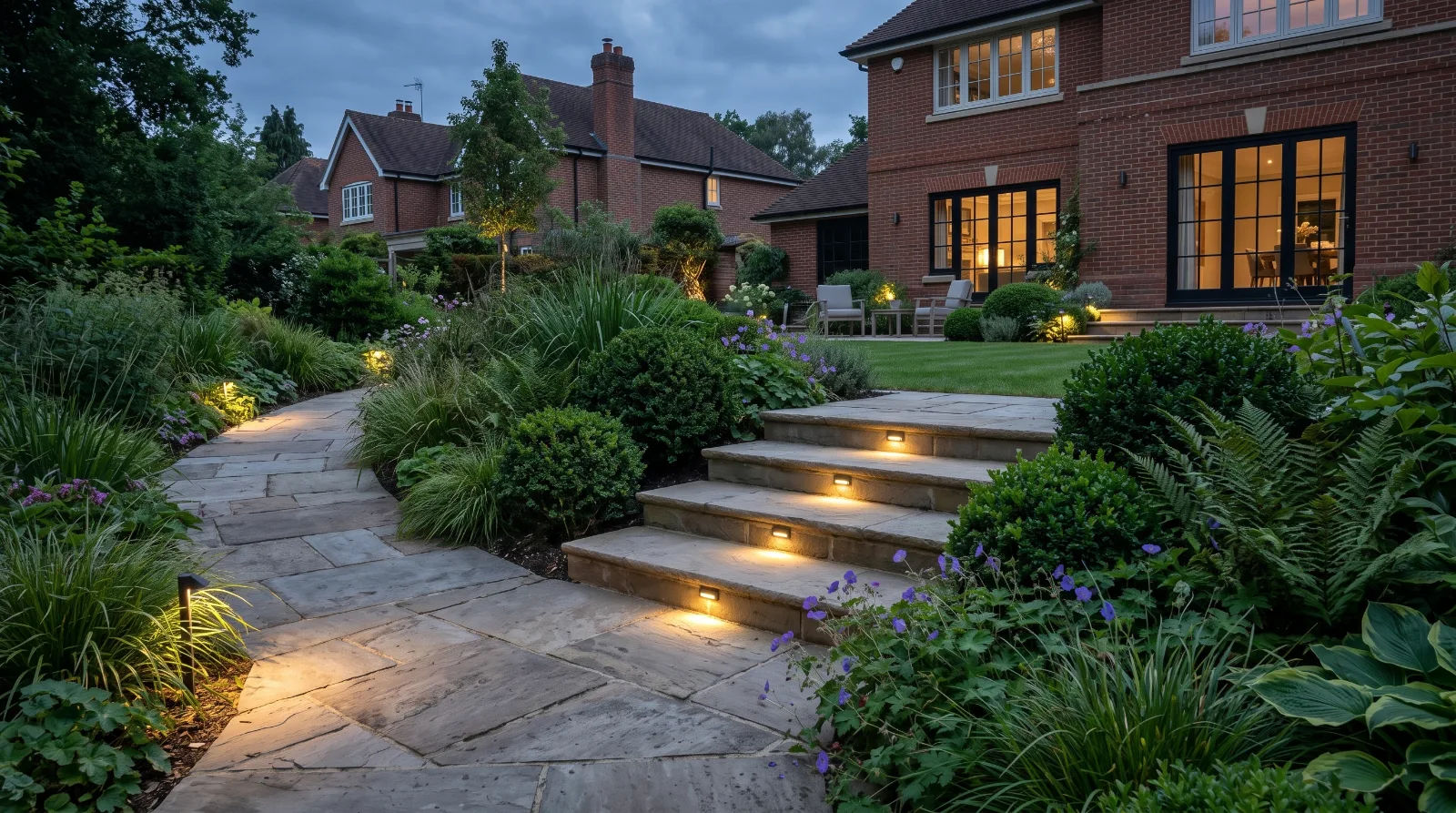
Lighting Can Change the Garden at Night
Lighting is particularly useful in a long garden because it can draw attention to features further away from the house.
Rather than illuminating the entire length equally, use a layered approach.
You could combine:
Low-level path lighting
Patio lighting
Lighting around steps
Feature lighting for trees
Subtle planting illumination
Lighting a tree or structure further down the garden can also make the space feel deeper from the house after dark.
The goal is to guide the eye through the garden without making every area equally bright.
Don't Forget Drainage
Long gardens can have drainage issues, particularly where the ground slopes towards the house or where hard landscaping covers substantial areas.
Before finalising the layout, think about where rainwater naturally travels and whether changes to levels or paving will affect it.
Drainage should be considered alongside patios, paths, planting and other hard landscaping rather than added as an afterthought.
This is especially important when replacing large areas of lawn or soil with impermeable surfaces.
Keep Maintenance in Mind
A beautifully designed garden can become difficult to enjoy if it requires more maintenance than you realistically have time for.
This is especially important in a long garden because there can be considerable amounts of:
Lawn to mow
Hedges to trim
Borders to weed
Paving to clean
Plants to prune
Think about how much maintenance each section will require before adding it to the design.
A combination of carefully chosen planting, practical paving and manageable lawn areas can create a garden that looks considered without becoming a constant source of work.
Common Mistakes in Long Narrow Gardens
Some approaches can make the proportions of the garden feel even more pronounced.
One long central path
This can create a strong corridor effect.
One large lawn
A long uninterrupted strip of grass may emphasise the length.
Overly tall boundaries
Solid fencing or walls along both sides can make the garden feel enclosed.
Too many small features
Adding lots of unrelated features can make a narrow garden feel cluttered.
Oversized furniture
Large tables and sofas can quickly consume the usable width.
Ignoring the far end
Leaving the back of the garden empty can make the whole space feel unfinished.
How to Make a Long Narrow Garden Feel Wider
You do not necessarily need to physically change the dimensions of the garden to make it feel more balanced.
Several design choices can help:
Use horizontal lines: Wider paving bands, borders and planting groups can visually draw attention across the garden rather than along it.
Offset features: Avoid placing every element directly along a central axis.
Create wider spaces: Small terraces or seating areas can interrupt the narrow proportions.
Use planting strategically: Layered planting along the boundaries can soften hard edges.
Control long views: Focal points and partial screening can prevent the garden from reading as one uninterrupted corridor.
Keep the centre open where useful: An open lawn or simple circulation route can prevent the space from becoming cluttered.
The strongest results usually come from using several of these techniques together rather than relying on one trick.
How to Design a Long Narrow Garden That Works
A successful long narrow garden is not about trying to hide its shape.
The better approach is to make the proportions work for you.
Create different areas with clear purposes, use planting to add depth, provide a reason to move towards the end of the garden and avoid layouts that simply draw a straight line from the house to the back boundary.
Keep the width in mind when choosing patios, furniture, paths and planting, and make sure the design remains practical to maintain.
Most importantly, design around how you actually use the garden.
A long narrow plot can become a surprisingly versatile outdoor space when its length is treated as an opportunity to create a sequence of connected spaces rather than a limitation.
Need Help Designing a Long Narrow Garden in Surrey?
Long gardens can require more careful planning because every feature has to work within a restricted width.
Surrey Oak Landscapes can help with garden design, paving, planting, fencing, lighting and outdoor living features, creating a layout that makes the most of your available space.
Planning a long narrow garden in Surrey? Get in touch with Surrey Oak Landscapes for a free, no-obligation quote.
About the author