How Much Does Garden Lighting Installation Cost in Surrey?
How much does garden lighting installation cost in Surrey? Explore indicative prices for simple lighting setups and bespoke schemes, discover what affects the budget and learn how to plan your outdoor lighting.
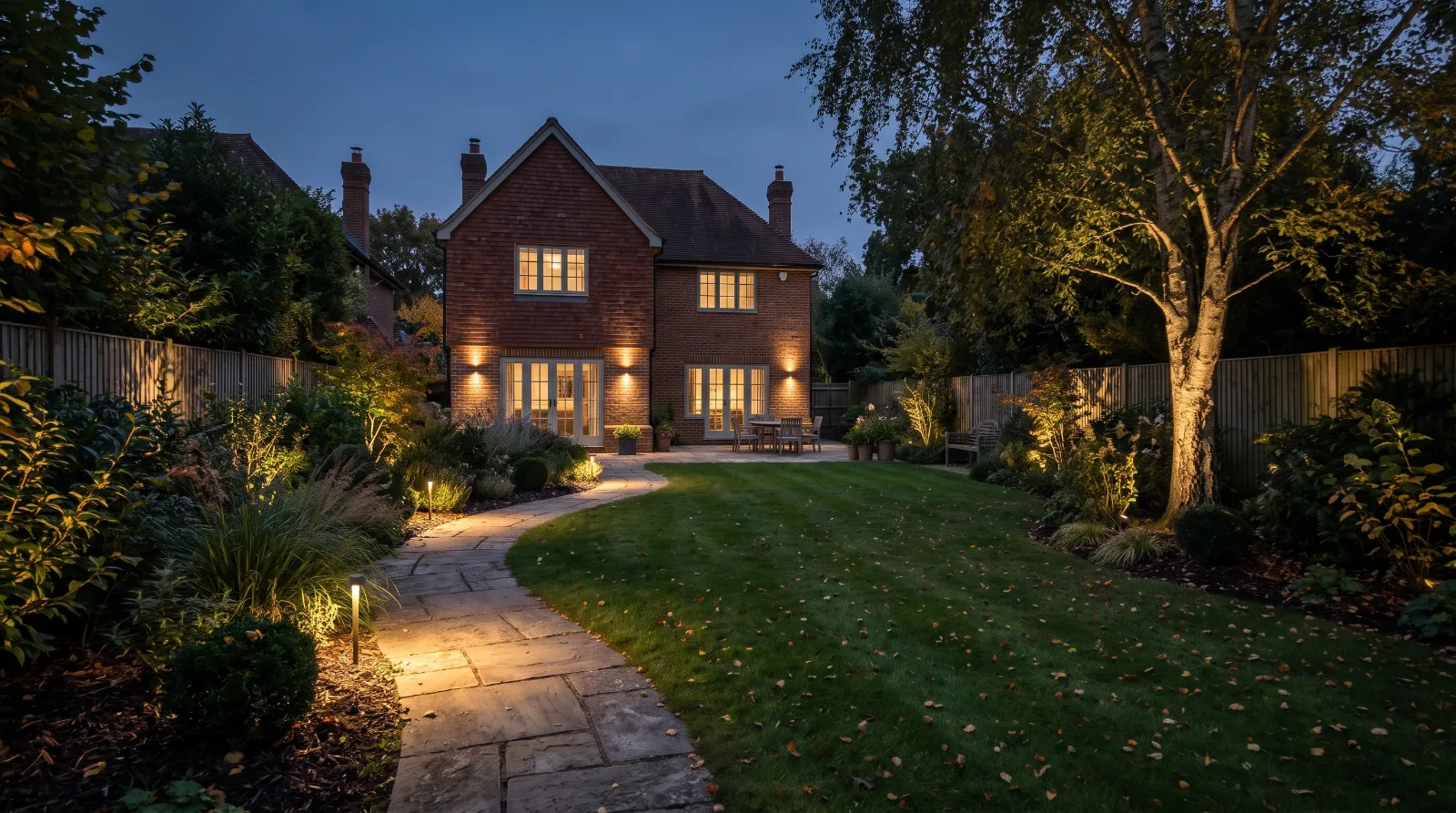
Garden lighting can transform an outdoor space after sunset, highlighting specimen trees, illuminating paths and creating a welcoming atmosphere around patios and seating areas. It can also make the garden easier to navigate when it gets dark, particularly during the shorter days of autumn and winter.
However, the cost of installing garden lighting varies considerably. Adding a couple of wall lights is very different from designing a complete lighting scheme with underground cabling, recessed step lights, tree uplighting and smart controls.
For homeowners in Surrey, understanding the different options can help when setting a budget and deciding which features are worth investing in. The aim is to create a lighting scheme that complements the garden without spending money on fittings or features that are not needed.
How Much Does Garden Lighting Installation Cost in Surrey?
The total cost depends on the number of lights, the fittings selected, the cable routes and the amount of installation work involved.
The following figures provide an indicative guide to different types of garden lighting projects.
Disclaimer: These figures are estimates for general budgeting only, based on published UK and Surrey pricing guides available in 2026. They are not fixed prices or quotations from Surrey Oak Landscapes. Actual costs may be lower or higher depending on the garden, specification, equipment, access, labour, groundwork and electrical requirements. Prices from different guides may also include different items and VAT treatments. Always confirm the full scope, whether VAT is included and the final price with your installer.
Type of garden lighting installation | Indicative estimated cost |
|---|---|
Single outdoor wall light connected to an existing supply | £100–£150 |
Outdoor security light with a suitable existing supply | £100–£200 |
Simple low-voltage lighting installation | £150–£450 |
Basic garden lighting scheme with around 4–8 lights | £500–£1,500 |
Bespoke small garden scheme with 8–12 fittings | £2,500–£4,500 |
Designed scheme for an average-sized garden with 15–25 fittings | £5,000–£9,000 |
Larger garden scheme with 30–50 fittings and multi-zone controls | £9,000–£15,000+ |
These estimates cover different types of projects, so they should not be compared as though each includes the same service. A basic installation may involve straightforward fittings and existing power arrangements, whereas a bespoke scheme can include lighting design, premium fittings, extensive cable routing and advanced controls.
A larger garden does not automatically need a more expensive scheme. The number of features being illuminated, the quality of the fittings and the complexity of the installation all influence the budget.
1. What Type of Garden Lighting Do You Need?
The first step in estimating the cost is deciding what you want the lighting to achieve. Different fittings have different installation requirements, and combining several types may be appropriate for a more comprehensive scheme.
Path and step lighting
Path lights help make routes through the garden easier to see after dark, while step lights can highlight changes in level around patios, retaining walls and raised terraces.
Options include low-level bollard lights, recessed fittings and lights incorporated into walls or steps. Recessed fittings may require additional preparation when installed into existing paving or masonry.
If you are already having a path, patio or steps installed, planning the lighting at the same time can help coordinate cable routes and reduce disruption.
Tree and planting uplighting
Uplighting can highlight a specimen tree, mature shrub or ornamental grass, creating depth and visual interest after sunset.
The cost depends on the number of features you want to illuminate, the fittings selected and the cable routes required to reach them. Lighting several mature trees across a large garden will generally require more work than illuminating a single small border.
Positioning matters as well. The aim is to highlight the tree or planting rather than create harsh glare or shine unnecessary light into neighbouring properties.
Patio and seating-area lighting
Wall lights, discreet spotlights and suitable downlights can make patios and outdoor seating areas more comfortable to use in the evening.
The final cost depends on the position of the fittings, whether a suitable power supply is already available and how the cabling will be routed. Lighting beneath a pergola or within a covered structure may also require coordination with the structure's construction.
Security lighting
A motion-activated light can provide practical illumination around entrances, side passages, garages and garden access points.
A single security light is usually a smaller project than a complete landscape lighting scheme. However, the cost can increase if new wiring is needed, the fitting is difficult to access or additional electrical work is required.
For most gardens, security lighting and decorative landscape lighting should be planned together so one does not overwhelm the other.
2. What Affects the Cost of Garden Lighting?
Even gardens of similar sizes can have very different installation costs. These are the main factors to consider when planning your budget.
Number and quality of fittings
The number of fittings affects the total cost of materials and installation time. However, the price of each fitting can also vary considerably.
Simple lights may be suitable for straightforward applications, while premium brass or stainless-steel fittings can cost more but offer a different finish and product specification.
The best choice depends on the location, desired appearance, expected exposure and overall design. You do not necessarily need expensive fittings everywhere; it can be more effective to invest in a few well-positioned feature lights and use simpler fittings where appropriate.
Cable length and installation route
Cable routing is one of the most important cost factors.
A light near an existing suitable power source may be relatively straightforward to install. Fittings at the far end of the garden can require longer cable runs, additional excavation and more installation time.
The route matters just as much as the distance. Running cables along a planting border may be simpler than routing them beneath an existing patio or driveway, where lifting and reinstating the surface can add to the work.
Existing electrical supply
If a suitable electrical supply is already available, the installation may be simpler. If new circuits, outdoor connections or additional protection are required, the cost can increase.
The electrical requirements depend on the chosen system and the existing installation. Permanent mains-powered garden lighting should be installed and tested by a suitably competent electrician, with the applicable electrical safety and building regulation requirements addressed.
Groundwork and access
The condition of the garden can affect the amount of work involved.
A newly landscaped garden may provide easier access for cable installation before turf, planting and paving are completed. In an established garden, the installer may need to work around mature plants, existing paths, retaining walls and other features.
Restricted access can also make it more difficult to bring in equipment or reinstate disturbed areas.
Where substantial landscaping is already planned, coordinating lighting with the wider project can help avoid paying to disturb completed work later.
Controls and automation
A basic lighting scheme may use a switch or timer, while a more advanced installation can include dimmers, motion sensors, photocells or smart controls.
These features can improve convenience by allowing you to adjust lighting for different uses. For example, you might have one setting for arriving home, another for outdoor dining and a third for illuminating selected garden features.
However, advanced controls add to the specification and installation cost. Consider which features you will genuinely use before deciding on the system.
3. Does a Small Garden Need an Expensive Lighting Scheme?
Not necessarily. A smaller garden may only need a few carefully positioned lights to make a noticeable difference.
For example, a compact patio could benefit from suitable wall lighting, while a short path may need only a small number of low-level fittings. A single uplight could also highlight a specimen tree or an attractive planting feature.
The key is to prioritise the parts of the garden that matter most. Lighting every border and corner is rarely necessary, and an excessive number of fittings can make the space feel cluttered.
For a modest budget, start with practical routes and the main seating area. Additional feature lighting can be added later if the system has been planned to accommodate it.
If you want a more comprehensive design with premium fittings, extensive cabling or smart controls, costs can rise even in a relatively small garden.
4. Can You Add Garden Lighting to an Existing Garden?
Yes. Garden lighting can be installed in an established garden, although the amount of work depends on the existing layout and the route the cabling needs to take.
Where possible, cables can be routed along planting borders or through suitable areas of lawn, reducing the need to disturb mature planting or hard landscaping.
However, the installation may be more involved where cables need to cross existing paving, driveways or retaining structures. Some surfaces may need to be lifted and reinstated, depending on the chosen route and installation method.
If you are planning a new patio, driveway, decking area or garden room, it is worth considering the lighting before construction starts. Conduit and cable routes can then be coordinated with the groundwork.
Retrofitting remains possible, but planning ahead can help make the installation more efficient and avoid unnecessary disruption.
5. Are Low-Voltage Garden Lights Cheaper to Install?
Low-voltage lighting is a common option for landscape lighting, particularly where several small fittings are distributed around a garden.
These systems commonly use a transformer to supply lower-voltage lighting. Depending on the system, low-voltage installations can offer flexibility in positioning and adding fittings, although the transformer, cable lengths and total load must be specified correctly.
The initial cost depends on the fittings, transformer, cabling and installation work. A basic low-voltage kit may be relatively inexpensive, while a professionally designed system using premium fittings and discreet underground cabling can cost considerably more.
Mains-powered lighting may be appropriate for certain applications, but it has different installation and safety requirements. The most suitable option depends on the design, location and electrical specification rather than simply choosing whichever system has the lowest initial cost.
6. How Can You Keep Garden Lighting Costs Under Control?
A well-planned lighting scheme can achieve a good result without illuminating every part of the garden.
Decide what needs lighting first
Identify the routes you use after dark and the features you want to highlight. This helps establish the number and type of fittings needed before you begin comparing products.
Coordinate lighting with landscaping work
If you are installing paving, steps, a pergola or a garden room, plan the lighting at the same time. This can reduce the need to lift finished surfaces or disturb new planting to install cables later.
Use different fittings for different purposes
You may not need premium feature lights along every path. Reserve more decorative fittings for prominent areas, and select practical lights suited to routes and entrances.
Keep the design simple
A small number of well-positioned lights can be more effective than a large number of poorly directed fittings. A restrained design can also reduce unnecessary light spill and ongoing energy use.
Compare quotations carefully
Check whether each quote includes the fittings, transformer, cabling, groundwork, controls, electrical work, testing and reinstatement. A lower quote may cover a narrower scope, making a direct price comparison misleading.
7. What Should a Garden Lighting Quote Include?
Before committing to a project, ask for a clear breakdown of what is included.
A suitable quotation should explain the proposed lighting layout, the type and number of fittings, the cable routes, the control system and any electrical work required.
It should also clarify whether the price includes excavation, reinstatement of lawns or paving, disposal of waste, testing and handover.
If the project includes smart controls, confirm whether programming and setup are included. If you are combining lighting with other landscaping work, establish which parts of the project are covered by each quotation.
A site assessment is important because the actual cost depends on the garden's layout, the existing electrical supply and the intended finished result.
Plan Your Garden Lighting with Surrey Oak Landscapes
Garden lighting can make outdoor spaces more practical and attractive after dark, from illuminating a path to highlighting specimen trees and creating a comfortable patio for evening entertaining.
At Surrey Oak Landscapes, we provide landscaping services to help homeowners create outdoor spaces suited to their properties and lifestyles. Whether you are considering subtle path lights, feature lighting for planting or a more comprehensive scheme as part of a garden transformation, planning the lighting alongside the wider design can help bring the whole space together.
Thinking about garden lighting for your Surrey property? Contact Surrey Oak Landscapes for a free, no-obligation quote.
Get a free quote.
About the author