What Goes Under a Driveway? A Guide to Sub-Base and Foundations
What goes under a driveway? Learn how sub-bases, foundations, drainage and ground preparation work together to create a durable driveway for Surrey homes.
When choosing a new driveway, most homeowners naturally focus on the surface. Whether that means block paving, resin-bound aggregate, tarmac or gravel, the finish is what you see every day.
But what happens underneath is just as important.
A driveway needs a stable foundation that can support vehicles, cope with changing weather and provide the right conditions for the chosen surface. Without proper preparation, even an expensive driveway can eventually develop movement, settlement, cracking or drainage problems.
So, what actually goes under a driveway?
In most cases, a driveway is made up of several carefully prepared layers, each serving a different purpose.
The Basic Structure of a Driveway
Although the exact construction varies depending on the surface and site, a typical driveway may include:
Layer | Purpose |
|---|---|
Existing ground | Provides the underlying support |
Separation membrane, where required | Helps separate weak or unsuitable soil from the sub-base |
Sub-base | Provides strength and distributes vehicle loads |
Laying or base layer | Provides the appropriate foundation for the chosen surface |
Surface | The visible driveway finish |
Edge restraints | Help prevent movement at the edges |
Drainage | Manages rainwater and surface runoff |
Not every driveway will use exactly the same materials or construction.
A block-paved driveway, for example, has a different build-up from a resin-bound surface, while a permeable driveway needs a construction designed specifically to allow water to pass through it.
The important point is that the driveway should be designed as a complete structure, rather than choosing the surface first and worrying about the foundation afterwards.
1. The Existing Ground
Everything starts with the existing ground, often referred to as the subgrade.
This could be natural clay, sand, gravel, made ground or a mixture of different materials. Its condition can also vary across the same property.
Before construction begins, the ground needs to be assessed for soft areas, excessive moisture, poor drainage or other conditions that could affect the driveway.
This is particularly relevant in Surrey, where the underlying geology varies considerably. Different parts of the county contain London Clay, Weald Clay, chalk, sands, gravels and Greensand formations.
That means there is no sensible one-size-fits-all approach to preparing the ground.
Why the ground matters
If the subgrade is weak or unstable, putting a high-quality surface on top will not solve the underlying problem.
Depending on the site, preparation may require additional excavation, removal of unsuitable material, replacement with appropriate aggregate or other measures to create a stable foundation.
The aim is to create a suitable base before the main sub-base construction begins.
2. The Separation Membrane
On some sites, a geotextile membrane is installed between the existing ground and the sub-base.
Its purpose is to help prevent the two materials from mixing, particularly where the underlying soil could migrate into the aggregate.
This can be useful on weaker or fine-grained soils, but it is not automatically required for every driveway.
It is also important to understand what a membrane does not do.
It does not replace proper excavation, suitable aggregate or compaction. If the ground itself is unsuitable, a membrane alone will not turn it into a reliable foundation.
3. The Sub-Base
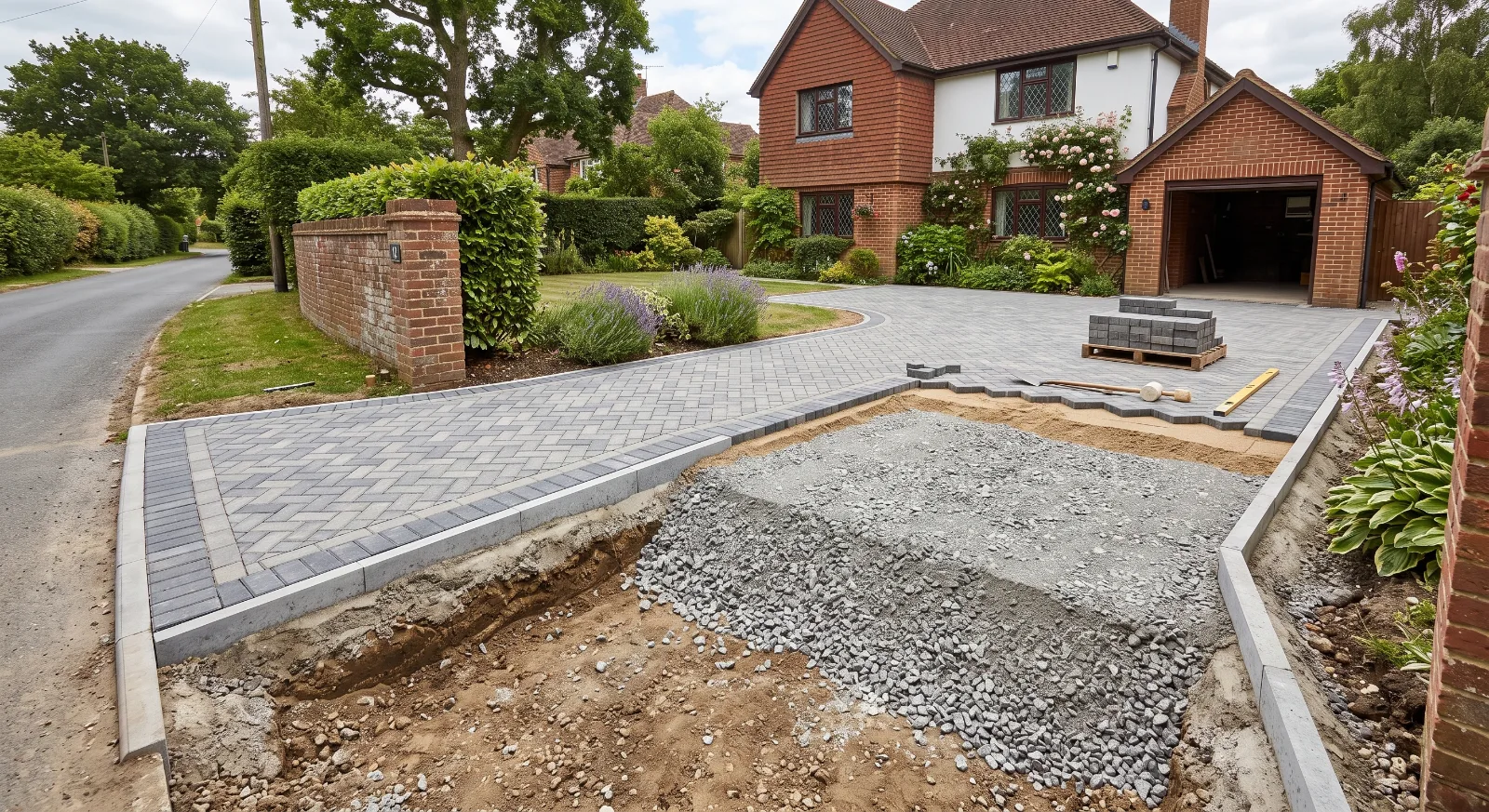
The sub-base is one of the most important parts of the driveway.
It sits beneath the visible surface and provides much of the structural support required to distribute the weight of vehicles across the ground.
For many domestic block-paved driveways, around 150mm of compacted MOT Type 1 is a common starting point. However, the appropriate depth depends on the ground conditions, expected loading and driveway construction rather than being a universal measurement. Current manufacturer guidance for domestic applications also bases sub-base requirements on ground conditions and anticipated loads.
What is MOT Type 1?
MOT Type 1 is a well-graded crushed aggregate containing a mixture of larger particles and fines.
When properly compacted, these different particle sizes lock together to create a dense and stable foundation.
It is widely used in driveway and paving construction because it provides a strong base for the layers above.
Why is compaction so important?
Simply filling the excavated driveway with aggregate is not enough.
The sub-base needs to be compacted properly so that the material forms a stable, dense layer.
On a typical domestic driveway, the sub-base may be installed and compacted in stages rather than placing one deep layer and attempting to compact it all at once. A current domestic block-paving installation guide, for example, illustrates 150mm of Type 1 compacted in two 75mm layers.
Poor compaction can leave voids or weak areas underneath the driveway, increasing the risk of future movement and settlement.
4. The Layer Above the Sub-Base
What comes next depends on the driveway surface.
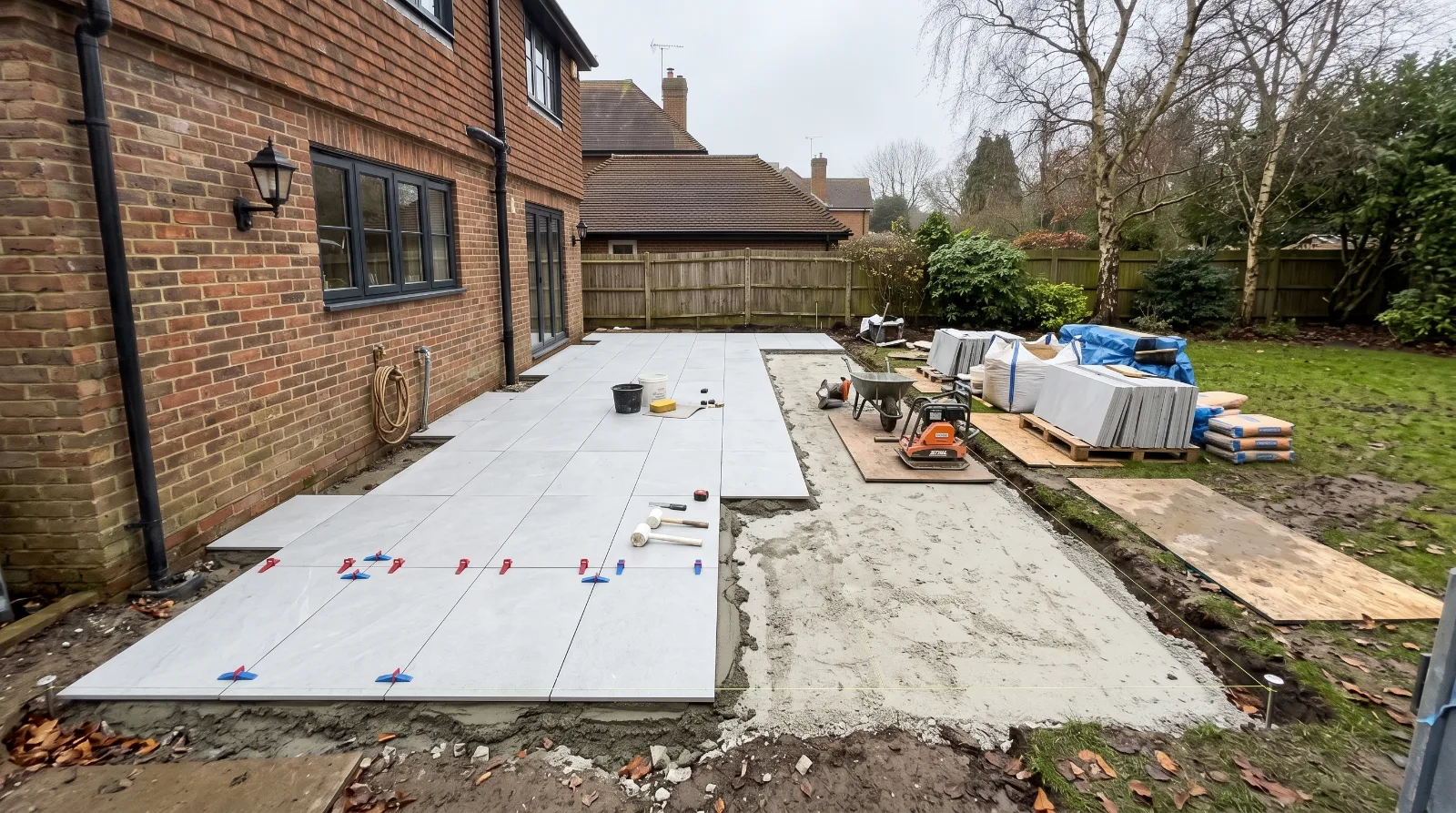
For block paving, a laying course is installed above the compacted sub-base before the paving blocks are placed.
A typical domestic block-paving construction uses a layer of sharp sand beneath the blocks, with the exact thickness and construction depending on the paving system being installed.
The laying course has an important job, but it should never be used to compensate for an inadequate sub-base.
Think of the construction as a chain: each layer needs to perform its own role.
5. The Driveway Surface
The final surface is the part everyone sees, but different materials require different construction methods.
Block Paving
Block paving is built from individual paving units laid over the prepared foundation.
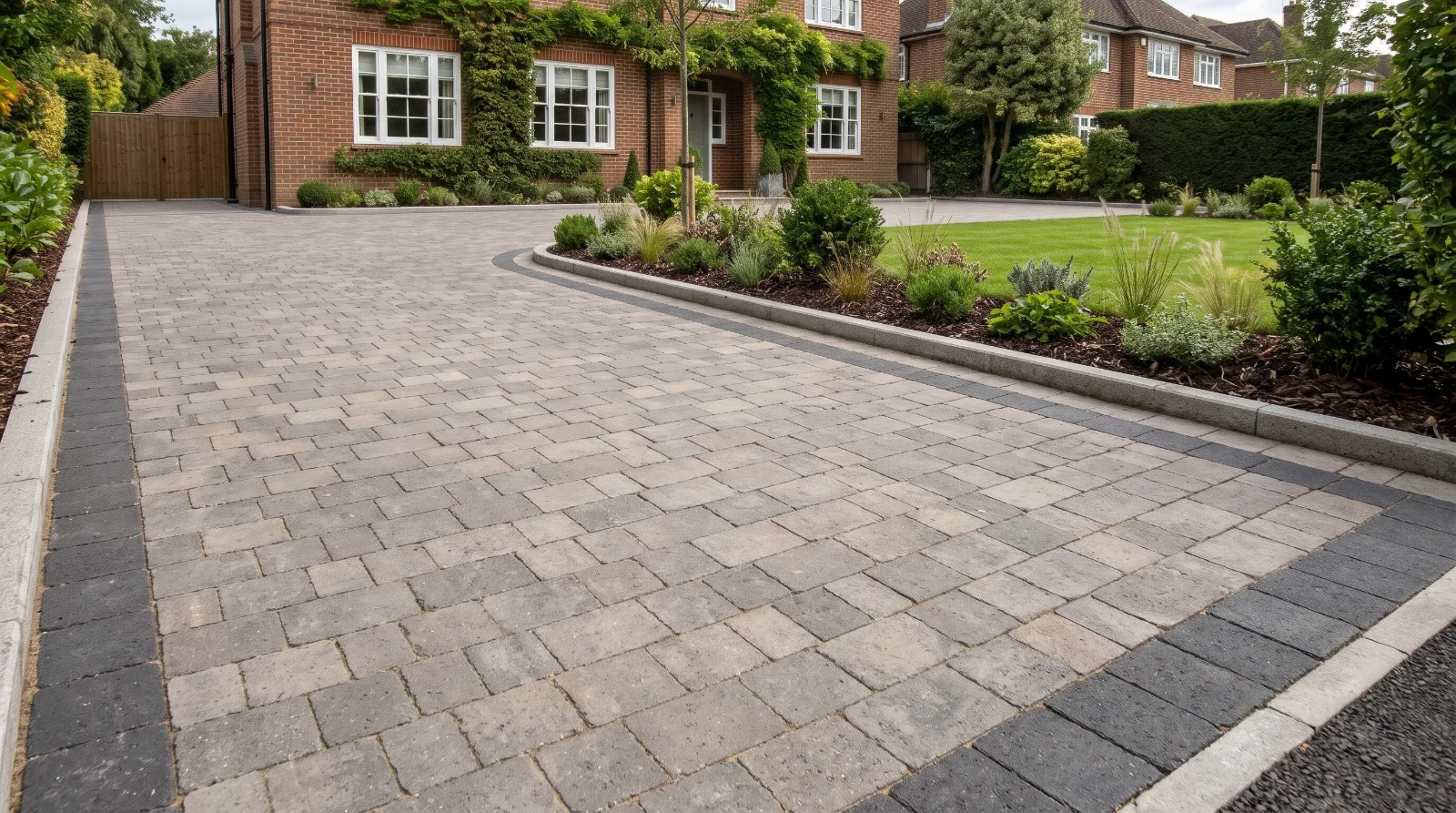
One of its biggest advantages is design flexibility. Different colours, sizes, laying patterns and borders can be combined to create anything from a traditional driveway to a contemporary design.
Individual blocks can also generally be lifted and replaced if a small area becomes damaged or needs access in the future.
Resin-Bound
Resin-bound surfacing combines selected aggregate with resin to produce a relatively smooth finished surface.
The supporting base is still critical. A resin surface should not simply be viewed as a thin decorative layer that can be applied over any existing ground.
Where a permeable resin-bound system is being installed, the supporting construction must also be designed to allow water to move through the pavement.
Tarmac
Tarmac provides a practical, relatively uniform surface and is often suitable for larger driveways.
Its construction still depends on a properly prepared foundation, and because standard tarmac is not itself a permeable surface, drainage needs to be considered as part of the wider design.
Gravel
Gravel is different because the finished aggregate remains loose.
The underlying ground still needs to be properly prepared, while edging helps prevent the gravel from spreading into lawns, paths or the road.
On a suitable site, gravel offers a natural appearance and allows rainfall to pass between the individual stones.
Permeable Paving
Permeable paving is designed as a complete water-management system.
Rather than simply allowing water through the visible paving, the supporting layers are constructed to provide space for water to move through and, where appropriate, temporarily store it before infiltrating into the ground or being directed elsewhere.
Modern guidance specifically distinguishes permeable pavement construction from conventional dense sub-base construction. Open-graded aggregates may be used where the design requires water to pass through the pavement structure.
Driveway Construction by Surface
Surface | Main Foundation Consideration | Drainage Approach |
|---|---|---|
Block paving | Stable compacted sub-base and suitable laying course | Falls, drainage or permeable construction |
Resin-bound | Strong, stable base appropriate for the system | Can be permeable when designed correctly |
Tarmac | Strong prepared base suitable for vehicle loading | Usually requires designed surface drainage |
Gravel | Firm sub-base and effective edging | Naturally permeable surface |
Permeable paving | Open-graded construction designed for water movement | Integrated into pavement structure |
6. Edge Restraints
A driveway experiences more than downward pressure from vehicles.
Turning wheels and repeated traffic can also create sideways forces, particularly around the edges.
This is why proper edge restraints are important.
Kerbs, paving restraints or other suitable edging can help hold the driveway together and prevent the surface from spreading or moving laterally.
They also give the finished driveway a clean transition into surrounding lawns, planting, paths or walls.
For block paving, installation guidance treats edge restraints as a structural part of the driveway rather than simply a decorative border.
7. Drainage: Where Does the Water Go?
A driveway needs to deal with rainwater properly.
This becomes especially important when a front garden is being converted from lawn or planting into hardstanding.
There are several ways to manage surface water.
Permeable surfaces
Rain can pass through the driveway and into the underlying construction.
Drainage towards a permeable area
Where suitable, an impermeable surface can be designed so that rainwater runs towards an adjacent lawn, border or other permeable area.
Drainage systems
Channels, gullies, soakaways and other drainage features can be used where required by the site.
The correct solution depends on the property's levels, soil, drainage conditions and the driveway surface.
For front gardens in England, there are also specific planning considerations surrounding impermeable driveway surfaces. A permeable driveway, or one where rainwater is directed to a permeable area, can generally avoid the planning issue that can arise when more than 5m² of an impermeable front garden is paved without suitable drainage.
The key point is simple:
Decide where the water is going before deciding how to build the driveway.
8. Protecting the House
The finished driveway also needs to sit at an appropriate level in relation to the property.
Where paving meets a house or other building, levels need to be carefully considered so that rainwater is not directed towards the structure.
As a general domestic installation principle, driveway paving is commonly positioned below the damp-proof course, with around 150mm often used as the benchmark. However, existing building construction and site conditions should always be assessed rather than applying a measurement without checking the property.
Older properties deserve particular care because foundations and construction methods can differ considerably from newer homes.
9. What Changes on a Sloping Driveway?
A sloping driveway introduces another layer of complexity.
The finished surface needs to remain stable while rainwater is directed safely away from the building and towards its intended drainage point.
Depending on the site, this may involve:
Changes in finished levels
Additional drainage
Stronger edge restraints
Retaining structures
Different paving arrangements
Careful management of water flow
The steeper the site, the more important it becomes to consider the driveway as an integrated structural and drainage system.
How Deep Should a Driveway Be?
This is one of the most common questions homeowners ask.
There is no universal excavation depth because the complete driveway build-up depends on the chosen surface and conditions beneath the site.
For a typical domestic block-paved driveway, an example construction might include:
Component | Typical Example |
|---|---|
Block paving | Around 50mm–60mm |
Laying course | Around 30mm–40mm |
Compacted sub-base | Around 150mm |
Approximate construction depth | 230mm–250mm+ |
These figures are illustrative rather than a specification for every driveway.
The excavation needs to accommodate the complete construction while achieving the correct finished levels.
For example, current domestic block-paving guidance shows 150mm of Type 1 sub-base beneath a 30–40mm laying course and typical 50mm driveway blocks.
A different surface, weaker ground or more demanding loading conditions can require a different construction.
Why Surrey Ground Conditions Matter
There is no single type of soil across Surrey.
The county contains a mixture of clays, sands, gravels, chalk and Greensand, meaning the conditions beneath a driveway can vary substantially from one location to another.
For homeowners, this means a driveway specification should be based on the actual site rather than simply copying the construction used on another property.
A driveway in one part of Surrey may require a different approach from a similar-sized driveway elsewhere.
What Can Cause a Driveway to Fail?
A driveway can develop problems for several reasons.
Insufficient foundation
If the sub-base is too shallow or unsuitable for the site, the driveway may not have enough structural support.
Poor compaction
Loose aggregate can settle under repeated loading.
Weak ground
Soft or unstable areas beneath the driveway can create local movement.
Poor drainage
Standing water and uncontrolled runoff can contribute to deterioration and create problems around the property.
Weak edges
Without suitable restraints, paving can move sideways under vehicle traffic.
Incorrect installation
Even good-quality materials can perform poorly if the construction method is wrong for the surface.
This is why the driveway should be considered as a complete build-up rather than simply a choice of surface.
What Should You Expect From a Professional Driveway Installation?
A properly planned driveway should involve several stages before the finished surface is installed.
Site assessment
The existing surface, ground, levels, access and drainage are considered.
Setting out
The driveway dimensions, boundaries, finished levels and falls are established.
Excavation
Existing paving, soil, vegetation or unsuitable material is removed to the required depth.
Subgrade preparation
Soft or unsuitable areas are identified and addressed.
Sub-base installation
Appropriate aggregate is installed and compacted in suitable layers.
Drainage installation
Water-management measures are incorporated where required.
Edge restraints
The perimeter is secured before the final surface is completed.
Surface installation
The chosen driveway material is installed using the appropriate construction method.
Finishing and inspection
Edges, joints, levels and drainage details are checked before the driveway is completed.
Current UK paving standards and installation guidance place significant emphasis on site preparation, sub-bases, restraints, drainage, surface construction and maintenance, reflecting the fact that a driveway is a complete pavement structure rather than simply a surface finish.
Don't Judge a Driveway by Its Surface
A finished driveway can look perfect when it is first installed, but the real test comes later.
Will it remain stable after years of vehicles passing over it? Will rainwater drain correctly? Will the edges remain secure? Will the surface continue to perform through Surrey's changing weather conditions?
Those questions are largely answered by what happens before the surface is installed.
The visible paving might get all the attention, but the subgrade, sub-base, drainage and edge restraints are what create the foundation for a durable driveway.
At Surrey Oak Landscapes, we approach driveway projects from the ground up, considering the existing site, levels, drainage, ground conditions and chosen surface before installation begins.
Whether you're replacing an old driveway, creating additional parking or redesigning your entire front garden, careful preparation can make the difference between a driveway that simply looks good and one that is built to perform.
Ready to Plan Your New Driveway?
A new driveway is a significant part of your property's first impression, so it deserves a design and construction approach that considers everything from the foundations upwards.
From excavation and sub-base preparation to drainage, edging and the final surface, Surrey Oak Landscapes can help create a driveway designed around your property and how you use it.
About the author