Drip Irrigation vs Sprinklers: Which Is Better for Your Garden?
Drip irrigation or sprinklers? Compare the two garden irrigation systems and find out which is best for lawns, planting borders, trees and mixed gardens.
Keeping a garden properly watered can become surprisingly time-consuming, particularly during dry periods or when a garden contains a large amount of planting.
An irrigation system can make watering easier, more consistent and much less dependent on manually using a hose. Two of the most common options are drip irrigation and sprinkler systems.
Both have their place, but they work in very different ways.
Drip irrigation delivers water slowly and directly to the soil around plants, while sprinklers distribute water over a wider area from above. The better choice depends on what you are watering, the layout of the garden, the soil and how much control you want over water use.
What Is Drip Irrigation?
Drip irrigation uses a network of pipes or tubing fitted with small emitters that release water gradually.
Instead of wetting a large area of the garden, the system delivers water close to the root zone of individual plants or along planting beds.
Depending on the system, emitters can be designed to release a measured amount of water over time. This makes drip irrigation particularly useful for borders, shrubs, trees, hedges, containers and other areas where targeted watering is important.
Because the water is delivered slowly, it can also be easier to control exactly where it goes.
What Is a Sprinkler System?
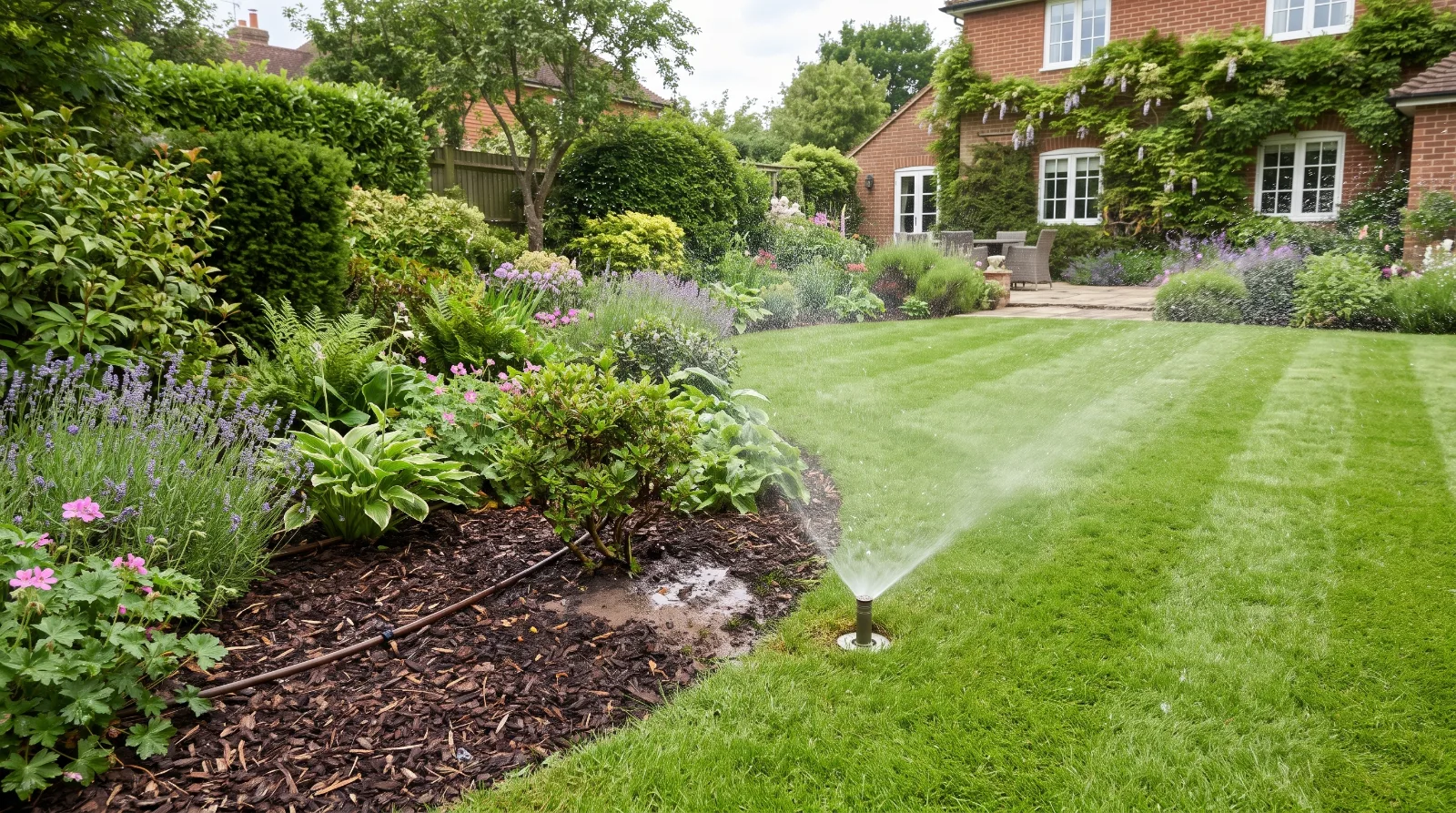
Sprinklers distribute water through the air, usually by spraying or rotating over a set area.
There are several different types, including fixed sprays, rotary sprinklers and pop-up systems. The exact design can be tailored to the shape and size of the area being watered.
Sprinklers are particularly useful where you need to cover a relatively large open area rather than individual plants.
For example, they can be useful for lawns and newly laid turf, where even coverage across the surface is important.
Drip Irrigation vs Sprinklers
The main difference is where the water goes.
Feature | Drip irrigation | Sprinklers |
|---|---|---|
Water delivery | Directly to the root zone | Sprayed over an area |
Best suited to | Borders, shrubs, trees and containers | Lawns and larger open areas |
Water control | Highly targeted | Area-based |
Wind sensitivity | Low | Higher |
Surface wetting | Limited | More widespread |
Installation | More detailed | Can be simpler for open areas |
Automation | Yes | Yes |
Water efficiency | Generally high when correctly designed | Can be lower due to evaporation and overspray |
Neither system is automatically the right choice for every garden. In fact, many well-designed irrigation systems use a combination of methods.
Which Is More Water Efficient?
Drip irrigation generally has the advantage when the priority is targeted watering.
Because water is delivered close to the root zone, there is less need to wet surrounding paving, paths and other surfaces. Drip systems can also reduce losses associated with evaporation and wind compared with overhead spray.
Sprinklers can lose water through evaporation, wind drift and runoff, particularly when they are used on unsuitable soils or during warm, windy conditions.
However, the irrigation method itself is only part of the equation.
A badly designed drip system can still waste water, while a properly designed sprinkler system can provide consistent coverage without unnecessary overspray.
Good irrigation is about matching the system to the area being watered and controlling when and how much water is delivered.
When Is Drip Irrigation the Better Choice?
Drip irrigation is particularly useful for planted areas where individual plants have different requirements.
Planting borders
Long runs of dripline can follow the shape of a border and provide consistent watering across a planting scheme.
Trees and shrubs
Larger plants can benefit from water being delivered directly around their root zones rather than having an entire surrounding area sprayed.
Hedges
A dripline can run along a hedge to provide a steady supply of water along the length of the planting.
Containers and raised beds
Targeted irrigation works well where plants are concentrated in pots, planters or raised beds.
Sloping gardens
Pressure-regulated drip systems can be useful on sloping sites because they can provide more controlled delivery than some types of seep hose.
This makes drip irrigation particularly attractive for landscaped gardens with lots of planting and clearly defined borders.
When Are Sprinklers the Better Choice?
Sprinklers are most useful when you need to cover a wider area.
Lawns
A lawn is one of the clearest examples. Sprinklers can distribute water across the grass rather than requiring individual watering points.
Newly Laid Turf
New turf needs consistent watering while it establishes, making even coverage particularly important.
Large Open Areas
A larger lawn or open planted area may be more practical to irrigate with carefully positioned sprinklers.
Areas With Dense Ground Cover
Where many plants are packed together and individual watering points would be impractical, an overhead system may be easier to manage.
The key is to choose sprinklers that provide appropriate coverage without spraying unnecessarily onto walls, paths, patios or neighbouring areas.
What About Watering Garden Borders?
For most established planting borders, drip irrigation is often the more targeted option.
A border might contain trees, shrubs, perennials and grasses, all positioned relatively close together. Delivering water directly into the planting area makes it easier to concentrate irrigation where the roots are located.
Dripline can also be installed beneath mulch, which keeps the tubing less visible while maintaining access to the root zone.
This can be particularly useful in a newly landscaped garden where the planting design is an important part of the finished appearance.
Can Sprinklers Work on Clay Soil?
They can, but the soil needs to be considered carefully.
Clay soils can absorb water more slowly, meaning that applying too much water too quickly may lead to runoff rather than allowing the water to soak into the ground.
This does not mean sprinklers cannot be used. It means the system may need to operate for shorter periods, with suitable intervals between watering cycles.
Irrigation should always be designed around the soil as well as the plants.
Can You Use Both Systems in One Garden?
Yes, and this can often be the most practical solution.
For example, a garden might have:
Sprinklers for the lawn
Drip irrigation for planting borders
Separate watering for containers
Dedicated irrigation for larger trees or hedging
Different areas of the garden have different watering requirements, so separating them into irrigation zones gives you greater control.
You can then adjust schedules for each zone instead of watering everything in the same way.
How Does Automated Irrigation Work?
Both drip and sprinkler systems can be automated.
A typical system can include a controller, valves, pipework and watering outlets. More advanced systems can also use rain sensors or other controls to avoid unnecessary watering when conditions do not require it.
Automation can be particularly useful if you are regularly away from home or simply do not want to spend time moving a hose around the garden.
It also provides more consistent watering than relying on memory.
The important thing is not to assume that an automatic system should run every day. Watering requirements change with weather, soil, plant maturity and the time of year.
Is Drip Irrigation Difficult to Maintain?
Drip irrigation requires some maintenance, particularly because the emitters are relatively small.
Filters and pressure regulation are important because blocked emitters can reduce or stop water flow. Tubing should also be checked for damage, leaks or accidental movement.
The system should be inspected periodically rather than being installed and completely forgotten.
Good maintenance helps maintain even watering across the whole system.
Do Sprinklers Need Maintenance?
Sprinklers also require regular checks.
Spray heads can become blocked, damaged or knocked out of position. A damaged sprinkler may start watering a patio or path instead of the lawn.
It is worth checking that each sprinkler is still providing the coverage it was designed to deliver.
Over time, planting can also grow and change the way water moves through a garden, so irrigation layouts may need occasional adjustments.
Which System Is Better for a Newly Landscaped Garden?
There is no one-size-fits-all answer.
A newly landscaped garden often contains a mixture of lawns, planting borders, trees, hedges and ornamental areas, so using one irrigation method for everything is not always the most effective approach.
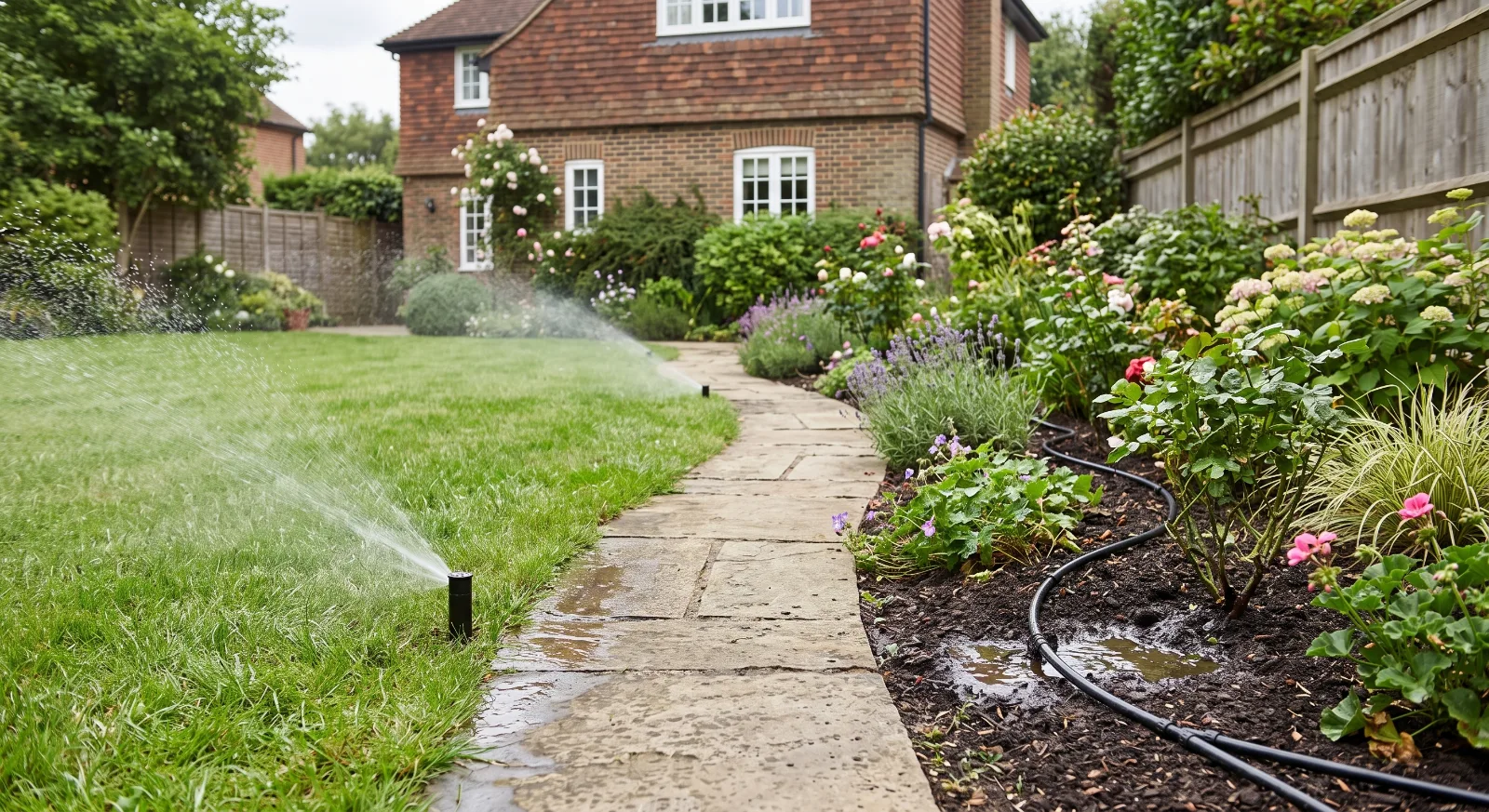
A sensible layout might use sprinklers for the lawn and drip irrigation for the planted areas.
This gives each part of the garden the type of watering it actually needs.
Irrigation is also much easier to install properly when it is considered during landscaping rather than added afterwards. Pipes and irrigation lines can be planned around patios, planting areas and other features before the finished surfaces are in place.
What Should You Consider Before Choosing?
Before deciding between drip irrigation and sprinklers, look at the garden as a whole.
Garden layout
A large open lawn has different requirements from a garden filled with narrow borders and individual planting areas.
Plant types
Trees, shrubs, perennials, hedges and containers may all require different watering approaches.
Soil
Clay, sandy and free-draining soils behave differently and can affect irrigation settings.
Sun and exposure
Sunny, windy areas can lose water more quickly than sheltered parts of the garden.
Maintenance
Consider how much time you want to spend checking and maintaining the system.
Budget
Drip systems can involve more detailed pipework and emitters, while larger sprinkler installations may require additional equipment and zoned coverage.
Future planting
A garden is likely to change over time, so leave some flexibility in the irrigation design where possible.
Drip Irrigation or Sprinklers: Which Should You Choose?
The best system depends on what you are trying to water.
Choose drip irrigation when:
You have planting borders, shrubs, trees, hedges or containers and want targeted watering directly around the root zones.
Choose sprinklers when:
You need to cover a lawn, newly laid turf or another relatively open area where even surface coverage is important.
Consider both when:
Your garden contains a mixture of lawns and extensive planting.
For many Surrey gardens, a combination of irrigation methods can provide the most practical solution because it allows different parts of the garden to be watered according to their needs.
Plan Irrigation Around the Whole Garden
Irrigation works best when it is treated as part of the overall landscape rather than an isolated system.
The position of patios, lawns, planting borders, trees, garden rooms and entertaining areas can all influence where irrigation should go.
Planning it at the same time as the garden design can also help keep pipes and outlets discreet and reduce the amount of disruption caused by installing them later.
A well-designed system should deliver the right amount of water to the right areas without creating unnecessary overspray, runoff or maintenance problems.
Need Help With Garden Irrigation in Surrey?
Whether your garden mainly consists of lawn, planting borders or a mixture of both, the right irrigation system can make ongoing watering much easier.
Surrey Oak Landscapes can help plan irrigation as part of a wider garden project, alongside planting, landscaping and garden design.
Looking to add irrigation to your Surrey garden?
About the author