Complete Guide to Swimming Pools in the UK
Planning a swimming pool? This complete guide covers pool types, installation, costs, heating, filtration, maintenance, safety and landscaping for UK gardens.
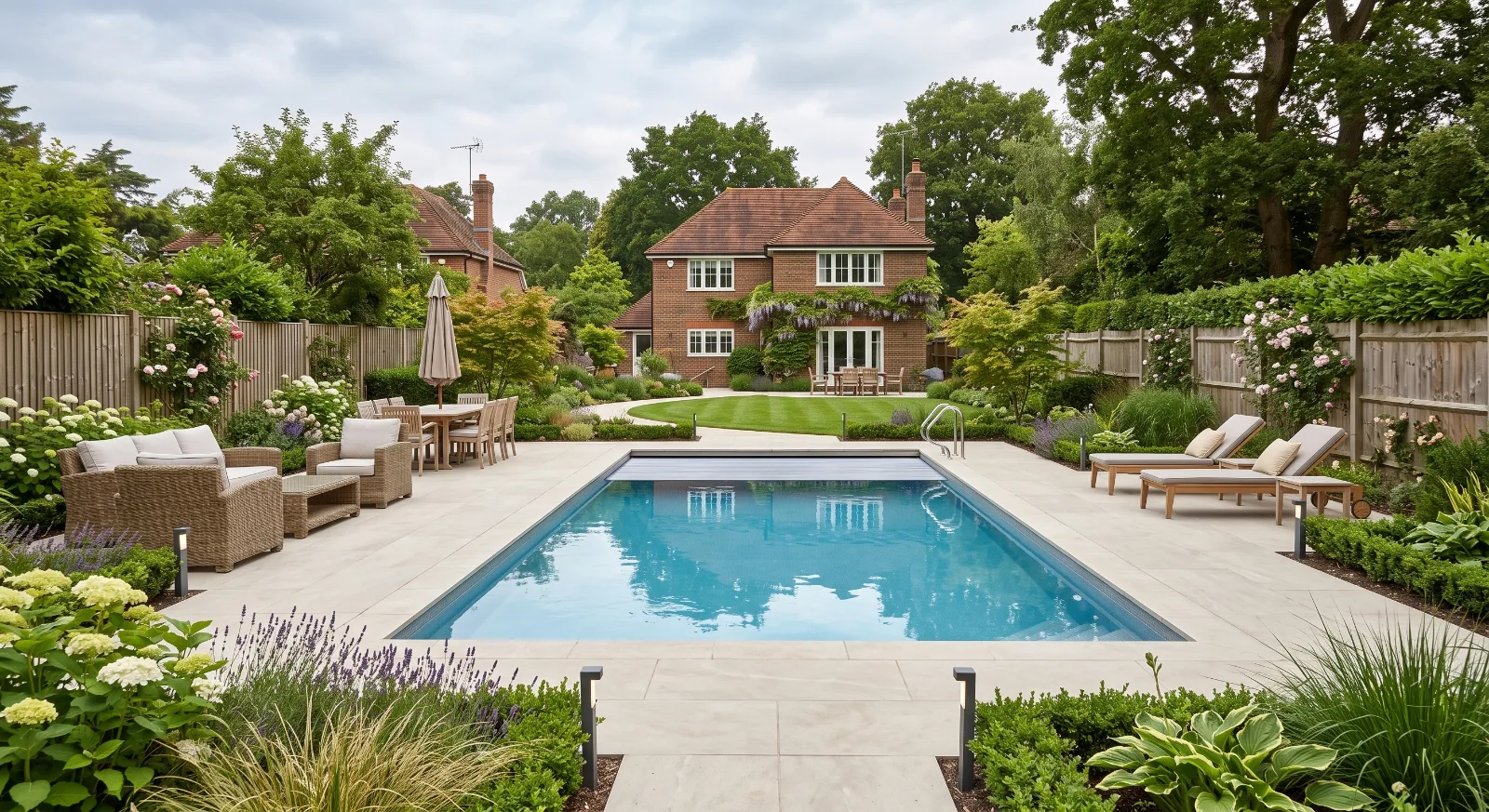
A swimming pool can become one of the biggest features of a garden, providing a place to exercise, relax and entertain throughout the warmer months. For homeowners with enough outdoor space, it can also become part of a much larger garden design, incorporating patios, planting, lighting, seating and other outdoor living features.
However, installing a swimming pool is a substantial project. The pool itself is only one part of it. Groundworks, drainage, heating, filtration, safety, access and the surrounding landscaping all need to be considered before construction starts.
The UK climate also adds another layer of planning. An outdoor pool needs to be designed with changing weather, heat loss and seasonal use in mind.
This guide explains the main things to know about swimming pools in the UK, from the different types available to installation, heating, maintenance and landscaping.
What Types of Swimming Pools Are Available?
There are several ways to approach a swimming pool project, and the right option depends on your garden, budget and how you intend to use the pool.
In-Ground Swimming Pools
An in-ground pool is excavated into the garden and is generally the most flexible option for a permanent installation.
It can be incorporated into a wider landscape design and can be built in a variety of shapes and sizes.
In-ground pools are particularly suited to homeowners planning a complete garden project where the pool, paving, planting and outdoor living areas can all be designed together.
Above-Ground Swimming Pools
Above-ground pools sit partially or completely above the existing ground level.
They can be suitable for certain gardens and may reduce the amount of excavation required, although the surrounding area still needs to be properly planned and finished.
Fibreglass Pools
Fibreglass pools are manufactured as a pre-formed shell and delivered to site before being installed into an excavated area.
One advantage is the controlled manufacturing process, but the available shapes and sizes are more limited than with a fully bespoke pool.
Concrete Pools
Concrete construction provides considerable design flexibility.
A concrete pool can be built to a particular shape, depth and specification, making it suitable for more complex designs or gardens where a standard shell does not work.
The trade-off is a more involved construction process and, typically, a higher overall cost.
Pool type | Main advantage | Main consideration |
|---|---|---|
In-ground | Fully integrated with the garden | Significant groundworks |
Above-ground | Can reduce excavation | Different visual appearance |
Fibreglass | Pre-formed and relatively quick to install | Limited shapes and sizes |
Concrete | Highly flexible design | More complex construction |
Planning Portal also identifies fibreglass, vinyl-lined and concrete pools among the common construction approaches used for domestic swimming pools.
How Big Should a Swimming Pool Be?
There is no standard pool size that suits every property.
The available garden space should be considered alongside the pool itself because you will also need room for circulation, access and the surrounding landscape.
A larger pool may be attractive, but making it too large can leave very little usable garden around it.
Consider what the pool is actually being used for.
Swimming and exercise
A longer, more straightforward shape may be preferable if swimming lengths is a priority.
Family use
A wider pool with generous surrounding space may work better for families.
Relaxation and entertaining
In this case, the surrounding patio, seating and outdoor living areas may be just as important as the pool dimensions.
A well-designed smaller pool can often work better than trying to fit the largest possible pool into an unsuitable garden.
Where Should a Swimming Pool Be Positioned?
The pool's location affects almost every other part of the garden.
Ideally, its position should be considered alongside:
Sunlight
Views from the house
Privacy
Existing trees
Garden levels
Drainage
Access
Surrounding landscaping
Pool equipment
A sunny position can help make an outdoor pool more pleasant to use, while a sheltered location may reduce exposure to wind.
The view from inside the house is also worth considering. A pool can become an attractive focal point when it is visible through kitchen or living-room windows.
Can a Swimming Pool Be Installed in a Sloping Garden?
Yes, but a sloping garden can require substantially more planning.
Changes in level may require additional excavation, retaining structures, terracing or alterations to the surrounding garden.
Instead of trying to eliminate the slope completely, the design can sometimes use different levels to create a more interesting landscape.
For example, a raised terrace could overlook the pool while steps connect it to a lower pool deck.
This is where the relationship between the pool and the wider garden becomes particularly important.
What Groundworks Are Involved?
The groundworks are often one of the largest parts of an outdoor pool installation.
For an in-ground pool, the basic sequence can involve:
Setting out the pool position
Excavating the ground
Removing or managing excavated material
Preparing the foundation
Constructing or positioning the pool structure
Installing pipework and drainage
Backfilling and preparing surrounding areas
Completing the pool surround and landscaping
The amount of excavation depends on the size, depth and construction method of the pool.
Access should also be considered before the project begins because machinery and materials need to reach the garden.
What Happens to the Excavated Soil?
An in-ground pool can produce a considerable quantity of excavated material.
Some material may be suitable for reuse elsewhere on the property, particularly where garden levels are being redesigned. Other material may need to be removed from site.
The logistics of spoil removal can become particularly important where access is narrow or the property is surrounded by neighbouring houses.
A project with straightforward machinery access can be very different from one where soil has to travel a long distance before reaching the removal point.
Does a Swimming Pool Need Drainage?
Drainage should be considered before excavation begins.
A garden with poor drainage can create additional challenges, particularly where groundwater or standing water is already an issue.
Drainage around the pool may involve:
Channel drains
Pumps
Pipework
Changes to surface levels
Other site-specific drainage measures
The right solution depends on the garden and how water behaves across the site.
It is much easier to design drainage into a pool project from the start than to discover a problem once the surrounding landscaping is finished.
Do You Need Planning Permission for a Swimming Pool?
Planning rules vary depending on where you live in the UK and the circumstances of the property.
In England, an outdoor domestic swimming pool can often fall within permitted development rights when it is considered incidental to the enjoyment of the dwelling and the relevant conditions are met. However, restrictions can apply to properties and locations such as listed buildings, conservation areas, National Parks and other designated land.
Wales has its own permitted-development framework, while Scotland has separate rules. The exact position should therefore be checked for the property before work begins.
Where a project includes additional structures, major changes to the garden or other development, the planning position can be different.
The important thing is not to assume that every domestic swimming pool is automatically exempt.
Does a Swimming Pool Need Building Regulations Approval?
For many outdoor domestic pools, building regulations approval is not normally required simply because the pool is being installed.
However, the position can change where the pool is enclosed or where a separate building is being constructed around it.
Planning Portal notes that building regulations approval is not normally required for an unenclosed outdoor domestic pool, while indoor pools and pool buildings bring additional considerations such as ventilation and thermal performance.
This is another reason to establish the requirements for the exact project before construction starts.
How Is a Swimming Pool Heated?
Heating is one of the most important decisions for a UK outdoor pool.
Without heating, an outdoor pool will have a shorter comfortable swimming season because water temperatures are strongly affected by the weather.
Common heating options include heat pumps, boilers and solar-assisted systems.
Heat Pumps
Heat pumps extract heat from the surrounding air and use it to warm the pool water.
They are widely considered for outdoor pools because they can provide controlled heating with relatively efficient operation when correctly specified.
Boilers
Pool boilers can provide rapid heating and are capable of producing high outputs, although running costs depend on the fuel and system.
Solar Heating
Solar systems can provide supplementary heat, particularly during periods of strong sunlight, although their effectiveness is naturally dependent on the weather and system design.
The best solution depends on the size of the pool, desired water temperature, season of use and available energy sources.
SPATA recommends considering a heat-retention cover alongside the chosen heating system because a significant proportion of heat loss occurs through evaporation from the water surface.
Why Is a Pool Cover Important?
A pool cover is more than a way of keeping leaves out.
When the pool is uncovered, water evaporates from its surface, taking heat with it. Wind can increase this effect.
A suitable cover can therefore help reduce:
Heat loss
Water loss
Heating requirements
Chemical consumption
Debris entering the pool
SPATA reports that evaporation is a major source of heat loss and recommends using a suitable cover as part of a pool heating strategy.
A cover should also be selected with the pool design and intended use in mind.
How Does Pool Filtration Work?
A swimming pool needs continuous or scheduled water circulation and filtration to remain clean.
A typical system includes:
Pump
Filter
Skimmer
Return inlets
Pipework
Water-treatment equipment
The pump moves water from the pool through the filtration system before returning it to the pool.
The exact system depends on the pool design and equipment specification, but the principle is the same: water needs to circulate regularly so debris can be captured and treatment chemicals can be distributed effectively.
How Is Pool Water Treated?
Filtration removes physical debris, but it is only one part of maintaining pool water.
Water treatment is used to control contaminants and keep the water suitable for swimming.
Many domestic pools rely on chlorine-based systems, although alternative treatment technologies are also available.
The water still needs to be monitored because chemical levels and water balance can change with usage, weather, temperature and contamination.
For larger or more sophisticated systems, automated dosing and monitoring can reduce some of the manual work involved.
How Much Maintenance Does a Swimming Pool Need?
Owning a pool means taking care of both the water and the equipment.
Routine maintenance can include:
Checking water chemistry
Cleaning the pool
Emptying baskets
Cleaning filters
Checking equipment
Managing the pool cover
Monitoring water levels
Inspecting surrounding surfaces
The amount of work depends on the pool and the equipment installed.
Automation can reduce some tasks, but it does not eliminate the need for regular checks.
Water loss also needs to be monitored. Evaporation and splashing are normal, but unusual or persistent water loss can indicate another problem that needs investigating.
What About Pool Safety?
Safety should be considered from the very beginning of the design.
This is particularly important for households with young children or regular visitors.
A swimming pool should be designed with controlled access and suitable barriers where appropriate. RoSPA recommends completely separating domestic pools from young children with a childproof safety barrier and self-locking gate, while emphasising that supervision around water remains essential.
Safety considerations can influence the design of:
Pool fencing
Gates
Pool covers
Access routes
Steps
Planting
Furniture placement
Lighting
It is also important to avoid placing objects near barriers that could make them easier for children to climb.
What Should Go Around a Swimming Pool?
The surrounding landscape is a major part of the finished project.
The pool may be the centrepiece, but the area around it determines how comfortable and practical it feels.
Popular choices include:
Paving
Porcelain and natural stone can create a clean, durable pool surround.
Decking
Timber or composite decking can create a warmer look and work particularly well with contemporary garden designs.
Planting
Shrubs, grasses and trees can soften the hard edges around the pool and provide privacy.
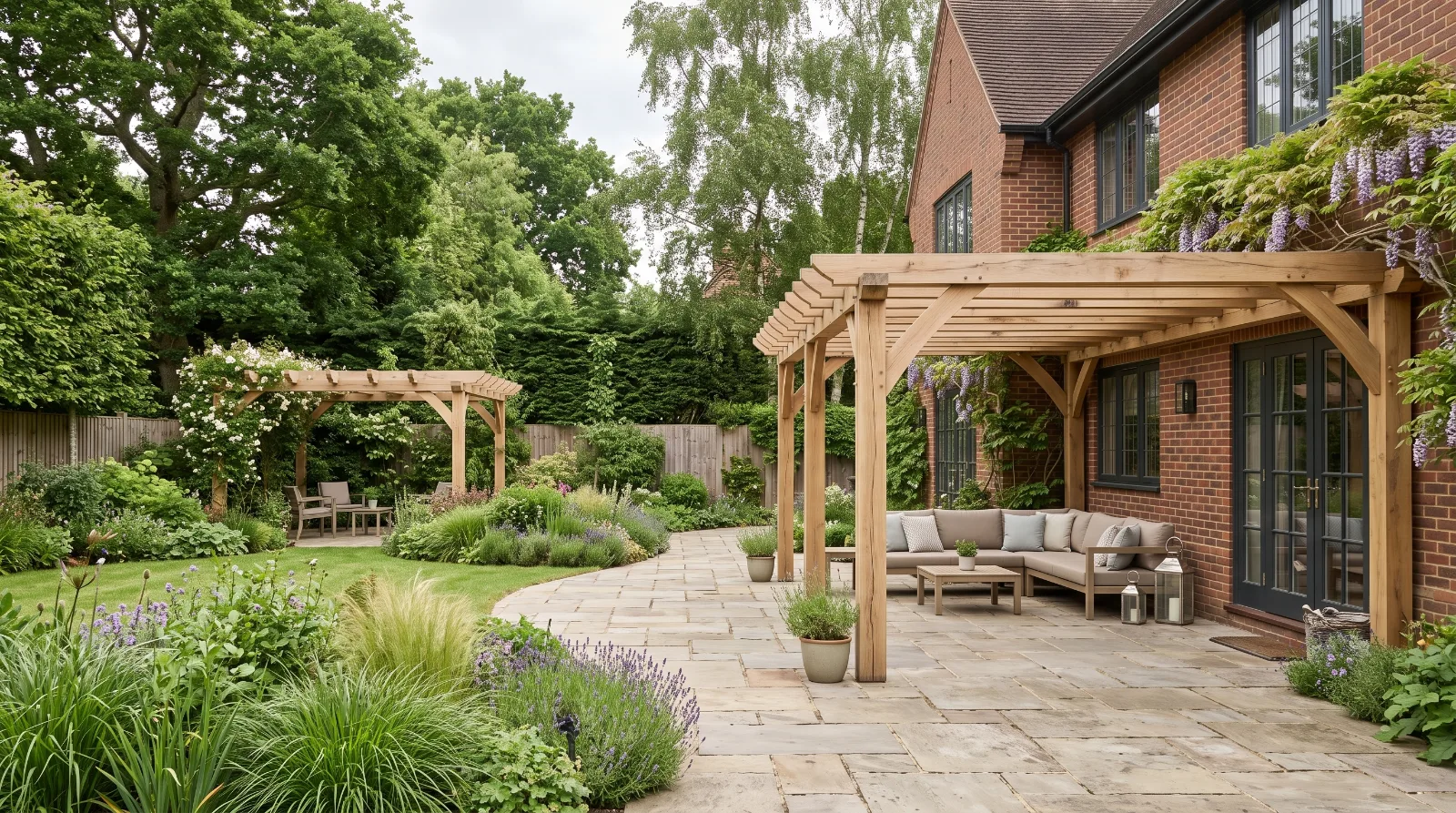
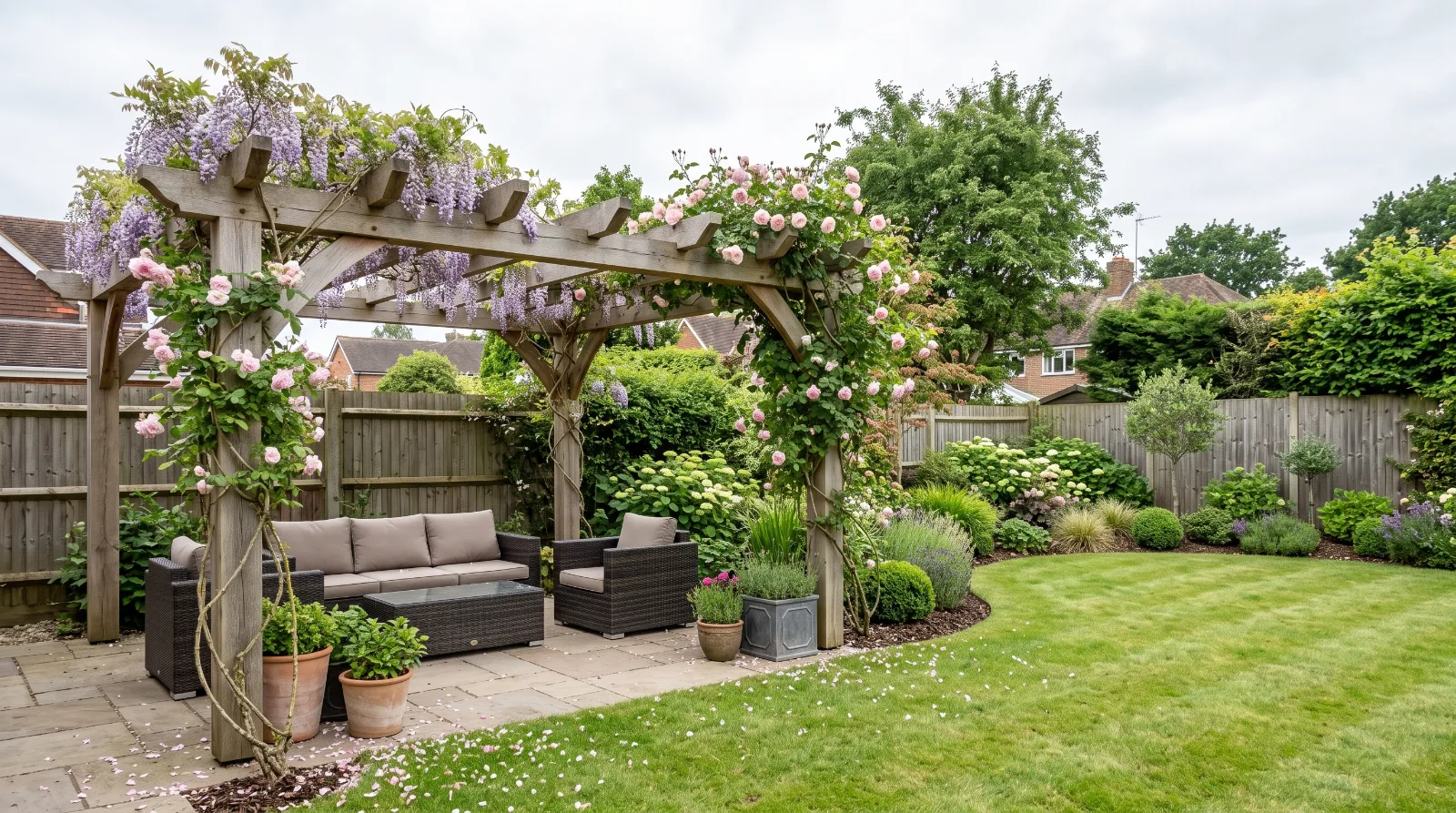
Pergolas
A pergola can create a shaded seating or entertaining area close to the pool.
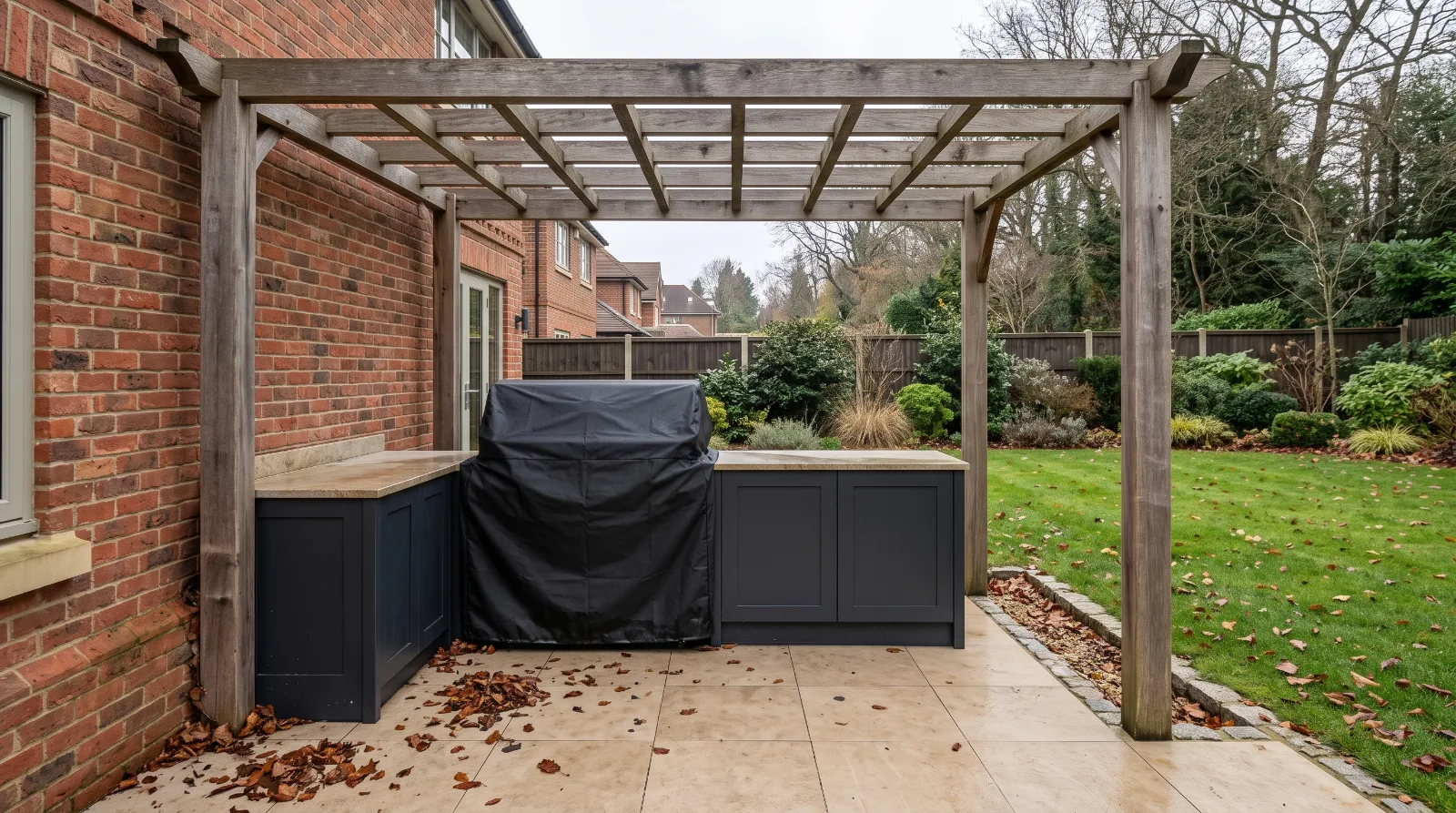
Outdoor Kitchens
For homeowners who regularly entertain, a nearby outdoor kitchen can make the pool area much more functional.
The key is to choose materials and features that work together rather than designing the pool separately from the rest of the garden.
How Can You Add Privacy Around a Pool?
Privacy is particularly important in overlooked gardens.
There are several ways to create it without making the pool area feel boxed in.
Fencing
Fencing provides immediate screening and creates a defined boundary.
Trees and shrubs
Planting creates a softer visual barrier and can be used at different heights.
Layered planting
Combining trees, shrubs and lower planting can produce a more natural screen than a single row of identical plants.
Structures
Pergolas and screening panels can provide targeted privacy around seating areas.
The right approach depends on the direction of overlooking and the proportions of the garden.
What About Pool Lighting?
Pool lighting can make the garden much more enjoyable in the evening.
Lighting can be used for both atmosphere and practical visibility.
Think about:
Pool illumination
Path lighting
Step lighting
Patio lighting
Planting highlights
Feature lighting
Lighting around the house
The aim is not necessarily to make the whole garden extremely bright.
A layered lighting scheme can create a more comfortable atmosphere by highlighting certain features while leaving other areas darker.
Electrical installations around swimming pools also require specialist consideration, so pool lighting should be planned and installed appropriately for the environment.
How Much Does a Swimming Pool Cost in the UK?
Swimming pool costs vary significantly.
Current UK cost guides put professionally installed pools into a very wide range depending on size, construction method, location, access and specification. One 2026 UK cost guide gives typical figures from around £60,000 to £150,000 for a standard outdoor pool, with more bespoke installations costing considerably more.
Those figures are only broad benchmarks.
A realistic project budget can also be affected by:
Excavation
Spoil removal
Drainage
Pool construction
Heating
Filtration
Covers
Plant rooms
Electrical work
Paving
Planting
Fencing
Lighting
Landscaping
Difficult site access
A pool that appears reasonably priced at the start can become a much larger project once all the surrounding work is included.
What Are the Ongoing Costs of Owning a Pool?
Installation is only the beginning.
Ongoing costs can include:
Cost | What affects it |
|---|---|
Heating | Pool size, temperature and usage |
Electricity | Pumps, filtration, lighting and controls |
Chemicals | Water volume and usage |
Cleaning | Pool size and maintenance approach |
Repairs | Age and condition of equipment |
Water | Top-ups, evaporation and cleaning |
Cover | Replacement and maintenance |
Heating is often one of the most significant ongoing expenses for an outdoor pool, which is why insulation, efficient equipment and a good cover are worth considering from the start.
How Long Does a Swimming Pool Installation Take?
There is no fixed installation period for every pool.
A straightforward garden with good access and uncomplicated ground conditions will generally be easier to work on than a restricted or heavily sloping site.
The construction programme can be affected by:
Pool size
Construction method
Ground conditions
Access
Excavation
Drainage
Weather
Material availability
Landscaping requirements
The pool construction itself is only one part of the overall project if you are also installing paving, planting, lighting, fencing or outdoor living features.
Is an Indoor or Outdoor Pool Better?
This depends entirely on how you intend to use it.
Outdoor pool
Advantages:
More natural connection with the garden
Usually simpler than constructing a dedicated pool building
Excellent for summer entertaining
Can become a major landscaping feature
Considerations:
Seasonal weather
Greater exposure to wind and rain
More dependence on heating and covers
Indoor pool
Advantages:
Can be used throughout the year
Greater protection from weather
More controlled swimming environment
Considerations:
Higher construction costs
Heating the pool room
Humidity and condensation control
Additional ventilation and climate-control requirements
Indoor pools require careful control of air temperature and humidity to protect both comfort and the building fabric.
For most residential gardens, the choice between indoor and outdoor will come down to budget, available space and how frequently the pool is expected to be used.
How Does a Pool Fit Into a Full Garden Design?
A pool should ideally be considered as part of the garden rather than as a standalone object.
The surrounding design might include:
Pool → Patio → Seating → Planting → Lawn → Outdoor Kitchen → Lighting
This gives the garden a natural flow and creates different ways to use the space.
For example, the pool can become the centrepiece, while a nearby patio provides space for dining. Planting softens the edges, a pergola creates shade and lighting makes the garden usable in the evening.
The pool should also work with the architecture of the house.
A contemporary property might suit clean paving lines and structured planting, while a traditional home may work better with natural stone, softer planting and more informal landscaping.
What Should You Think About Before Starting?
Before committing to a swimming pool, work through the practical questions as well as the design.
Space
Is the garden large enough for the pool and the surrounding areas you want?
Access
Can machinery, materials and excavated soil move in and out efficiently?
Ground conditions
Will the site require additional preparation, drainage or retaining structures?
Budget
Have you included the pool, heating, filtration, landscaping and other supporting work?
Heating
How much of the year do you realistically want to use the pool?
Maintenance
Are you prepared for the ongoing cleaning, water treatment and equipment maintenance?
Privacy
Will the pool area be overlooked by neighbouring properties?
Safety
How will access to the pool be controlled?
Landscaping
How will paving, planting, lighting and seating work around the pool?
Planning
Have you checked whether any planning restrictions or other requirements apply to the property?
Is a Swimming Pool Worth It?
A swimming pool is a major investment, and it will not automatically suit every property or homeowner.
For someone who enjoys swimming, entertaining outdoors and making full use of a large garden, it can become a hugely valuable part of the home.
The most successful projects tend to treat the pool as one part of a much bigger design.
The quality of the surrounding landscaping, the practicality of access, the efficiency of the heating and filtration systems, and the way the pool connects with the house can all be just as important as the pool itself.
Rather than choosing the largest pool or the most expensive specification, start with how you want the space to work.
Plan the Pool and Garden Together
A swimming pool can transform a garden, but the finished result depends on much more than the pool structure.
From excavation and drainage to heating, filtration, safety and ongoing maintenance, there are a lot of decisions to make before construction begins.
When the pool is planned alongside the wider garden, it becomes easier to create a cohesive outdoor space with the right balance of water, paving, planting, seating and outdoor living areas.
For Surrey homeowners, this integrated approach can be especially useful where gardens have slopes, mature planting, restricted access or other site-specific challenges.
Need Help With Swimming Pool Landscaping in Surrey?
Surrey Oak Landscapes can help bring the surrounding garden together with hard landscaping, planting, lighting, garden design and outdoor living features designed around your swimming pool.
Planning a swimming pool project in Surrey? Get in touch with Surrey Oak Landscapes for a free, no-obligation quote.
About the author