Can You Extend an Existing Patio?
Want more patio space? Learn how to extend an existing patio, from matching paving and levels to ground preparation, drainage and finishing.
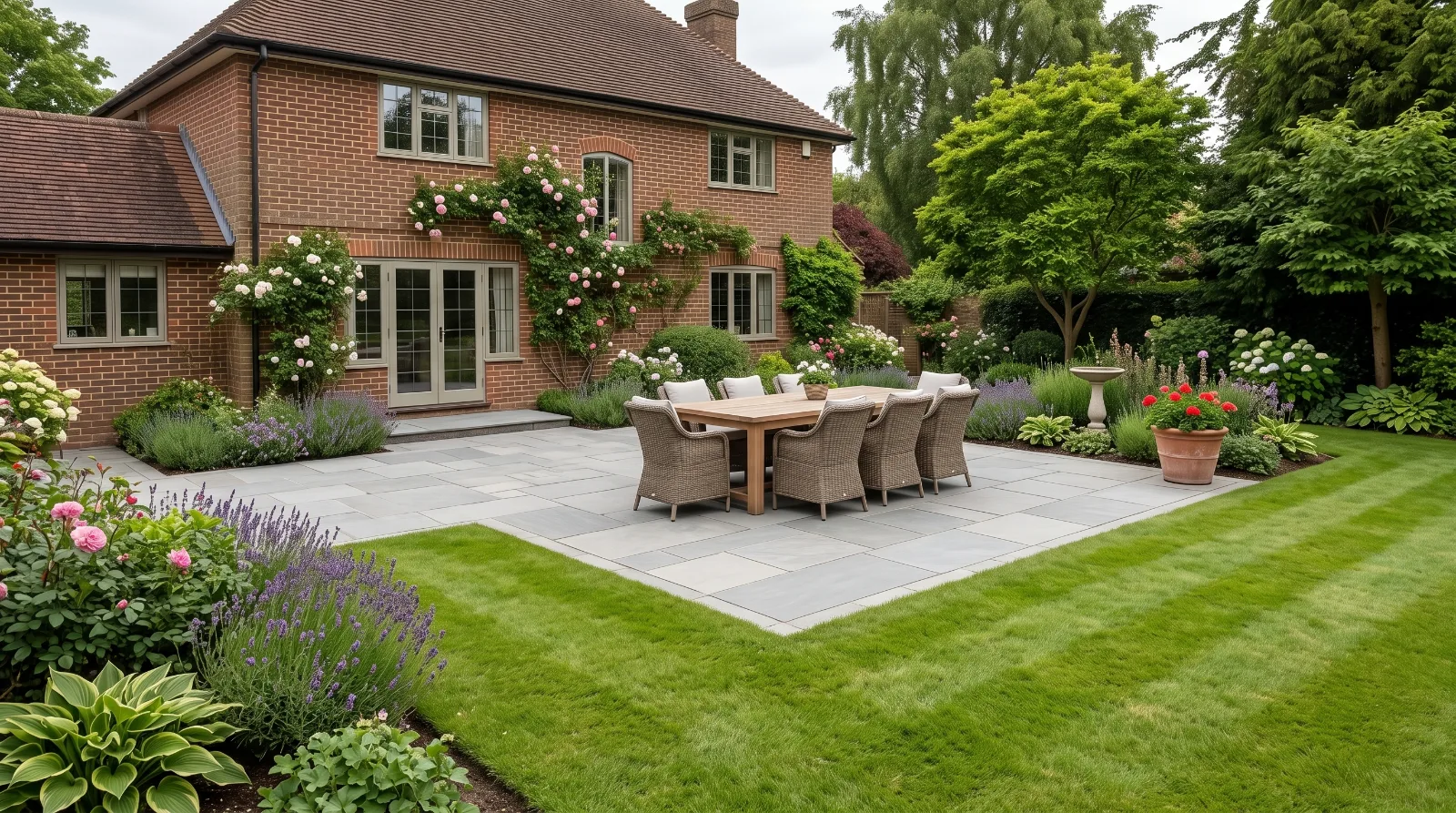
If your current patio has started to feel too small, extending it can be a practical way to create more usable outdoor space without replacing the entire garden.
You might want room for a larger dining table, more seating, a barbecue area or simply a better connection between the house and the rest of the garden.
In many cases, an existing patio can be extended successfully. However, the new section needs to be designed and constructed carefully so that it works with the original patio rather than looking like an obvious addition.
The biggest considerations are the condition of the existing patio, matching levels and materials, preparing the new ground properly and making sure water drains correctly.
Can Any Patio Be Extended?
Most patios can potentially be extended, but the condition of the existing installation matters.
A patio that is stable, level and properly constructed provides a much better starting point than one that is already suffering from movement or settlement.
Before extending it, check for:
Sunken slabs
Rocking or loose paving
Cracked joints
Uneven areas
Poor drainage
Damaged paving
Signs of movement
If the existing patio is already moving, extending it without addressing those problems can simply create a larger area with the same underlying issue.
In some cases, replacing or rebuilding the existing patio at the same time may make more sense than trying to join a new section onto a failing surface.
What Does Extending a Patio Involve?
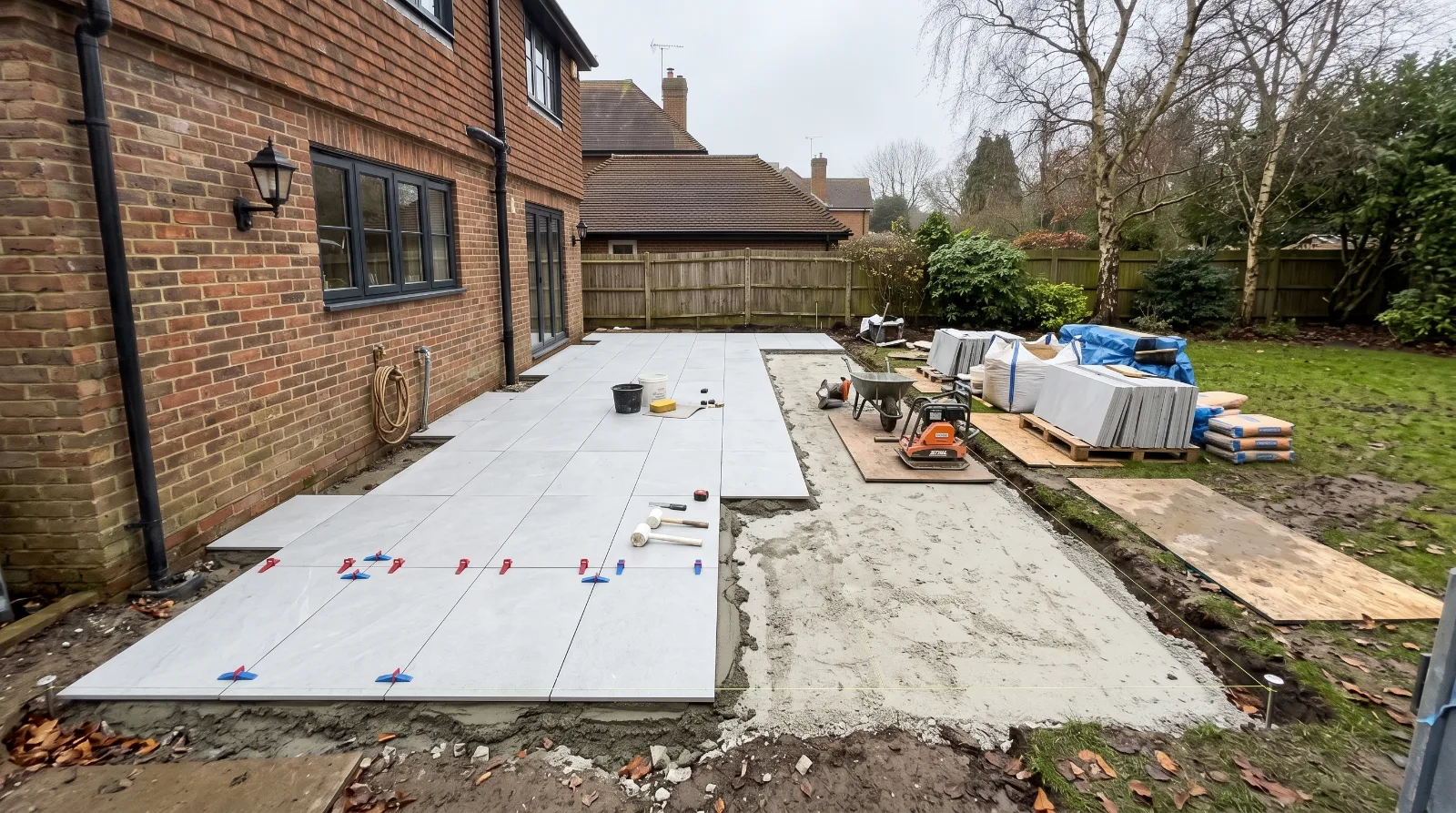
The exact process depends on the existing patio and the proposed extension, but it will generally involve preparing the new area and connecting it carefully to the original paving.
A typical project may include:
Setting out the new patio area
Removing lawn, soil or existing surfaces
Excavating to the required depth
Preparing and compacting the ground
Installing the appropriate sub-base
Creating the required levels and drainage falls
Laying the new paving
Connecting the new section to the existing patio
Completing the joints and finishing details
The new section should be treated as a proper piece of paving construction rather than simply filling the extra area with slabs.
Can You Just Lay New Slabs Next to the Existing Patio?
You can physically place paving next to an existing patio, but that does not mean the extension will remain stable.
The new section needs suitable support underneath it.
If the existing patio was built several years ago, its construction may also have settled differently from the newly prepared ground.
This makes the transition between old and new one of the most important parts of the project.
The new area needs to be constructed so that its finished level, support and drainage work with the existing patio.
What If the Existing Patio Has a Good Sub-Base?
A common question is whether the existing foundation can simply be continued into the new area.
The answer depends on how the original patio was constructed and what condition it is in.
The new section still needs its own properly prepared supporting layers. It should not be assumed that because the old patio has remained intact, the ground immediately beside it can be treated in exactly the same way without preparation.
The quality and depth of the existing construction may also be unknown.
For a straightforward extension, the safest approach is to assess the existing patio and construct the new section to a suitable specification rather than relying on what may be underneath the old paving.
How Do You Match the New Paving to the Existing Patio?
Matching the paving is often harder than homeowners expect.
Even when you identify the original manufacturer and product, a genuinely identical match may be difficult if the existing patio is more than a few years old.
Older paving can change colour and appearance through weathering, staining, fading and general wear, while manufacturers can also change products and production batches.
This means new slabs can sometimes look noticeably different even when they are supposed to be the same product.
What if the exact paving is no longer available?
There are several ways to approach the problem.
Use a close match:
Choose a new paving that is similar in colour, size and texture.
Replace a larger area:
Instead of extending with visibly different slabs, you may decide to replace a larger section so the new and old paving are less obviously separated.
Create a deliberate transition:
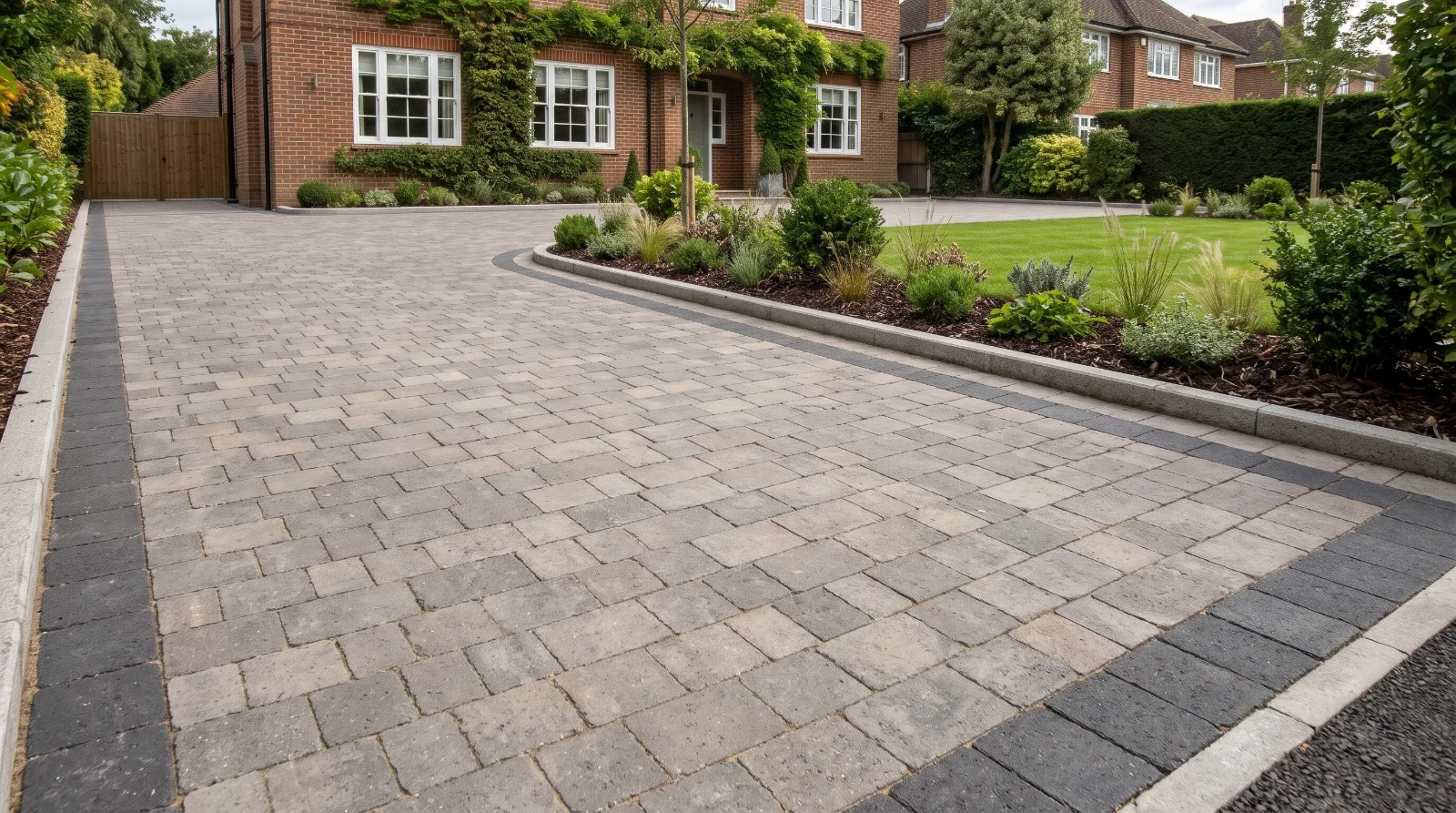
A contrasting border or feature band can make the change look intentional rather than like an unsuccessful attempt at matching.
This can sometimes produce a better-looking result than trying to hide an obvious difference.
Can You Extend a Patio With Different Paving?
Yes, and it can actually be a good design choice.
Using a complementary paving material can create a defined transition between the original patio and the new section.
For example, you might use the existing paving for the main terrace and introduce a contrasting border around the extension.
Alternatively, a different material could be used to create a separate outdoor zone for dining, seating or a barbecue.
The key is to make the difference look deliberate.
What About Matching the Existing Level?
The new patio should meet the existing patio at a sensible finished level.
This sounds straightforward, but existing gardens are rarely perfectly uniform.
The original patio may have settled slightly, the surrounding ground may have changed and the garden may have gradients that were not obvious when the first patio was installed.
The new section therefore needs to be set out carefully so that you do not end up with:
An unwanted step
A lip between surfaces
A low spot
Water collecting along the join
A patio that slopes in the wrong direction
Getting the levels right is one of the most important parts of making an extension look like it was designed as one complete patio.
Should an Extended Patio Have the Same Fall?
The new area needs appropriate drainage falls so rainwater can move away rather than sitting on the surface.
Where possible, the extension should work with the drainage direction of the existing patio.
However, the existing fall should not simply be copied if it creates a drainage problem.
The new area may need to be designed slightly differently depending on the position of the house, garden levels, boundaries and available drainage routes. Proper falls should be established through the supporting construction rather than trying to create them only with the final paving layer.
What If the Patio Extension Runs Along the House?
Extra care is needed where the extension approaches the property.
The finished patio level needs to remain appropriately below relevant damp-proof and building levels, while drainage should prevent water from being directed towards the house.
This is one of the reasons simply adding another layer of paving on top of an existing surface is often problematic. Raising the finished level can reduce the separation between paving and the building and create drainage or moisture issues.
Can You Extend a Porcelain Patio?
Yes.
Porcelain patios can be extended, but matching the original paving and installation system becomes particularly important.
Porcelain is manufactured in batches and even the same product can be difficult to match perfectly once the original paving has weathered.
The new section also needs to be installed using a suitable method for porcelain rather than treating it exactly like traditional concrete paving.
If the original patio is several years old, it may be worth considering whether a contrasting area would look better than trying to create an almost-but-not-quite identical match.
Can You Extend a Natural Stone Patio?
Yes, and natural stone can sometimes make the transition less obvious because each slab naturally varies in colour and texture.
However, older natural stone can still weather considerably.
A new batch may have a different tone from the existing patio, particularly if the original stone has changed colour over time.
A deliberate border or change in paving layout can help make the extension look integrated.
What If the Existing Patio Is Sinking?
This is where extending the patio becomes more complicated.
If the original paving is sinking because of movement or inadequate support, the problem should be investigated before the extension is installed.
Simply joining new paving to a section that continues to move can lead to cracked joints, uneven levels and a visible step developing over time.
Re-jointing alone also does not solve movement beneath paving. Where slabs are loose or moving, the underlying support needs attention first.
Can You Extend a Patio on a Sloping Garden?
Yes, but the design needs to account for the change in level.
Depending on the slope, the extension may involve:
A stepped layout
Retaining structures
Different terrace levels
Steps
Additional drainage
Changes in planting and access
Trying to keep everything at one level can sometimes require unnecessary excavation.
Instead, the slope can be incorporated into the garden design so the patio extension feels intentional.
Can You Make an Existing Patio Larger Without Changing the Whole Garden?
Absolutely.
An extension can be a relatively focused project if the existing layout already works.
For example, you could extend the patio:
Further into the lawn
Along one side of the garden
Around an existing seating area
Towards a pergola
To create space for an outdoor kitchen
To provide a larger dining area
The key is to consider how the new area will connect with the rest of the garden.
Extending a patio by a few square metres can have a surprisingly large effect on how the garden is used.
How Much Space Should You Add?
That depends on what you want the extension to achieve.
If the current patio is only slightly too small, a modest extension may be all you need.
If you want a dining table, outdoor sofa and barbecue, you will need more usable space around the furniture than the footprint of the furniture itself.
Think about how people will move through the space.
A patio may technically be large enough for a table and chairs but still feel cramped if there is no room to walk around them comfortably.
Should You Extend Into the Lawn?
This is one of the most common patio extensions.
The lawn is excavated and the new patio is built into the area.
This can work particularly well when the existing patio is already correctly positioned next to the house.
However, consider what you are losing.
A larger patio gives you more hardstanding but reduces the amount of lawn available for children, pets, planting or general garden use.
The best extension is not necessarily the largest one.
It should create the extra space you actually need without making the garden feel dominated by paving.
Can Patio Extensions Be Used to Create Outdoor Rooms?
Yes.
Instead of simply making the existing patio bigger, the extension can have a specific purpose.
For example:
Dining area: Larger paved space with room for a table and chairs.
Lounge area: Additional space for outdoor sofas and occasional seating.
Outdoor kitchen: A dedicated paved area around cooking equipment.
Fire pit area: A separate seating zone further into the garden.
Pergola area: A defined space underneath a garden structure.
This can make the extension feel like part of a wider garden design rather than an afterthought.
What About Edging?
The edge of the extension needs to be properly supported and visually finished.
An exposed paving edge can look incomplete and may be more vulnerable to movement.
Edging can be created using paving, kerbs, brickwork or other suitable materials depending on the design.
It can also become a useful visual detail.
A contrasting border around the extension can make the new section look deliberately designed while providing a clear transition between paving and lawn or planting.
Should You Replace the Whole Patio Instead?
Sometimes that is the better option.
If the existing patio is:
Heavily cracked
Uneven
Sinking
Poorly drained
Very difficult to match
Built on an inadequate foundation
then extending only one section may leave you with two different levels of quality.
Replacing the whole patio may provide a more consistent finish and allow the layout, materials, drainage and construction to be designed together.
It can cost more initially, but it may make sense when the existing patio is already nearing the end of its useful life.
How Much Does It Cost to Extend a Patio?
There is no standard price because a patio extension can involve very different amounts of work.
Current UK patio cost guides show how widely pricing can vary depending on the paving material, ground preparation, access and additional work such as drainage.
The main factors include:
Cost factor | Why it matters |
|---|---|
Extension size | More paving and preparation |
Paving material | Premium materials cost more |
Ground conditions | Difficult ground can require additional preparation |
Existing patio | Repairs may be needed before extending |
Drainage | Additional drainage may be required |
Access | Restricted access can increase labour |
Waste removal | Excavated soil and old materials may need disposal |
Steps or retaining walls | Changes in level add construction work |
Edging | Additional finishing materials and labour |
A small extension onto a sound, easily accessible patio can be relatively straightforward, while an extension involving poor ground conditions, difficult access or substantial level changes can become a much larger project.
What Should You Ask Before Extending Your Patio?
Before agreeing to the work, ask:
Is the existing patio structurally sound?
Will the new paving match, or would a deliberate contrast look better?
Will the new and existing areas finish at the same level?
Where will rainwater drain?
What preparation is needed underneath the extension?
Will the existing patio need to be lifted or repaired?
Is edging included?
Is waste removal included?
Will the new area affect the lawn or planting?
These questions help make sure the extension is designed around the whole garden rather than just the extra square metres of paving.
How to Make a Patio Extension Look Like It Was Always There
A successful extension should feel like part of the original garden.
There are several ways to achieve this.
Match the existing materials
Where a close match is genuinely possible, using the same paving can produce the most seamless result.
Repeat existing details
Use the same edging, joint colour, paving orientation or border style.
Create a deliberate contrast
If the old paving cannot be matched, introduce a new material or feature band intentionally rather than pretending the two areas are identical.
Connect it to the rest of the garden
Repeat planting, colours and materials elsewhere so the extension feels integrated.
The goal is not necessarily to make the extension invisible.
It is to make it look intentional.
Can a Patio Extension Improve the Garden?
A well-designed extension can make a garden considerably more practical.
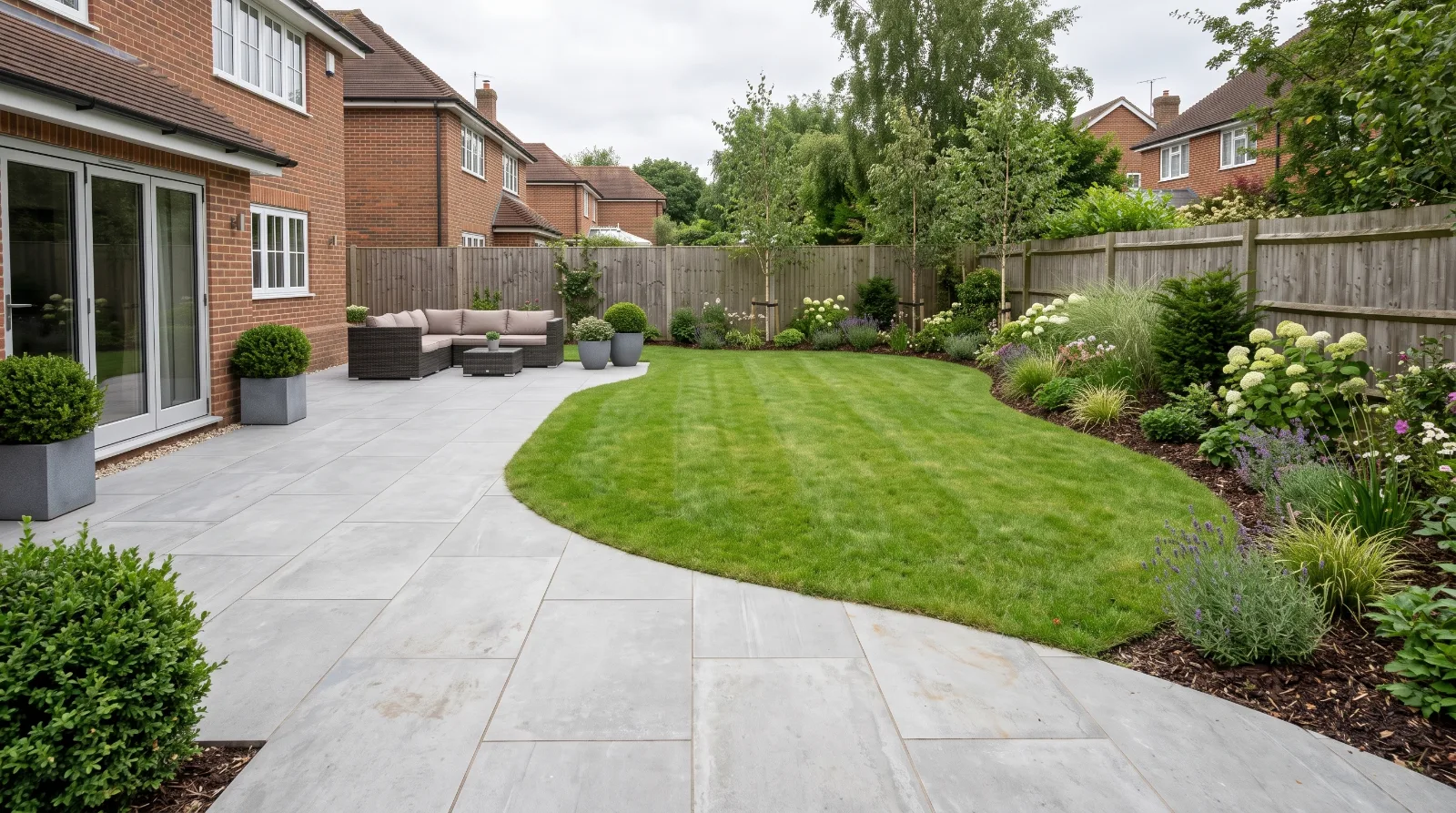
It can provide enough room for outdoor dining, create a dedicated entertaining area or simply give you more usable space immediately outside the house.
But size alone does not determine whether an extension is successful.
The best patio extensions improve the relationship between the house, patio, lawn, planting and other garden features.
That means considering the whole layout rather than simply continuing the existing paving as far as possible.
Can You Extend an Existing Patio?
Yes, in many cases.
The important part is understanding the condition of the existing patio and constructing the new section properly.
A successful extension needs:
Stable existing paving + properly prepared new ground + compatible levels + suitable drainage + a well-considered transition
If the old patio is already failing, extending it may not be the best solution. Likewise, if the original paving is no longer available, a contrasting design may be better than trying to force an imperfect match.
The extension should ultimately feel like a natural part of the garden rather than an extra patch of paving added later.
Need a Patio Extension in Surrey?
Whether you want more room for outdoor dining, entertaining or simply a more practical garden, extending an existing patio can be a great way to improve the space without redesigning everything.
Surrey Oak Landscapes can help with patio extensions, paving, ground preparation, drainage and wider garden landscaping, creating a finished layout that works with the existing garden.
Thinking about extending your patio in Surrey? Get in touch with Surrey Oak Landscapes for a free, no-obligation quote.
About the author