Smart Irrigation Systems: Are They Worth It for UK Gardens?
Smart irrigation systems take garden watering beyond a simple timer. Discover how sensors, weather data and zoned irrigation can help Surrey homeowners maintain healthier gardens while managing water use.
British weather can make keeping a garden properly watered a challenge. Long dry spells can leave lawns, borders and new planting struggling, while watering by hand quickly becomes time-consuming.
That is where smart irrigation systems come in. Using automated watering, sensors and weather-based controls, they can deliver water when and where the garden needs it, without relying on a fixed watering routine.
But are they actually worth the investment for UK gardens?
For Surrey homeowners with larger gardens, extensive planting or a newly landscaped outdoor space, smart irrigation can offer a convenient way to maintain healthy planting while using water more efficiently.
What Is a Smart Irrigation System?
A smart irrigation system is an automated watering system designed to deliver water to different parts of a garden according to their requirements.
A typical system can include:
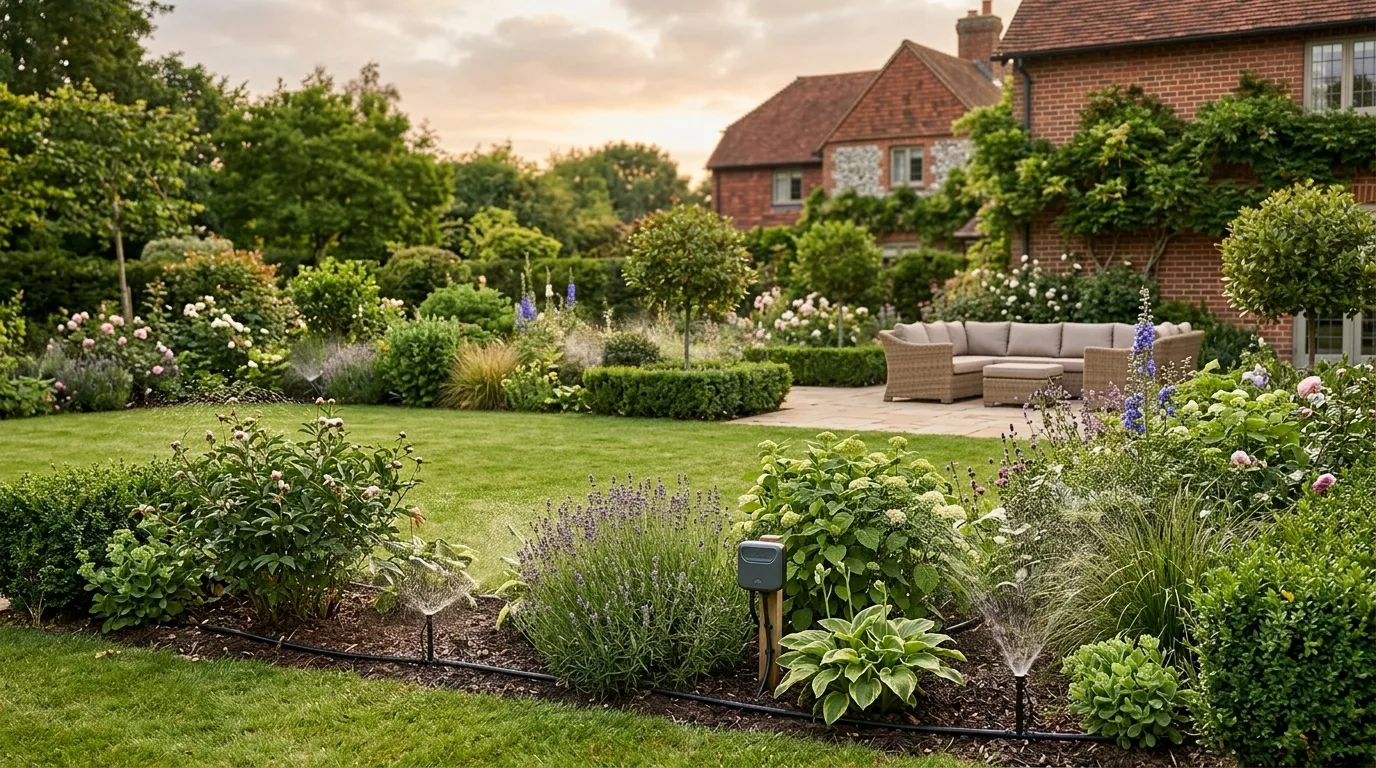
An irrigation controller
Drip lines or micro-irrigation
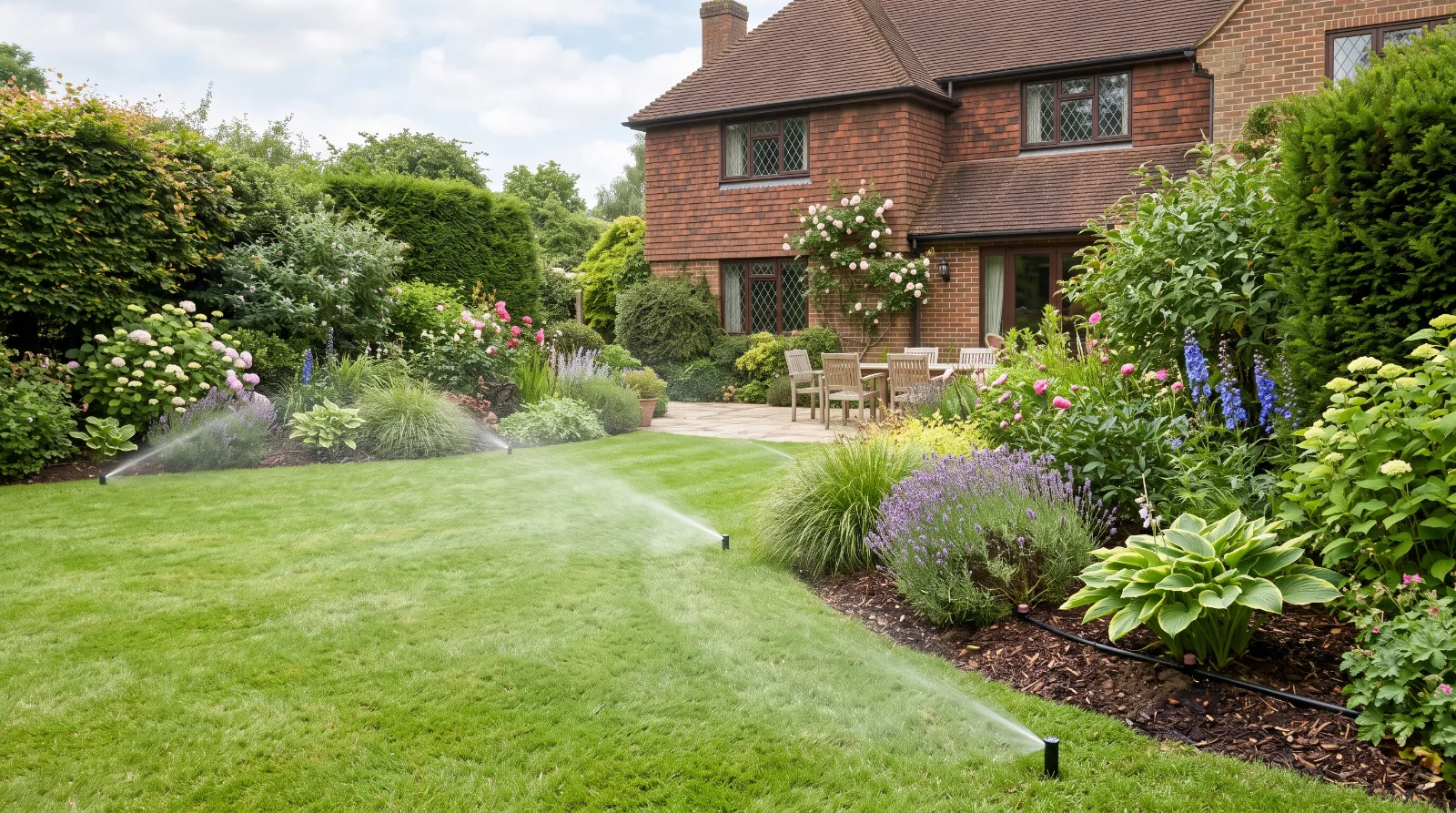
Sprinklers for suitable lawn areas
Soil moisture sensors
Rain sensors
Weather-based programming
Valves controlling different irrigation zones
Smartphone or app-based controls
The key difference between a standard automatic irrigation system and a smart system is the amount of information used to decide when and how much to water.
A simple timer might be programmed to run for 20 minutes every morning.
A smart controller can be set up to respond to changing conditions, helping reduce unnecessary watering when the garden has already received rainfall or when less water is required.
However, technology does not remove the need for good irrigation design. Sensors still need to be positioned correctly, irrigation zones need to be planned around plant requirements, and the system needs occasional checking and adjustment.
How Does Smart Irrigation Work?
The exact technology varies between systems, but the basic principle is straightforward.
1. The garden is divided into watering zones
Different areas of a garden can have very different watering requirements.
For example:
A lawn may require broader, more even coverage.
A planted border may benefit from slow drip irrigation.
Newly planted trees may require deeper watering around the root zone.
Containers and raised beds can dry out more quickly.
Shaded areas may require less water than exposed borders.
Dividing the garden into separate irrigation zones allows each area to be managed more appropriately rather than watering the entire garden in the same way.
2. Water is delivered where it is needed
Drip irrigation and other targeted methods can apply water close to the plant's root zone rather than spraying large amounts over surrounding paving, paths and other surfaces.
This can be particularly useful for planting beds and ornamental borders.
Waterwise recommends watering the root zone rather than areas where plants cannot use the water, and advises checking the weather before watering.
3. Sensors and weather information help adjust watering
Rain sensors can stop an irrigation cycle after rainfall, while soil moisture sensors can provide information about how much moisture is already present.
Some smart systems can also use weather information to modify irrigation schedules.
That means the system does not necessarily need to follow the same watering routine throughout the entire summer.
4. The system can be monitored remotely
Many modern controllers can be operated through a smartphone.
This can be useful for homeowners who travel regularly or simply want to check their garden's watering schedule without manually operating an outdoor tap or controller.
What Are the Main Benefits of Smart Irrigation?
The biggest advantage is not simply that the garden waters itself. The real benefit is having a system designed to deliver water more consistently and according to the needs of different areas.
More consistent watering
Hand watering depends on having the time and remembering to do it.
A professionally designed irrigation system can maintain a regular schedule, which is particularly helpful during periods of dry weather.
This can be valuable after a landscaping project when newly planted borders, trees and turf need reliable establishment.
Less time spent watering
Large gardens can take a considerable amount of time to water manually.
Automating the process means homeowners are not required to spend evenings moving hoses and sprinklers around the garden.
RHS guidance notes that automated irrigation can save time and labour, particularly across larger or more water-demanding areas.
Better control over different planting areas
Not every plant has the same water requirement.
A well-designed irrigation system can separate planting areas into zones, allowing watering schedules to reflect differences in exposure, soil and planting type.
This is particularly useful in landscaped Surrey gardens combining lawns, hedging, specimen trees, perennial borders and ornamental planting.
Reduced unnecessary watering
One of the biggest problems with manual watering is inconsistency.
It is easy to water when the soil is already wet or to continue a sprinkler cycle after rainfall.
Smart controls, rain sensors and soil moisture monitoring can help reduce this problem.
Waterwise also recommends using weather conditions to determine whether watering is actually needed.
Useful when you're away from home
Going on holiday during a dry period can create a dilemma.
A neighbour may be asked to water the garden, but that can mean inconsistent coverage or missed watering altogether.
An automated system can continue following its programmed schedule, while remote controls may allow homeowners to make adjustments while away.
Can Smart Irrigation Save Water?
Potentially, yes — but the system itself is only part of the equation.
The biggest water-saving gains come from good system design and appropriate programming.
Drip irrigation, for example, can deliver water slowly around the root zone instead of distributing water through the air.
This can reduce losses caused by evaporation and runoff compared with less targeted watering methods. RHS guidance notes that sprinklers can have significant water losses through evaporation and runoff, while automated drip and soaker systems can be adjusted to the requirements of the area being watered.
However, a smart irrigation system does not automatically guarantee lower water use.
A poorly designed system can still overwater a garden.
Sensors may also require checking and calibration. Research and guidance highlighted by the RHS notes that soil moisture sensors can improve irrigation decisions, but they still need to be checked to make sure their readings represent what plants actually need.
The goal should therefore be precision, not simply automation.
Are Smart Irrigation Systems Particularly Useful in Surrey?
Surrey's gardens can benefit from irrigation systems for several reasons.
Large suburban gardens, established planting schemes and newly landscaped outdoor spaces can contain a significant amount of vegetation that needs watering during prolonged dry spells.
The issue became especially visible in 2026. The Met Office reported that Wisley in Surrey experienced a 62-day run without measurable rainfall during the summer.
At the same time, water resources came under considerable pressure across England, with temporary use bans remaining in place across parts of Surrey during the summer.
That does not mean every Surrey garden needs a smart irrigation system. A small, established garden with drought-tolerant planting may require very little supplementary watering.
But larger gardens with extensive planting, lawns, hedging, trees and newly installed landscapes can benefit from having a properly planned watering system ready for extended dry periods.
Smart Irrigation During a Hosepipe Ban
This is an important point that homeowners should understand.
A smart irrigation system does not automatically mean you are exempt from water restrictions.
Temporary Use Bans are set by individual water companies and the exact rules and exemptions can vary.
For example, Thames Water's current legal notice states that an approved drip or trickle irrigation system fitted with a pressure-reducing valve and timer can fall within an exemption, provided it delivers water directly to the soil without spraying or misting into the air.
Affinity Water's published drought-planning documentation similarly identifies approved drip or trickle irrigation systems with a pressure-reducing valve and timer among its potential exemptions.
Homeowners should always check the current rules with their own water company before operating irrigation equipment during a Temporary Use Ban.
What Type of Garden Is Suitable for Smart Irrigation?
Smart irrigation can be worthwhile for many types of gardens, but some are particularly well suited to it.
Newly landscaped gardens
New planting needs careful watering while roots establish.
A properly planned irrigation system can provide consistent moisture without relying on manual watering.
Large lawns
Large areas of lawn can take a significant amount of time to water manually.
Where sprinkler irrigation is appropriate, automated control can make watering considerably easier.
Extensive planting borders
Large ornamental borders can benefit from zoned drip or micro-irrigation, especially where plants have different watering requirements.
Gardens with specimen trees and hedging
Established trees usually manage independently once properly rooted, but recently planted trees and hedging may require supplementary watering during dry conditions.
Holiday homes or frequently unattended gardens
Automation becomes particularly valuable where homeowners are regularly away from the property.
High-value planting schemes
For homeowners who have invested heavily in mature planting, specimen trees and carefully designed borders, irrigation can help protect the investment during periods of prolonged dryness.
When Might Smart Irrigation Not Be Worth It?
Not every garden needs a sophisticated system.
For a small garden with a few established borders and relatively low watering requirements, the cost and installation work may not justify a complex setup.
In these situations, simpler approaches such as watering cans, a basic irrigation timer, mulching and selecting plants suited to drier conditions may be sufficient.
Waterwise recommends measures such as mulching, grouping plants with similar watering requirements and watering only the root zone to reduce unnecessary water use.
The right solution depends on the garden rather than simply choosing the most advanced equipment available.
How Much Does Smart Irrigation Cost?
There is no single price for a smart irrigation system because the installation can vary substantially from one garden to another.
The overall cost can depend on:
Garden size
Number of irrigation zones
Lawn area
Number of planted borders
Number of trees and hedges
Type of irrigation used
Number of sensors
Controller specification
Water pressure and supply
Access for installation
Existing landscaping
Whether the system is being installed during a new garden project
A small retrofit installation can be relatively straightforward, while a large landscaped garden may require a much more extensive network of pipework, valves and irrigation zones.
For this reason, a site assessment is normally more useful than relying on a generic online price.
Smart Irrigation vs Traditional Watering
Method | Convenience | Water Control | Best Suited To |
|---|---|---|---|
Watering can | Low | High if used carefully | Small gardens and containers |
Garden hose | Medium | Moderate | Small to medium gardens |
Basic timer | High | Moderate | Simple automated watering |
Automatic irrigation | Very high | High | Larger lawns and planting areas |
Smart irrigation | Very high | Very high | Larger, established or extensively landscaped gardens |
The important distinction is that smart irrigation adds decision-making to automation.
A timer follows the schedule you give it.
A smart system can incorporate additional information to help decide whether watering is necessary.
How to Make a Smart Irrigation System More Efficient
Installing an advanced controller is only one part of creating an efficient irrigation system.
Water at the root zone
Targeting the root area helps avoid wasting water on paths, paving and other areas where it provides no benefit.
Use separate irrigation zones
Group plants according to their watering requirements rather than treating the whole garden as one area.
Add mulch to planting beds
Mulching can help reduce moisture loss from soil and reduce the frequency of watering required.
Review the system throughout the year
Plants and weather conditions change.
A watering schedule that is suitable during a hot summer may be excessive during cooler or wetter periods.
Combine irrigation with sensible planting
Plant choice still matters.
Plants with similar water requirements should be grouped together where possible, making irrigation easier to manage efficiently.
What About Rainwater Harvesting?
Smart irrigation does not have to rely entirely on mains water.
A water butt can provide stored rainwater for garden use, and Waterwise recommends rainwater collection as one way of reducing reliance on mains water for watering gardens.
For larger landscaping projects, the water source and irrigation system can be considered together during the design stage.
The practical options will depend on the size of the garden, available water storage, irrigation requirements and the property's existing plumbing.
Are Smart Irrigation Systems Worth It?
For the right garden, yes.
The strongest case is usually not simply the convenience of pressing a button on your phone.
A well-designed smart irrigation system can provide:
More consistent watering
Less manual maintenance
Better control of different planting zones
More responsive watering during changing weather
Potentially more efficient use of water
Greater peace of mind when you're away
For a small garden with limited planting, a simpler irrigation setup may be perfectly adequate.
For a larger Surrey garden with extensive planting, lawns, hedging, specimen trees or a newly completed landscaping project, smart irrigation can become a valuable part of the overall garden design rather than an optional gadget.
Designing Irrigation Into a Surrey Garden
Irrigation works particularly well when it is considered at the same time as the rest of the landscape design.
At Surrey Oak Landscapes, irrigation can be planned alongside planting, lawns, patios and garden lighting so that pipework and irrigation points are positioned discreetly and efficiently.
Rather than adding a system after the garden is complete, planning irrigation during the landscaping process can help reduce disruption and ensure the watering system is matched to the planting scheme from the outset.
Planning Irrigation for Your Surrey Garden
Smart irrigation is not about watering more. It is about watering more intelligently.
For Surrey homeowners investing in new planting, lawns and landscaped outdoor spaces, a properly planned irrigation system can make garden maintenance easier while helping manage water use during increasingly challenging dry periods.
Whether you are creating a new garden or upgrading an established landscape, irrigation can be designed around the specific needs of your planting rather than treated as an afterthought.
Surrey Oak Landscapes provides professional garden landscaping and irrigation solutions across Surrey, with systems designed to work discreetly alongside planting, lawns and the wider garden layout.
Frequently asked questions
- Are smart irrigation systems suitable for UK weather?
- Yes. UK weather can change considerably throughout the year, which is one of the reasons smart controls can be useful. Instead of relying on one fixed watering schedule, systems can be adjusted around changing rainfall and moisture conditions.
- Do smart irrigation systems work with sprinklers?
- They can, but the type of irrigation should match the area being watered. Sprinklers can be appropriate for some lawns, while drip or micro-irrigation is often better suited to planted borders and individual plants.
- Can smart irrigation prevent overwatering?
- It can help reduce overwatering by using tools such as rain sensors, moisture sensors and weather-based controls, but the system still needs to be properly designed and monitored.
- Is smart irrigation suitable for a newly landscaped garden?
- Yes. Newly planted trees, shrubs, hedging, borders and turf can benefit from consistent watering while they establish. Irrigation is particularly useful when incorporated into the garden during the landscaping process.
- Can smart irrigation be installed in an existing garden?
- Yes. Systems can be retrofitted into existing gardens, although installation complexity will depend on the layout, existing paving and planting, access and the required irrigation zones.
About the author