How to Choose an Irrigation System for Your Garden
Not sure which irrigation system your garden needs? Learn how to choose between drip lines, sprinklers, automation and different watering zones.
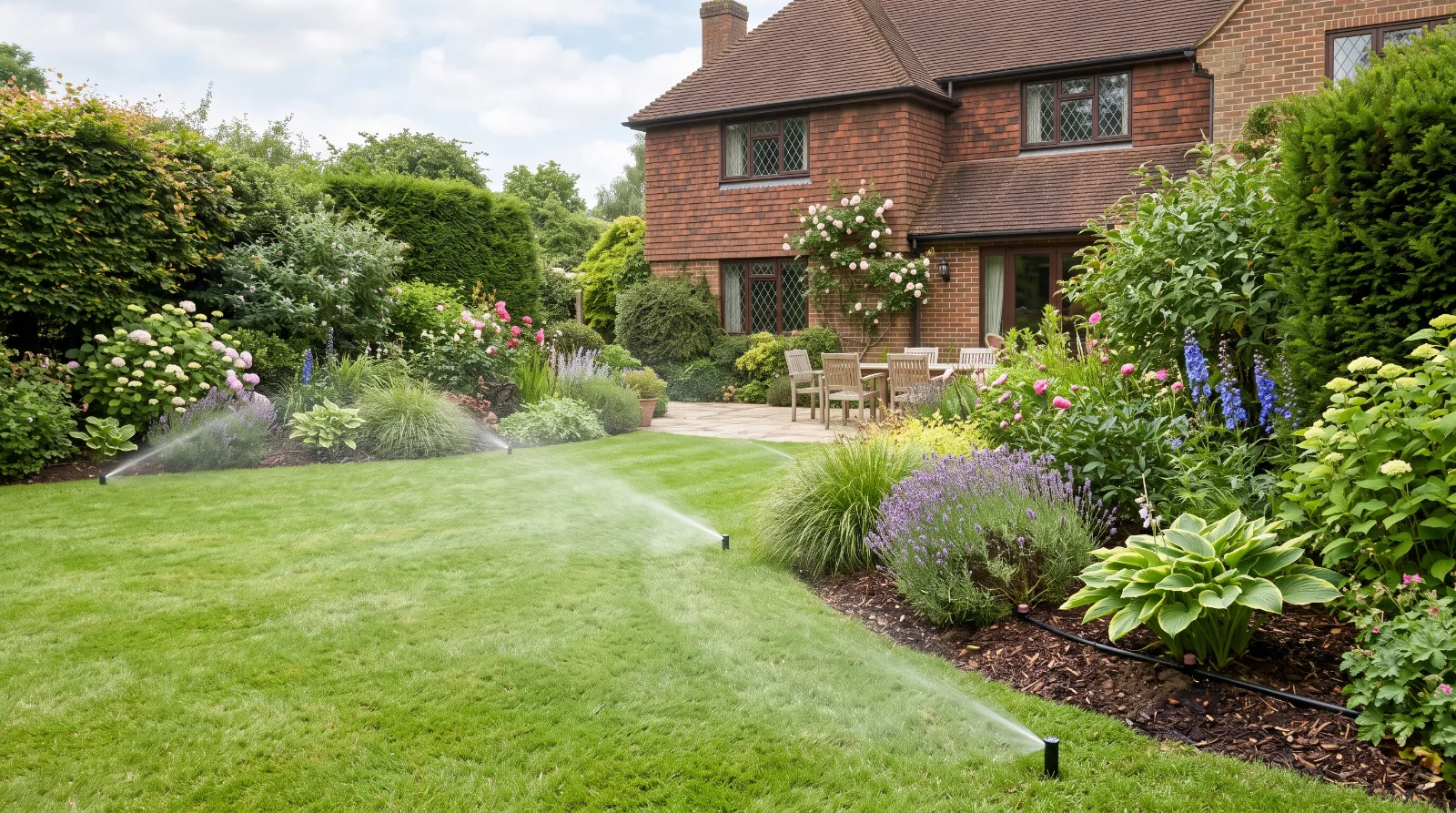
A good irrigation system can make watering a garden far easier, particularly when you have large planting borders, a new lawn, established hedges or areas that are difficult to reach with a hose.
However, choosing an irrigation system is not simply a case of picking sprinklers or drip irrigation.
The right system depends on what needs watering, the size and layout of the garden, the available water supply, soil conditions and how much automation you want.
A small garden with a few borders may need a relatively simple system, while a larger landscaped garden could benefit from several irrigation zones using different types of equipment.
So, how do you choose the right irrigation system?
Start With What Needs Watering
The first step is to look at the garden as a collection of different areas rather than assuming everything needs the same amount of water.
A typical garden might contain:
Lawn
Planting borders
Hedges
Trees
Raised beds
Containers
Vegetable beds
Hanging baskets
Newly planted areas
Each of these can have different watering requirements.
For example, a lawn may need broad coverage, while a hedge may benefit from targeted watering along its root zone.
This is why a well-designed irrigation system normally divides the garden into separate watering zones.
What Are Irrigation Zones?
An irrigation zone is an area of the garden that is watered separately from another area.
The purpose is to make it possible to control how much water different parts of the garden receive.
For example, you might have:
Zone | Example irrigation |
|---|---|
Lawn | Pop-up sprinklers |
Planting border | Drip line |
Hedge | Targeted drip irrigation |
Raised beds | Drippers |
Containers | Micro-irrigation |
Newly planted trees | Individual emitters |
This approach is particularly useful when plants with different requirements are growing close together.
It also helps when parts of the garden receive different amounts of sunlight or have different soil conditions.
Drip Irrigation or Sprinklers?
This is one of the first decisions most homeowners consider.
Drip irrigation
Drip systems deliver water slowly and directly around the root zones of plants.
They are particularly useful for:
Borders
Hedges
Trees
Shrubs
Raised beds
Vegetable gardens
Containers
Because the water is delivered close to the plants, there is less need to wet large areas of surrounding soil.
Sprinklers
Sprinklers distribute water over a wider area and are particularly useful for lawns and other open spaces.
Pop-up sprinklers can sit below the surface when not operating, then rise when the system runs.
They can provide consistent coverage across a lawn when correctly positioned.
The choice is therefore often not drip or sprinklers.
A well-designed garden can use both.
How Large Is Your Garden?
Garden size has a major effect on the type of irrigation system you need.
A small garden may only require a simple micro-irrigation system supplying a few borders.
A larger garden may need:
Multiple zones
Longer pipe runs
More valves
Several sprinkler heads
Different irrigation methods
Automated controls
Additional water storage or pumping equipment
The bigger the system becomes, the more important its design becomes.
Trying to run an entire large garden from one irrigation zone can produce uneven coverage if the available water pressure and flow are insufficient.
Check Your Water Supply Before Choosing the System
This is one of the most important parts of irrigation planning.
Before selecting equipment, you need to understand how much water the garden can actually receive.
Two measurements are particularly important:
Pressure: How strongly water is delivered through the supply.
Flow: How much water is available over a given period.
A system may look suitable on paper but perform poorly if too many sprinklers or emitters are expected to operate simultaneously.
This is why larger systems are often divided into separate zones.
Only certain areas run at one time, allowing the available supply to work effectively.
What If Your Water Pressure Is Low?
Low pressure does not necessarily mean irrigation is impossible.
It may simply affect the design.
Possible solutions can include:
Using smaller zones
Choosing irrigation equipment suited to the available pressure
Using lower-flow emitters
Adding a suitable pump
Incorporating water storage
The correct solution depends on the existing supply and the size of the garden.
It is better to design the system around the available water than to install equipment that requires more pressure than the property can provide.
What Type of Soil Do You Have?
Soil affects how quickly water spreads and how long it remains available to plants.
Clay soil
Heavy clay can hold water well but may drain slowly. Applying water too quickly can lead to runoff or surface pooling.
Slower, targeted irrigation can therefore be useful.
Sandy soil
Sandy soil tends to drain more quickly, meaning water may need to be applied carefully and potentially more regularly.
Loamy soil
Loam generally provides a useful balance between drainage and moisture retention, although the exact conditions still depend on the garden.
The irrigation system should therefore work with the soil rather than assuming every area of the garden behaves in exactly the same way.
Consider Your Planting
The plants themselves are another major factor.
A newly planted border may need more regular watering while plants establish, whereas established shrubs and trees may need considerably less once their root systems are developed.
Grouping plants with reasonably similar watering requirements can make irrigation more efficient.
For example, moisture-loving plants should not automatically share a zone with drought-tolerant plants simply because they occupy the same border.
Good planting design and irrigation design should work together.
What About Trees?
Trees need particular consideration.
A mature tree and a newly planted tree have very different root systems and watering needs.
A new tree may benefit from targeted watering around the root zone while it establishes.
A mature tree may have a much wider root system and may not require routine irrigation under normal conditions.
This is why an irrigation system should be designed around the garden's actual planting rather than simply installing the same emitter beside every plant.
What About New Planting?
If you have recently landscaped your garden, irrigation can be particularly useful during the establishment period.
New plants have not yet developed the extensive root systems of established specimens, so watering can be more important during dry periods.
An irrigation system can provide consistent watering while reducing the need to manually move hoses around the garden.
As plants mature, the irrigation schedule may need to be adjusted.
The system should therefore be capable of being changed as the garden develops rather than being treated as a fixed watering programme.
Do You Need Automated Irrigation?
Not every garden needs a fully automated system.
Automation becomes more attractive when:
The garden is large
There are many planting areas
You are regularly away from home
Watering takes significant time
New planting needs reliable aftercare
The garden has several irrigation zones
A timer or controller can operate different areas according to a programmed schedule.
More advanced systems can also incorporate rain sensors or other controls to reduce unnecessary watering.
Automation should make watering more appropriate, not simply make the system run more frequently.
Should You Choose a Smart Irrigation System?
Smart irrigation can be useful where you want greater control.
Depending on the system, you may be able to manage schedules remotely, create different watering programmes and integrate sensors.
This can be particularly useful for larger or more complex gardens.
However, smart features do not automatically make a system better.
A basic irrigation system that is correctly designed can outperform a sophisticated controller attached to poorly positioned sprinklers.
Start with the irrigation design itself, then decide how much control and automation you actually need.
Do You Need Drip Lines for Planting Borders?
Drip irrigation can be particularly effective in planted borders because water is delivered close to plant roots rather than sprayed across the entire area.
The lines can often be hidden beneath mulch or positioned discreetly among planting.
This can help keep the system visually unobtrusive.
It also allows long borders to be watered without installing large sprinkler heads throughout the planting.
The exact spacing and emitter arrangement should be chosen according to the planting density, soil and irrigation requirements.
When Are Sprinklers Better?
Sprinklers are particularly useful when you need to cover a broad open area.
They can be suitable for:
Lawns
Large grassed areas
Some groundcover planting
Open garden zones
The sprinkler layout needs to be planned so areas receive reasonably even coverage.
Simply placing one sprinkler in the middle of a lawn does not necessarily produce consistent watering.
Overlapping coverage is often used to reduce dry patches.
Can One System Use Different Irrigation Types?
Yes, and this can often be the best approach.
For example, a landscaped garden could use:
Pop-up sprinklers for the lawn
Drip irrigation for borders
Individual emitters for new trees
Micro-irrigation for containers
This allows each area to receive a more appropriate type of watering.
The different systems can operate through separate zones controlled by the same overall irrigation system.
What About Containers and Hanging Baskets?
Containers tend to dry out more quickly than plants growing in the ground because they have a limited volume of growing media.
If you have a large number of containers, manually watering them can become a daily task during warm weather.
Micro-irrigation can provide individual lines or emitters to containers, reducing the need to water each one separately.
Hanging baskets can also be incorporated into suitable irrigation systems.
The exact arrangement depends on the number and position of the containers.
Do You Need a Water Butt?
Not necessarily.
An irrigation system can potentially use mains water, stored rainwater or a combination depending on the design and available equipment.
Rainwater storage can be useful for reducing reliance on mains water, although a large garden irrigation system may require more storage and pressure than a standard domestic water butt can provide.
Where stored water is used, the system may require a suitable pump to achieve the pressure needed for the irrigation equipment.
The water source should therefore be considered at the design stage.
What If You Have a Large Garden?
Large gardens are usually better served by a properly zoned irrigation system rather than a single simple watering circuit.
You may have different areas with different:
Soil types
Sun exposure
Planting
Slopes
Water requirements
Irrigation methods
A large garden may therefore need several zones operating separately.
This also makes the system easier to adjust later as planting matures or the garden changes.
What About a Sloping Garden?
Slopes can affect irrigation because water naturally moves downhill.
This can result in uneven watering if the system is not designed appropriately.
Drip irrigation can be useful on planting areas because it delivers water gradually and close to the root zone.
Sprinkler systems on slopes need careful planning so water does not run off before it has had time to soak into the soil.
The direction and gradient of the slope should therefore be considered when laying out irrigation zones.
Where Should Irrigation Components Be Positioned?
A good irrigation system should be effective without becoming a visual feature of the garden.
Controllers should normally be positioned somewhere accessible and protected.
Valves can be housed discreetly, while pipework can be buried or concealed where appropriate.
Drip lines can often be hidden beneath mulch or within planting.
Pop-up sprinklers should sit flush with the lawn when not operating.
The aim is to create a system that is there when you need it but barely noticeable when you don't.
How Much Maintenance Does Irrigation Need?
An irrigation system still needs occasional attention.
You should periodically check:
Sprinkler heads
Drippers
Filters
Valves
Pipework
Connections
Controller settings
Coverage
Plants and landscaping also change.
A shrub may grow over a sprinkler head, a border may become denser or a lawn layout may change.
The irrigation system should therefore be checked as the garden develops.
How Much Does a Garden Irrigation System Cost?
There is no standard price because irrigation systems range from relatively simple installations to complex automated systems covering large gardens.
Cost can be affected by:
Garden size
Number of zones
Type of irrigation
Water supply
Pipework length
Number of sprinkler heads
Number of emitters
Controller
Sensors
Pump
Water storage
Existing landscaping
Access and installation complexity
A system designed for a few borders will obviously require much less equipment than a fully automated system covering a large lawn, mature borders, trees and containers.
This is why an irrigation system should be quoted around the actual garden rather than based solely on a price per square metre.
Should You Install Irrigation During Landscaping?
If you are planning a new garden, installing irrigation at the same time as the landscaping can be particularly efficient.
Pipework can be installed before patios, lawns and planting are finished, reducing the amount of disruption.
However, irrigation can also be retrofitted into an established garden.
Your existing garden does not need to be redesigned simply to accommodate an irrigation system.
How Do You Choose the Right Irrigation System?
Start with five questions:
1. What needs watering?
Lawn, borders, hedges, trees, containers or a combination?
2. How large is the garden?
The size affects pipework, zones and equipment.
3. What is the soil like?
Clay, sand and loam behave differently.
4. What water supply is available?
Pressure and flow need to support the proposed system.
5. How much control do you want?
A simple timer may be enough, or you may benefit from a fully automated smart controller.
Once these questions are answered, the appropriate irrigation equipment becomes much easier to choose.
A Simple Irrigation Decision Guide
Garden requirement | System to consider |
|---|---|
Small planting border | Drip or micro-irrigation |
Long hedge | Drip line |
Large lawn | Pop-up sprinklers |
New trees | Targeted emitters |
Raised beds | Drip irrigation |
Containers | Micro-irrigation |
Large mixed garden | Multiple zones using different systems |
Garden frequently left unattended | Automated controller |
Sloping planting area | Targeted, low-flow irrigation |
This is only a starting point. The actual system should be designed around the garden rather than selected solely from the table.
Common Mistakes When Choosing Irrigation
Using one system for everything
Lawns and planting borders rarely need exactly the same approach.
Ignoring water pressure
A system can fail to provide adequate coverage if too much equipment is operated at once.
Installing before understanding the planting
Plants have different water requirements.
Overwatering
More water does not automatically mean healthier plants.
Forgetting future growth
New planting will become larger and can eventually cover irrigation components.
Choosing technology before designing the system
A smart controller cannot compensate for poor irrigation layout.
Ignoring maintenance
Even automated systems need occasional inspection and adjustment.
Is Professional Irrigation Design Worth It?
For a small garden with a few containers, a simple irrigation kit may be enough.
For larger or more complex gardens, professional design can be worthwhile because the system can be planned around:
Water pressure and flow
Planting requirements
Garden zones
Coverage
Drainage
Existing landscaping
Future plant growth
Automation requirements
The aim is not to install the most complicated system possible.
It is to install the simplest system that can reliably do what your garden needs.
How to Choose an Irrigation System for Your Garden
The right irrigation system starts with the garden rather than the equipment.
A lawn may benefit from sprinklers, while borders and hedges may be better suited to drip irrigation. Trees may need targeted watering, while containers can benefit from individual emitters.
From there, consider the available water supply, garden size, soil, planting, slope and how much automation you actually need.
A good system should provide the right amount of water to the right areas without becoming an unnecessary source of complexity.
Make Irrigation Part of the Garden Design
Irrigation works best when it is considered alongside the rest of the garden.
When installed during landscaping, pipework can be planned around patios, planting, lawns and garden structures from the start. In an established garden, the system can instead be designed around the features that are already there.
Either way, the goal is the same: reliable watering that works quietly in the background.
Need Garden Irrigation in Surrey?
Surrey Oak Landscapes can design and install irrigation systems around lawns, planting borders, hedges, trees and wider landscaped gardens.
Whether you are planning a new garden or looking to make an established garden easier to maintain, the irrigation system can be designed around your space and its watering requirements.
Planning garden irrigation in Surrey? Get in touch with Surrey Oak Landscapes for a free, no-obligation quote.
About the author