Why Is Drainage Important Behind a Retaining Wall?
Discover why drainage behind a retaining wall is essential, how drainage pipes and aggregate help manage water pressure, and which warning signs Surrey homeowners should look out for.
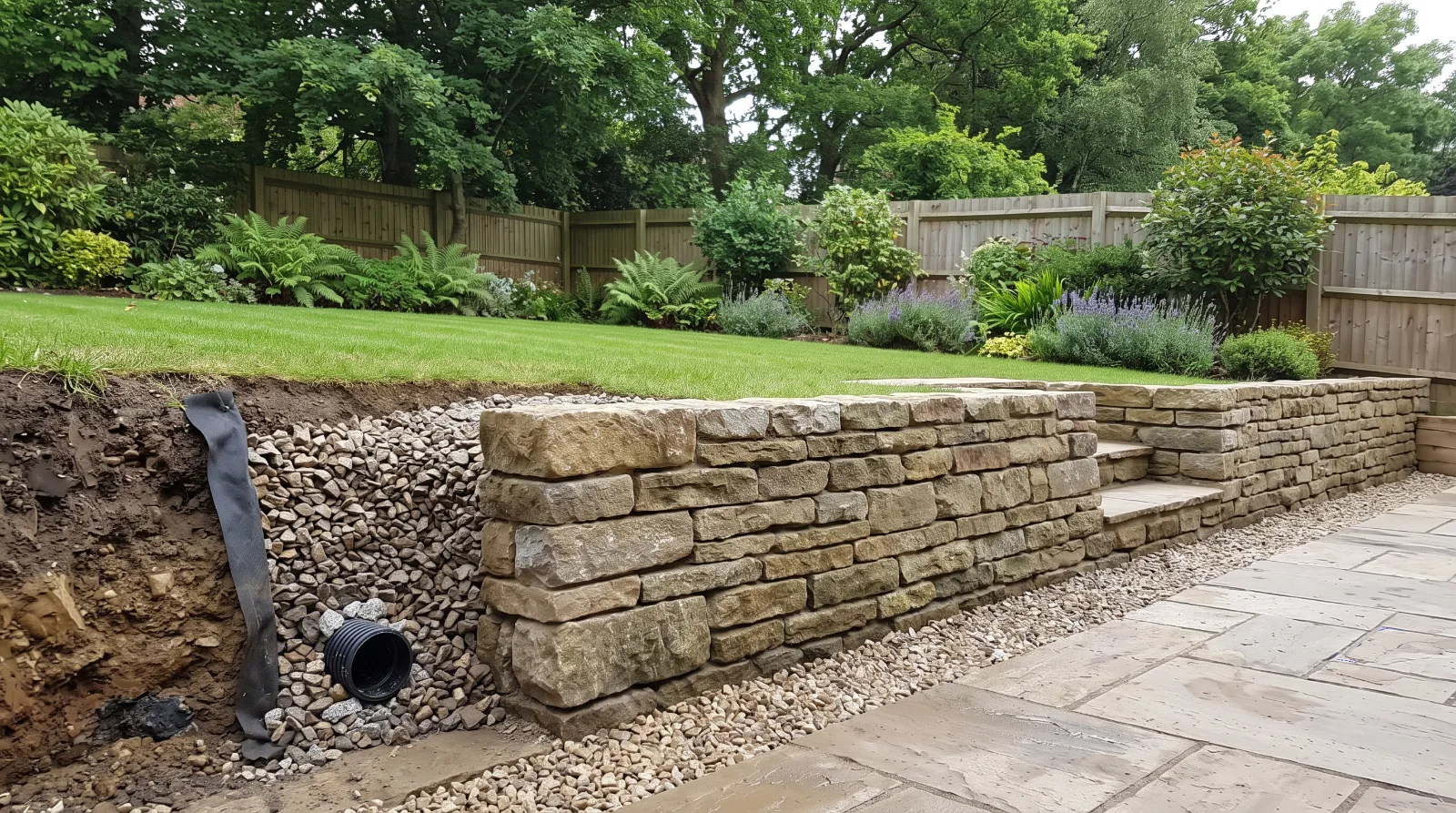
Retaining walls play an important role in landscaping, helping to hold back soil, create level areas and make sloping gardens more usable. However, a retaining wall needs more than a strong visible structure to perform properly. What happens behind the wall is just as important.
Without suitable drainage, water can build up in the soil behind the wall, increasing pressure on the structure and raising the risk of cracking, movement or failure. This is particularly important in gardens where heavy rainfall, clay soil or changes in ground level affect how water moves through the site.
For homeowners planning landscaping work in Surrey, understanding retaining wall drainage can help prevent avoidable problems and protect the long-term stability of the garden.
How Does Water Build Up Behind a Retaining Wall?
Rainwater naturally moves through the ground, but its movement depends on the soil type, ground levels and the drainage conditions around the wall.
When water enters the soil behind a retaining wall, it needs a suitable route to drain away. If the ground holds water or the drainage arrangement is inadequate, moisture can accumulate behind the structure.
This creates additional pressure against the wall. Unlike dry soil, water adds hydrostatic pressure, which increases with depth. If the wall and its drainage system have not been designed to manage these forces, the extra load can contribute to movement or structural damage.
Clay-heavy soils can be particularly challenging because they tend to drain more slowly than many sandy or gravelly soils. However, water can accumulate behind retaining walls in a range of ground conditions if drainage is poorly planned.
1. Reducing Pressure on the Wall
One of the main purposes of retaining wall drainage is to help prevent excessive water pressure from building up behind the structure.
A retaining wall must resist the sideways force exerted by the soil it retains. When water becomes trapped within that soil, the pressure can increase significantly, placing additional stress on the wall and its foundations.
Over time, this may contribute to:
Leaning or bulging: Sections of the wall may begin to move outwards under pressure.
Cracking: Masonry joints or blocks may develop cracks as the structure experiences additional loads or movement.
Displaced materials: Individual blocks, bricks or other components may shift out of position.
Structural failure: In severe cases, the wall may become unstable and require substantial repairs or reconstruction.
Proper drainage helps manage water behind the wall, reducing one important source of pressure. However, drainage alone cannot compensate for inadequate foundations, poor structural design or unsuitable construction.
2. Preventing Waterlogging and Soil Problems
Poor drainage can affect the garden as well as the retaining wall itself.
When water remains trapped behind a wall, the surrounding soil may become saturated. This can make planting areas difficult to manage and may contribute to erosion or localised waterlogging, depending on the site conditions.
Excess moisture can also wash fine soil particles towards drainage outlets if the system is not designed with suitable filtration. Over time, this can contribute to blockages and reduce drainage performance.
A well-planned drainage arrangement should therefore consider the type of soil, the volume of water likely to reach the wall and where that water can safely discharge.
This is especially important where a retaining wall supports a lawn, patio, driveway or planted area. Water movement should be considered across the whole landscape rather than treating the wall as an isolated feature.
3. How Does Retaining Wall Drainage Work?
The drainage system behind a retaining wall will depend on its height, construction, ground conditions and the amount of water it needs to manage. Several components may work together to move water away from the structure.
Free-draining backfill
A layer of suitable free-draining aggregate is commonly placed behind the wall. Compared with many natural soils, this material allows water to move more readily towards the drainage system.
The drainage layer needs to be appropriate for the wall design and installed with care. Suitable separation or filter materials may be needed to prevent surrounding soil from migrating into the aggregate.
Perforated drainage pipe
A perforated pipe may be installed near the base of the drainage layer to collect water and carry it towards a suitable outlet.
The pipe needs appropriate positioning, a suitable fall where required and a discharge point that will not create further drainage problems elsewhere in the garden. Simply installing a pipe is not enough if the water has nowhere safe to go.
Drainage outlets or weep holes
Some retaining wall designs incorporate weep holes or other outlets to allow collected water to escape. Their suitability and arrangement depend on the wall construction and the drainage design.
These openings need to remain clear and function as intended. They should not be treated as a substitute for a properly designed drainage system where one is required.
The following table summarises the role of common drainage components.
Component | Main purpose |
|---|---|
Free-draining aggregate | Helps water move through the backfill |
Perforated drainage pipe | Collects and directs water towards an outlet |
Filter or separation material | Helps prevent fine soil particles entering and clogging the drainage layer |
Weep holes or drainage outlets | Allow water to escape where included in the design |
Surface drainage | Helps control rainwater entering the area behind the wall |
Not every retaining wall will use exactly the same arrangement. The correct solution depends on the structure, the site and the expected water flow.
4. Why Drainage Matters in Surrey Gardens
Gardens across Surrey can have very different ground conditions. Some properties have relatively free-draining soils, while others have clay-heavy ground that can hold moisture for longer periods. Sloping sites and gardens with patios, driveways or other hard surfaces may also direct additional runoff towards a retaining wall.
These factors make site assessment an important part of the planning process.
For example, a retaining wall at the bottom of a sloping lawn may receive water from a much larger area than the ground immediately behind it. A wall supporting a paved terrace may also need to account for how rainwater runs off the surrounding surface.
Drainage should therefore be considered alongside the wall's foundations, height, structural requirements and the layout of the garden. The aim is to manage water safely without directing it towards neighbouring properties, buildings or areas where it could cause further problems.
5. Signs of Poor Retaining Wall Drainage
Drainage problems are not always obvious at first, but certain changes may indicate that water is not being managed effectively.
Look out for the following warning signs:
Water collecting behind the wall after rainfall.
Persistent wet patches or unusually saturated soil near the structure.
New or widening cracks in masonry or concrete.
Sections of the wall beginning to lean, bulge or move.
Drainage outlets that appear blocked or no longer discharge as expected.
Soil erosion or repeated washout around the wall.
A single sign does not automatically mean that drainage is the cause. Cracks and movement can also result from foundation problems, soil movement or inadequate structural design.
If a retaining wall is visibly moving, bulging or showing significant cracking, arrange a professional assessment promptly. Avoid attempting repairs without understanding the cause, particularly where the wall supports a raised garden, driveway or other loaded area.
6. Can Poor Drainage Be Fixed After Construction?
In some cases, drainage problems can be improved after a retaining wall has been built. However, the right solution depends on the cause and severity of the problem.
Clearing an accessible blocked outlet may help where the issue is a simple obstruction. Other situations may require improvements to surface water management, the installation or repair of drainage components, or more extensive work behind the wall.
Where a wall is already leaning or structurally damaged, adding a drain alone may not restore its stability. The structure may need to be assessed before any remedial work begins.
This is why it is generally better to consider drainage during the initial design and construction stages. Installing suitable drainage at the outset is often more straightforward than trying to access the back of an existing wall later.
Plan Your Retaining Wall Properly
Retaining walls can transform sloping gardens, create useful level areas and provide structure to a landscape. Their long-term performance, however, depends on more than the visible materials and finish.
By accounting for water pressure, soil conditions, drainage materials and safe discharge from the beginning, you can reduce the risk of moisture-related problems and help protect the stability of the structure.
At Surrey Oak Landscapes, we consider retaining walls as part of the wider landscaping design, taking into account ground levels, surrounding surfaces and how water moves through the garden.
Planning a retaining wall or garden landscaping project in Surrey? Contact Surrey Oak Landscapes to discuss your requirements and request a free, no-obligation quote.
About the author